
Introduction
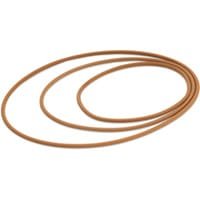
Fluorocarbon (FKM) O-Rings with a 0.139-inch cross section are precision sealing components engineered for applications requiring excellent chemical resistance, thermal stability, and low outgassing. This cross section is commonly specified for compact grooves and high-performance vacuum or fluid systems where reliable sealing must be maintained under elevated temperatures and aggressive media.
Detailed Description
Our FKM O-Rings (0.139 section) are molded from premium fluorocarbon elastomer compounds formulated to resist oils, fuels, solvents, and many corrosive chemicals. Compared with larger cross sections, the 0.139-inch profile allows for efficient sealing in space-constrained designs while still providing sufficient compression and recovery for dependable performance.
The material maintains elasticity over a wide operating temperature range and exhibits low compression set, ensuring long-term sealing integrity. Precision molding and controlled post-curing processes deliver consistent cross-sectional geometry, smooth surfaces, and dimensional accuracy—critical for vacuum service and repeatable installation. Multiple compound grades and hardness options are available to match specific pressure, temperature, and chemical exposure requirements.
Applications
Fluorocarbon (FKM) O-Rings with 0.139 section are widely used in:
Vacuum chambers and UHV/HV components
Semiconductor and thin film processing equipment
Chemical processing and fluid handling systems
Pumps, valves, and fittings with compact groove designs
Aerospace and automotive sealing applications
Laboratory and research instrumentation
Technical Parameters
| Parameter | Typical Value / Range | Importance |
|---|---|---|
| Material | Fluorocarbon (FKM) | Heat & chemical resistance |
| Cross Section | 0.139 inch | Fits compact sealing grooves |
| Hardness | 70 – 90 Shore A (custom) | Balances sealing force and wear |
| Operating Temperature | −20 °C to +200 °C (typical) | High-temperature capability |
| Chemical Resistance | Oils, fuels, acids, solvents | Long service life |
| Color | Brown / Black (typical) | Standard identification |
Comparison with Other Elastomer O-Rings
| Material | Key Advantage | Typical Application |
|---|---|---|
| FKM | Excellent heat & chemical resistance | Vacuum & chemical systems |
| NBR (Buna-N) | Economical | General oil sealing |
| EPDM | Steam & weather resistance | Water-based systems |
| Silicone | Very wide temperature range | Low-pressure static seals |
FAQ
| Question | Answer |
|---|---|
| Can inner diameters be customized? | Yes, a wide range of inner diameters is available on request. |
| Are these suitable for vacuum applications? | Yes, FKM is commonly used in vacuum and thin film systems due to low outgassing. |
| What hardness is recommended? | 75 Shore A is typical; higher hardness is available for higher pressure. |
| How are the O-rings packaged? | Cleaned, sealed in protective bags, and packed in export-grade cartons. |
Packaging
Our FKM O-Rings (0.139 Section) are carefully cleaned and sealed to prevent contamination or deformation. Clear labeling and protective packaging ensure traceability and safe transport for immediate installation upon delivery.
Conclusion
Fluorocarbon (FKM) O-Rings with a 0.139-inch cross section provide a compact, durable, and chemically resistant sealing solution for vacuum, semiconductor, and industrial systems. With consistent quality, dimensional accuracy, and customization options, they deliver reliable performance in demanding operating environments.
For detailed specifications and a quotation, please contact us at sales@thinfilmmaterials.com.

Reviews
There are no reviews yet.