
Introduction
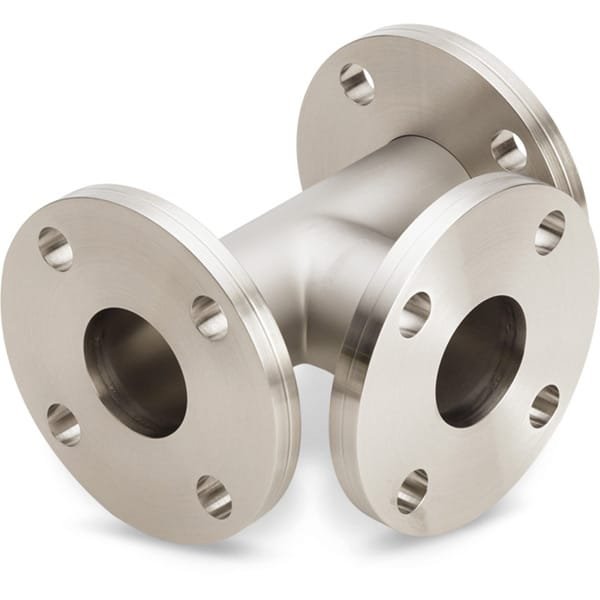
ASA HV Tees (Grooved & Flat Flanges) are high-vacuum pipeline components designed to provide reliable branching connections in medium and high vacuum systems. Available in both grooved flange (O-ring sealed) and flat flange configurations, these tees offer flexibility for different sealing methods and system requirements.
Widely applied in thin film deposition systems, vacuum furnaces, semiconductor processing lines, and research vacuum setups, ASA HV Tees combine structural integrity, vacuum tightness, and convenient assembly.
Detailed Description
ASA HV Tees are typically manufactured from high-quality 304L or 316L stainless steel. These materials provide excellent corrosion resistance, mechanical strength, and low outgassing performance, which are critical in high vacuum environments.
Two primary flange types are available:
Grooved Flange Type
Designed for elastomer O-ring sealing
Quick clamp-based assembly
Suitable for high vacuum applications requiring frequent maintenance
Cost-effective and easy to install
Flat Flange Type
Flat sealing surface for gasket-based sealing
Compatible with specific bolt-through flange systems
Provides stable mechanical alignment
Suitable for semi-permanent installations
All tees are precision-machined and TIG welded to ensure structural stability and leak-tight performance. The internal bore is smoothly finished to minimize turbulence, particle trapping, and virtual leaks.
Surface finishing and dimensional tolerances are carefully controlled to meet vacuum industry standards, ensuring consistent sealing performance.
Applications
ASA HV Tees (Grooved & Flat Flanges) are widely used in:
Thin Film Deposition Systems
Sputtering, evaporation, and CVD equipment.Vacuum Furnaces
Gas inlet and pressure monitoring branch connections.Semiconductor Manufacturing Equipment
Integration of valves, pumps, gauges, and sensors.Analytical & Research Instruments
Mass spectrometers and surface analysis systems.Industrial Vacuum Systems
Coating lines and vacuum process chambers.Modular Laboratory Vacuum Lines
Flexible expansion and system reconfiguration.
Technical Parameters
| Parameter | Typical Value / Range | Importance |
|---|---|---|
| Material | 304L / 316L Stainless Steel | Strength & corrosion resistance |
| Nominal Sizes | DN16 – DN100 (custom available) | System compatibility |
| Sealing Type (Grooved) | O-ring (Elastomer) | Quick assembly & vacuum tightness |
| Sealing Type (Flat) | Gasket / Bolt-through connection | Stable mechanical alignment |
| Surface Finish | ≤ Ra 0.8 µm (internal typical) | Reduced outgassing |
| Vacuum Range | Up to 10⁻⁶ mbar (system dependent) | High vacuum suitability |
| Leak Rate | ≤ 1 × 10⁻⁹ mbar·L/s | Ensures system integrity |
Comparison with Related Flange Systems
| Flange Type | Key Advantage | Typical Application |
|---|---|---|
| ASA HV Grooved Flange | Quick clamp installation | Laboratory HV systems |
| ASA HV Flat Flange | Stable bolt-through sealing | Semi-permanent setups |
| CF (ConFlat) Flange | Metal-to-metal UHV sealing | Ultra-high vacuum systems |
| KF (Quick Flange) | Rapid assembly for rough vacuum lines | Foreline applications |
ASA HV flanges are typically selected when high vacuum performance is required with faster assembly and moderate cost compared to UHV knife-edge systems.
FAQ
| Question | Answer |
|---|---|
| What is the difference between grooved and flat flanges? | Grooved flanges use O-ring seals with clamp connections, while flat flanges use gasket and bolt-through sealing. |
| What vacuum level can these tees support? | Typically suitable for high vacuum applications down to 10⁻⁶ mbar, depending on system design. |
| Are custom sizes available? | Yes, custom diameters and branch configurations can be manufactured. |
| Is helium leak testing available? | Yes, leak testing services can be provided upon request. |
| How are the tees packaged? | Cleaned, sealed, and packed with protective materials to prevent contamination and mechanical damage. |
Packaging
Our ASA HV Tees (Grooved & Flat Flanges) are meticulously tagged and labeled externally to ensure efficient identification and maintain high standards of quality control. We take great care to prevent any potential damage during storage and transportation, ensuring the components arrive in perfect condition.
Conclusion
ASA HV Tees with Grooved and Flat Flange options provide reliable and flexible solutions for branching connections in high vacuum systems. With precision machining, dependable sealing performance, and customizable configurations, they are ideal for deposition systems, semiconductor equipment, and research vacuum lines.
For detailed specifications and a quotation, please contact us at sales@thinfilmmaterials.com.


Reviews
There are no reviews yet.