
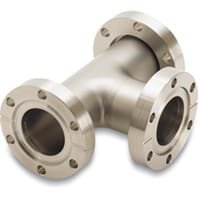
Introduction
Conflat (CF) UHV Standard Tees are essential vacuum components used to create three-way connections in ultra-high vacuum (UHV) systems. Designed with CF knife-edge flanges, these tees provide reliable, leak-tight performance and are widely used in semiconductor processing, surface science, and high-precision research environments where vacuum integrity is critical.
Detailed Description
CF UHV standard tees are precision-machined from high-quality stainless steel, typically 304L or 316L, ensuring excellent corrosion resistance, low outgassing, and long-term durability. Each port of the tee is equipped with a ConFlat (CF) flange featuring a knife-edge sealing surface that compresses a soft copper gasket to form a metal-to-metal seal capable of achieving pressures down to 10⁻¹⁰ mbar or lower.
The tee configuration allows for efficient branching of vacuum lines, enabling integration of pumps, gauges, valves, or additional chambers within a compact footprint. Internal surfaces are typically machined to high smoothness and can be electropolished to further reduce contamination and virtual leaks.
CF standard tees are available in equal or reducing configurations, with a wide range of flange sizes (e.g., CF16 to CF200 and larger). Their rigid, welded construction ensures mechanical stability and compatibility with high-temperature bake-out procedures commonly required in UHV systems.
Key features include:
CF knife-edge flange design for UHV sealing
High-grade stainless steel construction (304L / 316L)
Excellent vacuum performance with low leak rates
Compatible with high-temperature bake-out processes
Available in equal and reducing tee configurations
Smooth internal surfaces for minimal outgassing
Applications
CF UHV standard tees are widely used in:
Ultra-high vacuum (UHV) systems and beamlines
Semiconductor manufacturing and thin film deposition (PVD, CVD)
Surface science and analytical instrumentation
Particle accelerators and synchrotron facilities
Vacuum system integration and distribution networks
Research laboratories requiring high vacuum integrity
Technical Parameters
| Parameter | Typical Value / Range | Importance |
|---|---|---|
| Material | SS304L / SS316L | Corrosion resistance & UHV compatibility |
| Flange Type | ConFlat (CF) | Metal seal for UHV |
| Size Range | CF16 – CF200+ | System compatibility |
| Leak Rate | ≤ 1×10⁻¹⁰ mbar·L/s | Ensures vacuum integrity |
| Surface Finish | Machined / electropolished | Reduces outgassing |
| Bake-out Temp. | Up to 450°C (typical) | UHV system preparation |
Comparison with Related Materials
| Material/System | Key Advantage | Typical Application |
|---|---|---|
| CF Standard Tee | UHV sealing, high reliability | UHV systems |
| KF Tee | Quick assembly | HV systems |
| ISO-K Tee | Large diameter capability | Industrial vacuum |
| ASA Tee | Robust bolted connection | Industrial HV systems |
FAQ
| Question | Answer |
|---|---|
| What type of seal is used in CF tees? | A metal-to-metal seal using a copper gasket and knife-edge flange. |
| Are CF tees suitable for UHV applications? | Yes, they are specifically designed for ultra-high vacuum environments. |
| Can these tees withstand high temperatures? | Yes, they are compatible with bake-out temperatures up to ~450°C. |
| Are reducing tees available? | Yes, both equal and reducing configurations can be supplied. |
| What industries use CF tees most? | Semiconductor, research, aerospace, and vacuum technology industries. |
Packaging
Our Conflat (CF) UHV Standard Tees are meticulously tagged and labeled externally to ensure efficient identification and maintain high standards of quality control. Each component is carefully cleaned, vacuum-packed, and protected against contamination and mechanical damage during storage and transportation.
Conclusion
Conflat (CF) UHV Standard Tees provide a reliable and high-performance solution for branching vacuum systems in ultra-high vacuum environments. With their robust construction, excellent sealing capability, and compatibility with demanding applications, they are indispensable components in modern vacuum engineering.
For detailed specifications and a quotation, please contact us at sales@thinfilmmaterials.com.
Ordering Table
| Flange Size/OD | Flange Material | Drawing | Part Number |
| 304L SS | 304L SS |
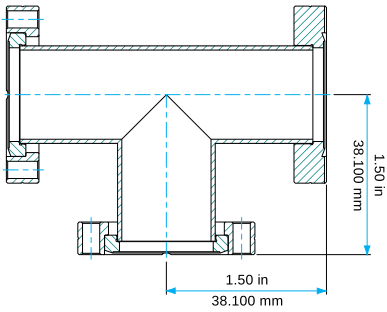
| T-0133 |
| 304L SS | 304L SS |
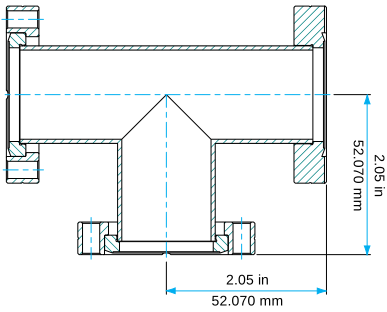
| T-0212 |
| 304L SS | 304L SS |
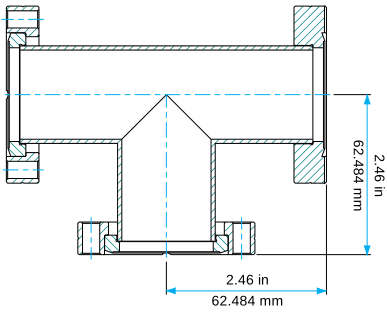
| T-0275 |
| 304L SS | 304L SS |
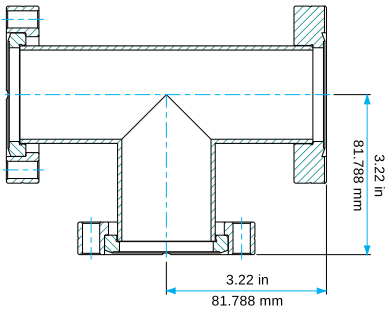
| T-0337 |
| 304L SS | 304L SS |
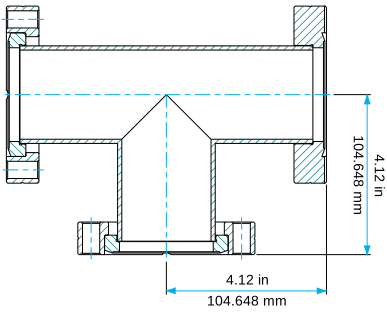
| T-0450 |
| 304L SS | 304L SS |
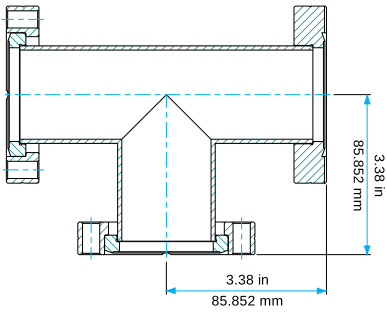
| T-0450S |
| 304L SS | 304L SS |
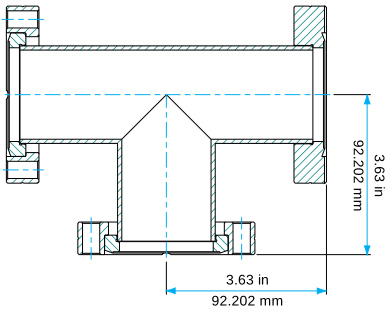
| T-0462 |
| 304L SS | 304L SS |
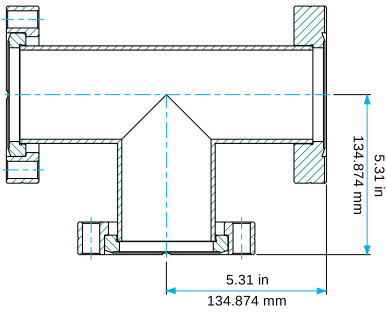
| T-0600 |
| 304L SS | 304L SS |
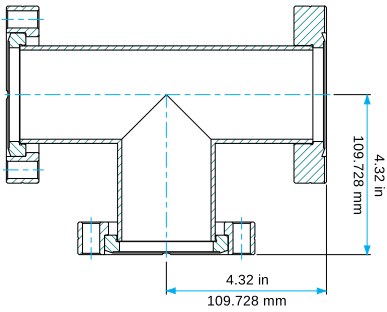
| T-0600S |
| 304L SS | 304L SS |
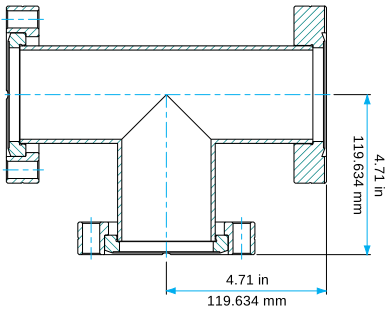
| T-0675 |
| 304L SS | 304L SS |
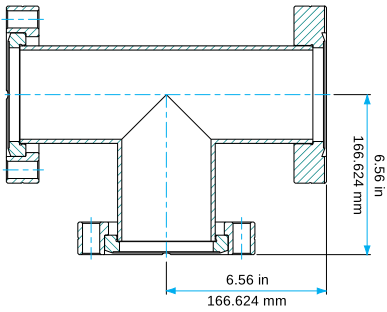
| T-0800 |
| 304L SS | 304L SS |
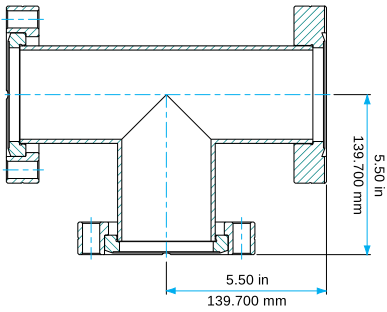
| T-0800S |
| 304L SS | 304L SS |
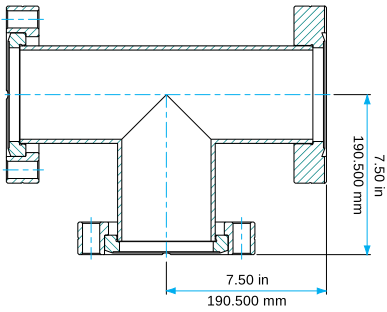
| T-1000 |
| 304L SS | 304L SS |
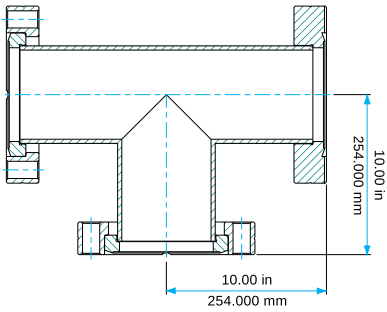
| T-1325 |

Reviews
There are no reviews yet.