
Introduction
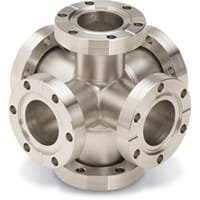
ConFlat (CF) UHV 6-Way Standard Crosses are critical junction components in ultra-high vacuum (UHV) systems, enabling multidirectional connections with exceptional sealing reliability. Designed for complex vacuum architectures, these crosses allow integration of multiple ports for instrumentation, pumping, and process access while maintaining ultra-low leak rates. They are widely used in semiconductor fabrication, surface science, and high-energy physics applications.
Detailed Description
CF UHV 6-Way Standard Crosses consist of six orthogonally arranged ports, each equipped with precision-machined ConFlat (CF) flanges. These flanges utilize a metal-to-metal sealing mechanism with copper gaskets, ensuring vacuum integrity down to 10⁻¹⁰ Torr or lower. The knife-edge sealing design creates a permanent, reliable seal suitable for repeated bake-out cycles and long-term operation.
Manufactured from high-grade stainless steel such as 304L or 316L, these crosses offer excellent corrosion resistance, mechanical strength, and low outgassing characteristics. The internal surfaces are carefully machined and cleaned to minimize contamination and ensure compatibility with sensitive UHV environments.
The six-way configuration provides maximum flexibility in system design, allowing simultaneous connection of gauges, valves, viewports, feedthroughs, and vacuum pumps. This design is particularly beneficial in research and process systems where multiple diagnostic or functional components must be integrated into a compact space.
Optional features such as electropolishing, helium leak testing, and custom port configurations are available to meet stringent application requirements.
Applications
ConFlat UHV 6-Way Crosses are widely used in:
- Ultra-high vacuum (UHV) chambers and experimental systems
- Semiconductor processing equipment (PVD, CVD, etching systems)
- Particle accelerators and synchrotron beamlines
- Surface analysis systems (XPS, SEM, TEM)
- Vacuum instrumentation and diagnostics setups
- Aerospace and space simulation vacuum systems
Technical Parameters
| Parameter | Typical Value / Range | Importance |
|---|---|---|
| Material | 304L / 316L Stainless Steel | Low outgassing and corrosion resistance |
| Flange Type | CF (ConFlat) | Reliable metal sealing for UHV |
| Port Configuration | 6-way (orthogonal) | Enables multi-directional connections |
| Nominal Size | DN16 – DN160 (custom available) | Compatibility with system components |
| Leak Rate | ≤ 1 × 10⁻¹⁰ mbar·L/s | Ensures UHV performance |
| Surface Finish | Machined / Electropolished (optional) | Reduces contamination and outgassing |
| Bake-out Temp | Up to 450°C | Suitable for UHV degassing processes |
Comparison with Related Components
| Component Type | Key Advantage | Typical Application |
|---|---|---|
| 6-Way CF Cross | Maximum connectivity, compact design | Complex UHV systems |
| 4-Way CF Cross | Simpler configuration | Basic vacuum junctions |
| CF Tee | Linear branching | Vacuum pipelines |
FAQ
| Question | Answer |
|---|---|
| What is the benefit of a 6-way cross configuration? | It allows multiple components to be connected in different directions, improving system flexibility and compactness. |
| Are CF crosses reusable? | Yes, the flanges are reusable, but copper gaskets must be replaced after each sealing. |
| Can the ports be customized? | Yes, different flange sizes or mixed configurations can be provided upon request. |
| Are these suitable for UHV applications? | Yes, CF flanges are specifically designed for ultra-high vacuum environments. |
| What surface treatments are available? | Options include standard machining, electropolishing, and specialized cleaning for UHV compatibility. |
Packaging
Our Conflat (CF) UHV 6-Way Standard Crosses are meticulously tagged and labeled externally to ensure efficient identification and maintain high standards of quality control. We take great care to prevent any potential damage during storage and transportation, ensuring the products arrive in perfect condition.
Conclusion
ConFlat (CF) UHV 6-Way Standard Crosses provide a highly reliable and flexible solution for complex vacuum system integration. With robust construction, superior sealing performance, and customizable configurations, they are an essential component in advanced UHV applications.
For detailed specifications and a quotation, please contact us at sales@thinfilmmaterials.com.
Ordering Table
| Flange Size/OD | Flange Material | Drawing | Part Number |
| DN16CF (1.33" OD) | 304L SS |

| C6-0133 |
| DN25CF (2.13" OD) | 304L SS |

| C6-0212 |
| DN35CF-DN40CF (2.75" OD) | 304L SS |

| C6-0275 |
| DN50CF (3.38" OD) | 304L SS |

| C6-0337 |
| DN63CF (4.50" OD) | 304L SS |

| C6-0450 |
| DN63CF (4.50" OD) | 304L SS |

| C6-0450S |
| DN75CF (4.63" OD) | 304L SS |

| C6-0462 |
| DN100CF (6.00" OD) | 304L SS |

| C6-0600 |
| DN100CF (6.00" OD) | 304L SS |

| C6-0600S |
| DN125CF (6.75" OD) | 304L SS |

| C6-0675 |
| DN160CF (8.00" OD) | 304L SS |

| C6-0800 |
| DN160CF (8.00" OD) | 304L SS |

| C6-0800S |
| DN200CF (10.00" OD) | 304L SS |

| C6-1000 |
| DN275CF (13.25" OD) | 304L SS |

| C6-1325 |
Reviews
There are no reviews yet.