
Introduction
ISO80 HV Flanges are standardized vacuum components widely used in high vacuum (HV) systems for creating reliable, leak-tight connections between vacuum chambers, pipelines, and instrumentation. As part of the ISO-K / ISO-F flange family, ISO80 flanges are designed to support vacuum pressures typically ranging from rough vacuum down to approximately 10⁻⁸ mbar, depending on system configuration and sealing methods.
Due to their robust construction, modular compatibility, and easy installation, ISO80 HV flanges are commonly used in vacuum deposition systems, semiconductor equipment, research laboratories, and industrial vacuum processing equipment. Their standardized dimensions ensure compatibility with a wide range of vacuum components, making them an essential element in many vacuum engineering applications.
Detailed Description
ISO80 HV flanges follow international ISO standards for high-vacuum flange systems, offering a reliable and modular solution for connecting vacuum components. The “80” designation refers to the nominal bore size of approximately 80 mm, providing sufficient conductance for medium to large vacuum systems.
These flanges are typically manufactured from high-quality stainless steel (commonly 304 or 316L) to provide excellent corrosion resistance, mechanical strength, and vacuum compatibility. The material choice also ensures low outgassing rates, which are critical for maintaining stable vacuum conditions in sensitive systems.
ISO80 flanges use elastomer O-ring seals (often Viton® or similar materials) combined with clamps or bolts to form a vacuum-tight joint. This sealing method allows for rapid assembly and disassembly compared with ultra-high vacuum flanges such as CF flanges that use metal gaskets. As a result, ISO80 flanges are particularly suitable for vacuum systems requiring frequent maintenance or reconfiguration.
Two common variants exist within the ISO flange family:
ISO-K flanges, which use double claw clamps for quick installation
ISO-F flanges, which use bolt holes for more rigid and secure connections
Both designs share the same sealing geometry and can be used interchangeably with the appropriate hardware.
Applications
ISO80 HV flanges are widely used in many vacuum technology fields, including:
Physical Vapor Deposition (PVD) systems, such as sputtering and evaporation equipment
Vacuum furnaces and heat treatment systems
Semiconductor manufacturing equipment
Particle accelerators and research vacuum systems
Analytical instruments, including mass spectrometers and surface analysis tools
Industrial vacuum processing equipment used in coating and materials processing
Technical Parameters
| Parameter | Typical Value / Range | Importance |
|---|---|---|
| Nominal Size | ISO80 (DN80) | Determines system compatibility and conductance |
| Inner Diameter | ~80 mm | Controls vacuum flow and pumping efficiency |
| Material | Stainless Steel 304 / 316L | Provides corrosion resistance and vacuum stability |
| Seal Type | Elastomer O-ring (Viton®, NBR optional) | Ensures leak-tight vacuum connection |
| Surface Finish | Vacuum-grade machined surface | Minimizes leakage and contamination |
| Operating Pressure | Atmospheric to ~10⁻⁸ mbar | Suitable for high vacuum systems |
Comparison with Related Vacuum Flanges
| Flange Type | Key Advantage | Typical Application |
|---|---|---|
| ISO80 HV Flange | Quick assembly with high conductance | High vacuum industrial systems |
| KF (QF) Flange | Very fast clamp connection | Small vacuum lines and instruments |
| CF (ConFlat®) Flange | Metal gasket for ultra-high vacuum | UHV systems down to 10⁻¹¹ mbar |
FAQ
| Question | Answer |
|---|---|
| What is the difference between ISO-K and ISO-F flanges? | ISO-K flanges use claw clamps for quick installation, while ISO-F flanges use bolt holes for a more rigid connection. |
| What sealing materials are commonly used? | Viton® O-rings are most commonly used, but other elastomers such as NBR or silicone can be supplied depending on temperature requirements. |
| Are ISO80 flanges compatible with other ISO sizes? | ISO80 components are compatible with other ISO80 vacuum hardware but require appropriate reducers or adapters to connect with different flange sizes. |
| What vacuum level can ISO80 flanges support? | ISO80 flanges are typically used in high vacuum systems reaching pressures around 10⁻⁸ mbar. |
| Can custom vacuum components be supplied with ISO80 flanges? | Yes. Vacuum chambers, tees, crosses, reducers, and adapters with ISO80 connections can be manufactured to meet specific system designs. |
Packaging
Our ISO80 HV Flanges are meticulously tagged and labeled externally to ensure efficient identification and maintain high standards of quality control. Each flange is carefully cleaned for vacuum compatibility and packaged using protective materials to prevent contamination or surface damage. Components are securely packed in export-grade cartons or wooden crates to ensure safe transportation and storage.
Conclusion
ISO80 HV Flanges provide a reliable and versatile connection solution for high vacuum systems. Their standardized dimensions, durable stainless steel construction, and easy assembly make them ideal for a wide range of vacuum applications, from industrial coating systems to advanced research equipment.
With precise manufacturing, high-quality materials, and full compatibility with ISO vacuum standards, ISO80 HV flanges offer dependable performance in demanding vacuum environments.
For detailed specifications and a quotation, please contact us at sales@thinfilmmaterials.com.
Ordering Table
| Flange Size/OD | Type | Flange Material | Drawing | Nominal Tube OD | Bore | Counter Bore | Thickness | Bolt Circle Dia. | Bolt Hole Dia. | # of Bolt Holes | Minimal Number of Clamps | Part Number |
| ISO80-F (5.71" OD) | Bored, Bolt Style | 304L SS |
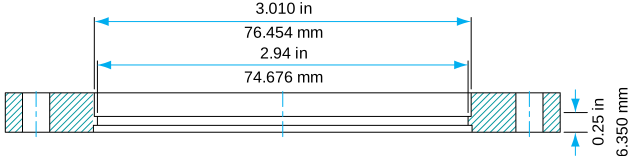
| 3 | 2.94 | 3.010 | 0.47 | 4.921 | 0.354 | 8 | — | QF80-SWF |
| ISO80-F (5.71" OD) | Blank, Bolt Style | 304L SS |

| 3 | — | — | 0.47 | 4.921 | 0.354 | 8 | — | QF80-BF |
| ISO80-F (5.71" OD) | Blank, Bolt Style | 6061-T6 Aluminum |
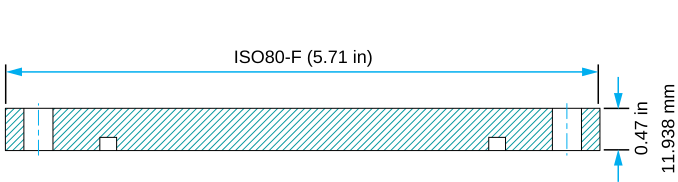
| 3 | — | — | 0.47 | 4.921 | 0.354 | 8 | — | QF80-ABF |
| ISO80-F (5.71" OD) | Bored, Bolt Style | 316L SS |
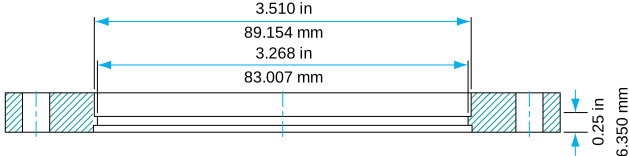
| 3-1/2 | 3.268 | 3.510 | 0.47 | 4.921 | 0.354 | 8 | — | QF80-SWF-M |
| ISO80-K (4.33" OD) | Bored, Clamp Style | 304L SS |
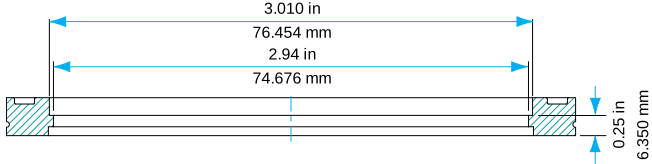
| 3 | 2.94 | 3.010 | 0.47 | — | — | — | 4 | QF80-SWK |
| ISO80-K (4.33" OD) | Blank, Clamp Style | 304L SS |
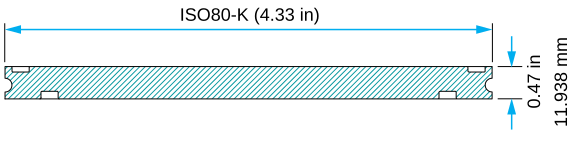
| 3 | — | — | 0.47 | — | — | — | 4 | QF80-BK |
| ISO80-K (4.33" OD) | Bored, Clamp Style | 316L SS |
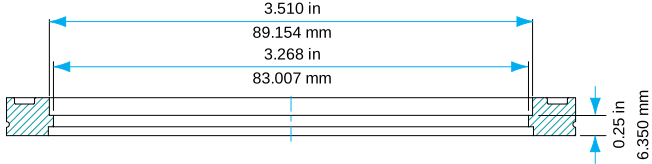
| 3-1/2 | 3.268 | 3.510 | 0.47 | — | — | — | 4 | QF80-SWK-M |
| ISO80-K (4.33" OD) | Blank, Clamp Style | 6061-T6 Aluminum |
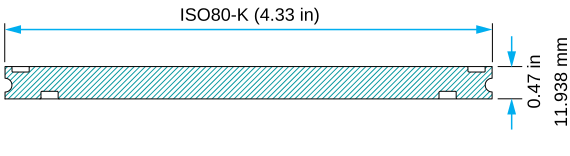
| 3 | — | — | 0.47 | — | — | — | 4 | QF80-ABK |

Reviews
There are no reviews yet.