
Introduction
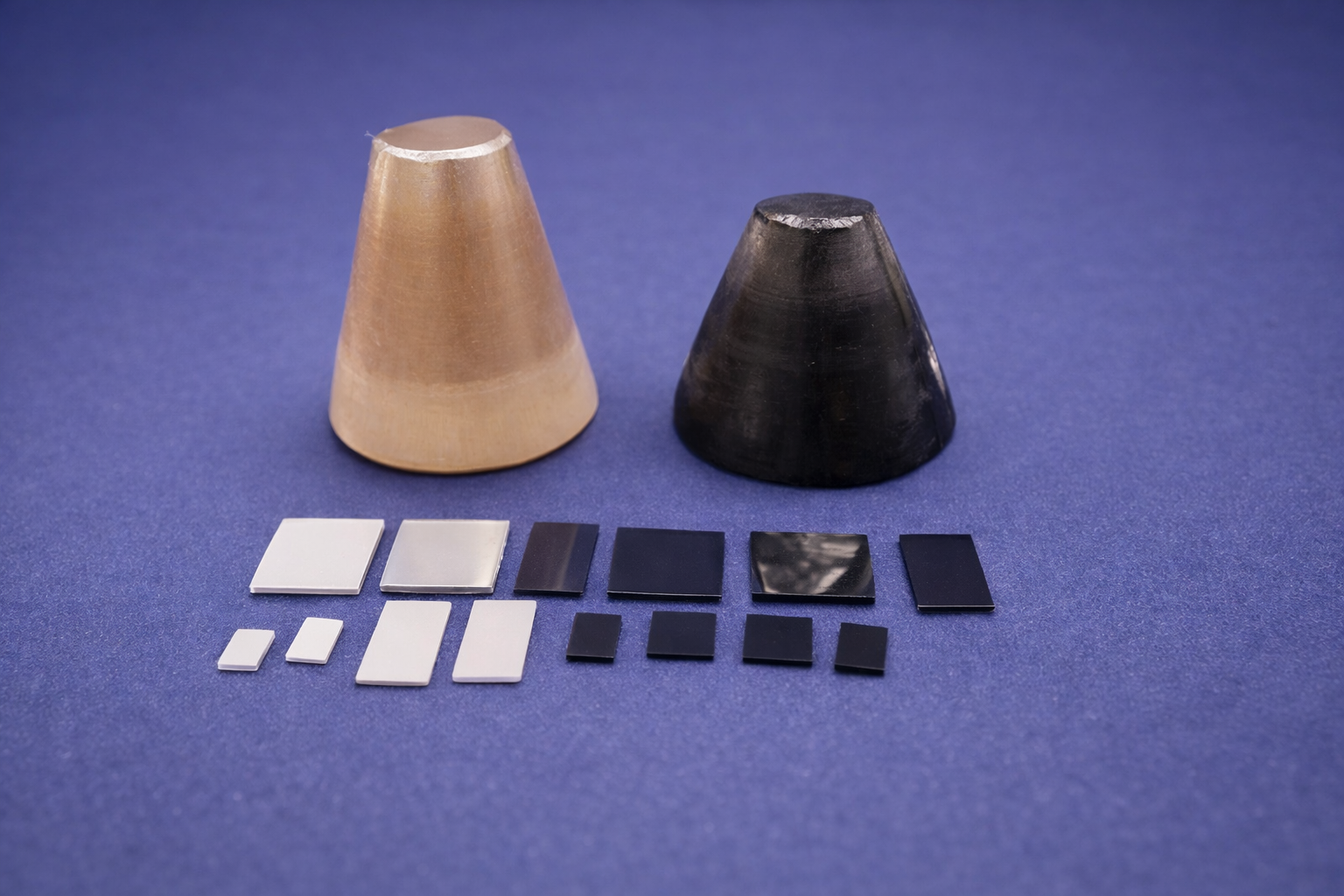
Fe-Doped SrTiO₃ Substrate (Iron-Doped Strontium Titanate) is a functional perovskite oxide single crystal engineered to introduce controlled defect states and modified electronic behavior within the SrTiO₃ lattice. By incorporating iron ions into the crystal structure, the substrate exhibits tailored electrical, optical, and defect-related properties while preserving excellent structural compatibility for epitaxial oxide film growth.
Fe-Doped SrTiO₃ Substrate is widely used in oxide electronics research, resistive switching studies, photocatalysis investigations, and defect-engineered thin film systems where controlled carrier compensation and deep-level states are required.
Detailed Description
Fe-Doped SrTiO₃ Substrate is produced by substituting a fraction of Ti⁴⁺ ions in the perovskite lattice with Fe³⁺ or Fe⁴⁺ ions. This substitution modifies the electronic band structure and introduces localized states within the bandgap, which influence conductivity, carrier trapping, and defect dynamics.
Unlike Nb-doping, which typically enhances n-type conductivity, Fe-doping often results in semi-insulating or compensated behavior depending on concentration and oxygen stoichiometry. This makes Fe-Doped SrTiO₃ Substrate particularly valuable for studying:
Oxygen vacancy migration
Redox-related switching mechanisms
Deep trap states in oxide semiconductors
Photoconductive and catalytic responses
The substrates are grown using controlled crystal growth techniques to ensure low dislocation density and high crystallographic uniformity. After slicing, wafers undergo precision polishing to achieve epi-ready surfaces suitable for PLD, MBE, sputtering, and CVD deposition processes.
Surface termination control and post-annealing can be performed to achieve atomically flat step-terrace structures, enabling high-quality heteroepitaxial film growth.
Applications
Fe-Doped SrTiO₃ Substrate is widely used in advanced materials research and functional oxide device development:
Resistive switching (memristor) studies
Oxygen vacancy migration and redox research
Photocatalytic oxide thin films
Defect-engineered semiconductor studies
Multiferroic and correlated electron systems
Gas sensing and catalytic surface investigations
Spin-dependent transport research
Electrochemical and energy conversion experiments
Its defect-engineered nature makes it an ideal model system for investigating electronic compensation mechanisms in perovskite oxides.
Technical Parameters
| Parameter | Typical Value / Range | Importance |
|---|---|---|
| Crystal Structure | Perovskite (Cubic) | Enables epitaxial oxide growth |
| Fe Doping Level | 0.1 – 2.0 mol% (customizable) | Controls defect concentration |
| Resistivity | 10⁻¹ – 10⁴ Ω·cm (depending on stoichiometry) | Defines electronic behavior |
| Orientation | (100), (110), (111) | Determines film growth mode |
| Surface Finish | SSP / DSP (Epi-ready optional) | Influences thin film quality |
| Size | 5×5 mm – 20×20 mm (custom) | Compatible with deposition systems |
| Thickness | 0.5 mm – 1.0 mm | Mechanical and thermal stability |
Comparison with Related Materials
| Material | Key Advantage | Typical Application |
|---|---|---|
| Fe-Doped SrTiO₃ Substrate | Controlled defect states & compensation effects | Memristors & redox studies |
| Nb-Doped SrTiO₃ | High conductivity (n-type) | Bottom electrode & transport measurements |
| Undoped SrTiO₃ | Highly insulating, low defect density | Dielectric & epitaxial growth base |
| LaAlO₃ | Lattice match for specific oxide systems | 2DEG heterostructures |
Compared with Nb-doped variants, Fe-Doped SrTiO₃ Substrate is more suitable for defect-driven and compensation-based research rather than purely conductive applications.
FAQ
| Question | Answer |
|---|---|
| Can Fe concentration be customized? | Yes, doping levels can be tailored to achieve specific resistivity or defect density targets. |
| Does Fe doping affect lattice parameters? | Slight variations may occur, but lattice compatibility with perovskite oxides is largely preserved. |
| Is it suitable for high-temperature deposition? | Yes, the substrate maintains structural integrity at typical oxide deposition temperatures above 800°C. |
| Can oxygen stoichiometry be controlled? | Yes, post-growth annealing under controlled atmospheres can adjust oxygen vacancy concentration. |
| How are substrates packaged? | Each substrate is individually packed in clean, protective containers to avoid contamination and mechanical damage. |
Packaging
Our Fe-Doped SrTiO₃ Substrate products are meticulously tagged and labeled externally to ensure efficient identification and maintain high standards of quality control. We take great care to prevent any potential damage during storage and transportation, ensuring the substrates arrive in perfect condition.
Conclusion
Fe-Doped SrTiO₃ Substrate provides a reliable and well-controlled platform for defect engineering, resistive switching studies, and advanced oxide electronics research. With customizable doping levels, high crystalline quality, and excellent epitaxial compatibility, it serves as a versatile foundation for both fundamental investigations and emerging device concepts.
For detailed specifications and a quotation, please contact us at sales@thinfilmmaterials.com.
Reviews
There are no reviews yet.