
 MSDS File
Product Overview
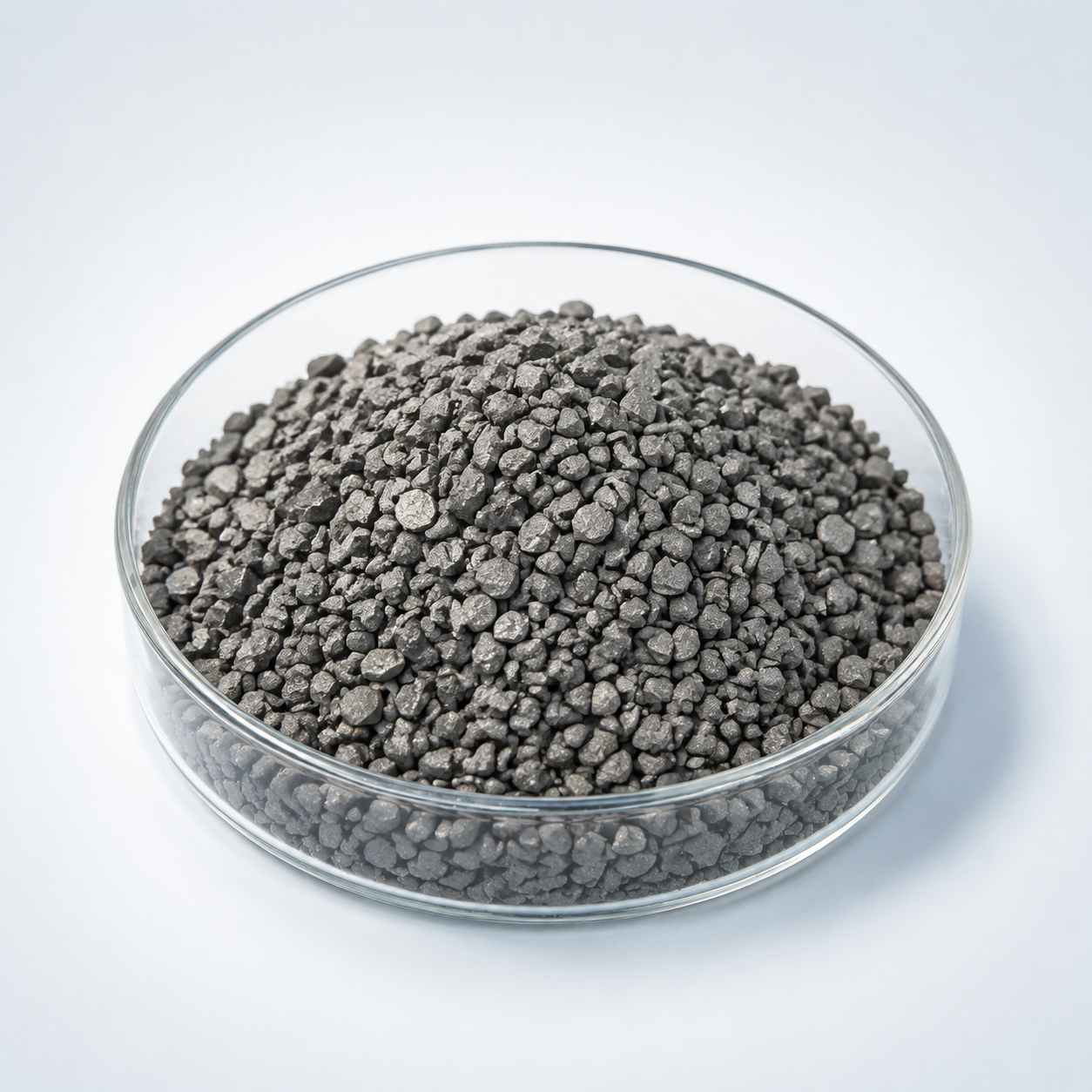
Manganese Evaporation Materials (Mn) is an elemental evaporation material used to deposit metallic thin films by vacuum evaporation. Depending on vapor pressure, melting behavior, source geometry, and the available evaporator, the material may be processed by resistance heating, electron-beam evaporation, or another suitable high-vacuum source. For repeatable deposition, purity, source form, handling cleanliness, and compatibility with the boat, basket, crucible, or hearth are important procurement variables.
Evaporation Behavior and Process Considerations
The choice between resistance heating and electron-beam evaporation depends on vapor pressure, melting temperature, source mass, required rate, and the available boat or crucible. Low-to-moderate melting metals may be compatible with resistance heating, while higher-temperature materials can favor e-beam evaporation. Gradual preheating is useful for removing adsorbed gases and establishing a stable evaporation rate before deposition.
Technical Data
| Parameter | Typical Value / Range | Importance |
|---|---|---|
| Material | Manganese (Mn) | Core functional element |
| Purity | 99.9% – 99.99% | Minimizes film contamination |
| Form | Pellets, granules, pieces (custom) | Fits different evaporation sources |
| Melting Point | ~1246 °C | Influences evaporation method |
| Deposition Method | Thermal / E-beam evaporation | Process flexibility |
| Packaging | Vacuum-sealed | Prevents oxidation |
| Material | Key Advantage | Typical Application |
|---|---|---|
| Manganese (Mn) | Magnetic and alloy functionality | Spintronics, alloys |
| Iron (Fe) | Strong ferromagnetism | Magnetic films |
| Chromium (Cr) | Good adhesion, corrosion resistance | Adhesion layers |
| Cobalt (Co) | High magnetic anisotropy | Magnetic devices |
| Question | Answer |
|---|---|
| Can manganese evaporation materials be customized? | Yes, purity, size, and shape can be tailored to your evaporation source. |
| Is manganese suitable for reactive evaporation? | Yes, Mn is commonly used with oxygen to form manganese oxide films. |
| How should manganese be stored? | Vacuum-sealed or inert-gas packaging is recommended to avoid oxidation. |
| Is it suitable for e-beam evaporation? | Yes, high-purity Mn can be used in e-beam systems with proper crucibles. |
| Are small R&D quantities available? | Yes, laboratory-scale quantities are supported. |
Typical Thin-Film Applications
- Manganese metallic coatings for electronic, optical, conductive, reflective, catalytic, or contact-layer applications
- Semiconductor and laboratory PVD research
- Multilayer stacks and co-evaporation processes requiring a pure elemental source
Source Form and Ordering Considerations
For quotation, provide material, purity, source form, particle or piece size, quantity, evaporation method, and any boat, basket, crucible, or e-beam hearth constraints. If the material will be used for a specific coating stack, sharing the intended film thickness or deposition application can help with source-form selection and packaging recommendations.
Frequently Asked Questions
Can Manganese be used for thermal evaporation?
It depends on melting point, vapor pressure, charge size, and the source hardware. Many elemental metals can be resistance-heated, while higher-temperature materials are often more convenient to evaporate with an electron beam.
How do I choose between pellets, pieces, and granules for Manganese?
Choose a form that loads securely into the boat, crucible, basket, or e-beam pocket and provides stable heating. Smaller pieces can improve packing, while larger pieces may reduce handling and dust.
Why should Manganese be preheated before opening the shutter?
Preheating removes adsorbed gases and stabilizes the evaporation flux. This can reduce pressure spikes, spitting, and contamination during the actual film deposition.
Can the crucible material affect Manganese evaporation?
Yes. At elevated temperature, the charge can react with, dissolve, wet, or contaminate some source materials. Crucible and boat compatibility should be checked for the actual evaporation temperature.
Does source purity directly affect film purity?
Source purity is one of the main contributors to film contamination, although chamber cleanliness, crucible condition, substrate preparation, and background pressure also affect the final film.
What information should I send TFM for Manganese evaporation material?
Please provide purity, preferred source form and size, quantity, evaporation method, source-holder details, and any packaging, inspection, or documentation requirements.
Reviews
There are no reviews yet.