Evidence note: The repository did not contain the customer authorization, order record, dated manufacturing traveler, inspection report, export document, or delivery proof needed to substantiate the former customer, country, 23-day, and on-time-delivery claims. Those claims have been removed; this page is now an engineering specification guide.
A custom nickel e-beam crucible cannot be specified by nominal volume alone. The part must physically fit the source assembly, provide the required usable volume, and remain compatible with the evaporant, beam geometry, cooling arrangement, and operating procedure. The equipment manufacturer’s instructions and an application-specific compatibility review take precedence over generic material guidance.
Start With the Source Assembly, Not a Catalog Volume
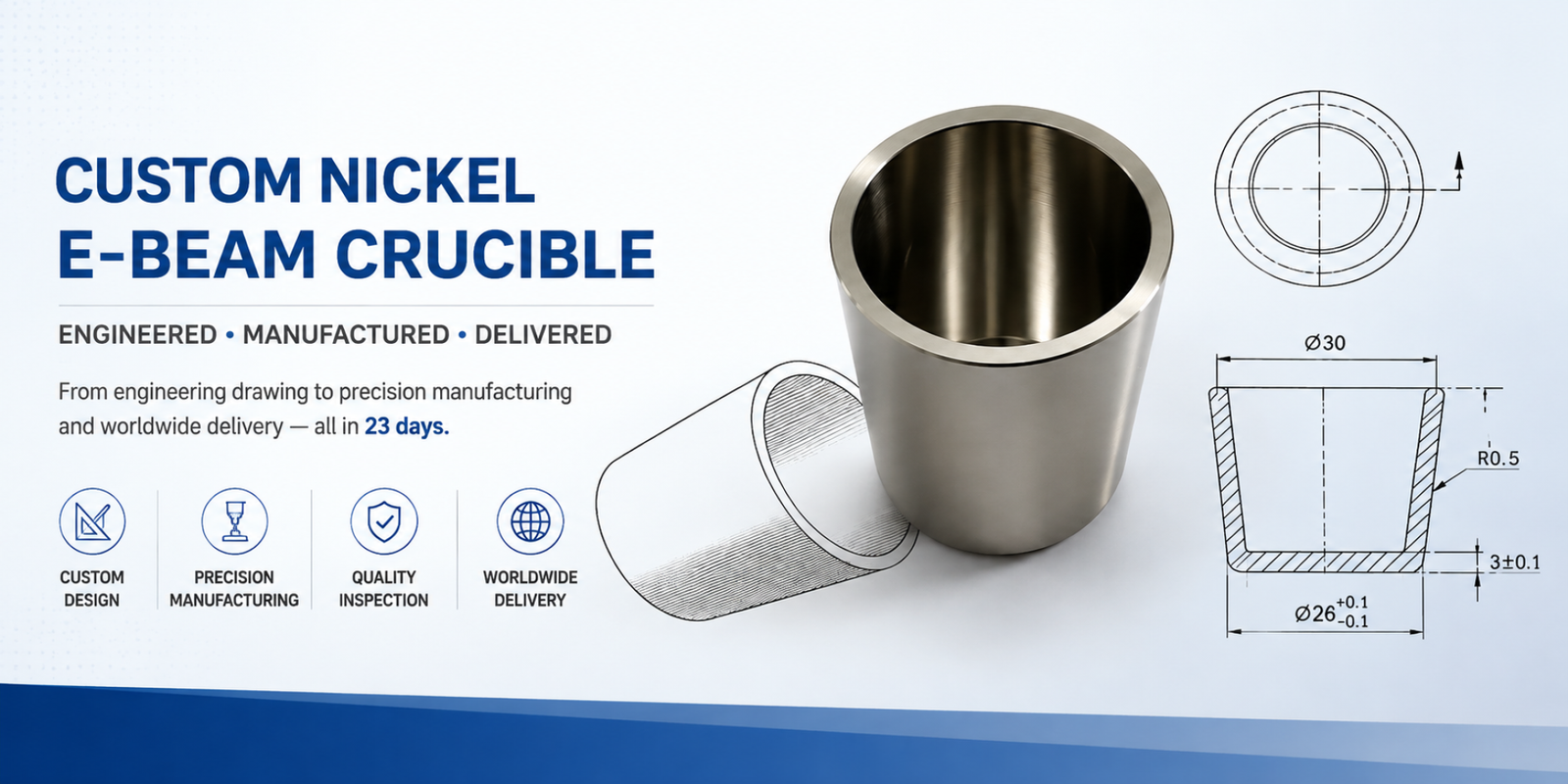
“10 mL” describes a capacity target, but it does not define outer diameter, overall height, flange or lip, wall thickness, bottom contour, internal taper, seating surface, or the position of the usable fill line. Two crucibles with the same nominal volume can be mechanically incompatible.
Before a production drawing is released, provide the source manufacturer and model, pocket dimensions, clearances, retention method, beam-access constraints, cooling arrangement, and any existing drawing or measured sample. If measurements are taken from a used part, identify wear, deformation, coatings, or deposits that may distort the nominal geometry.
Drawing Fields That Require Explicit Agreement
| Drawing field | Decision | Acceptance evidence |
|---|---|---|
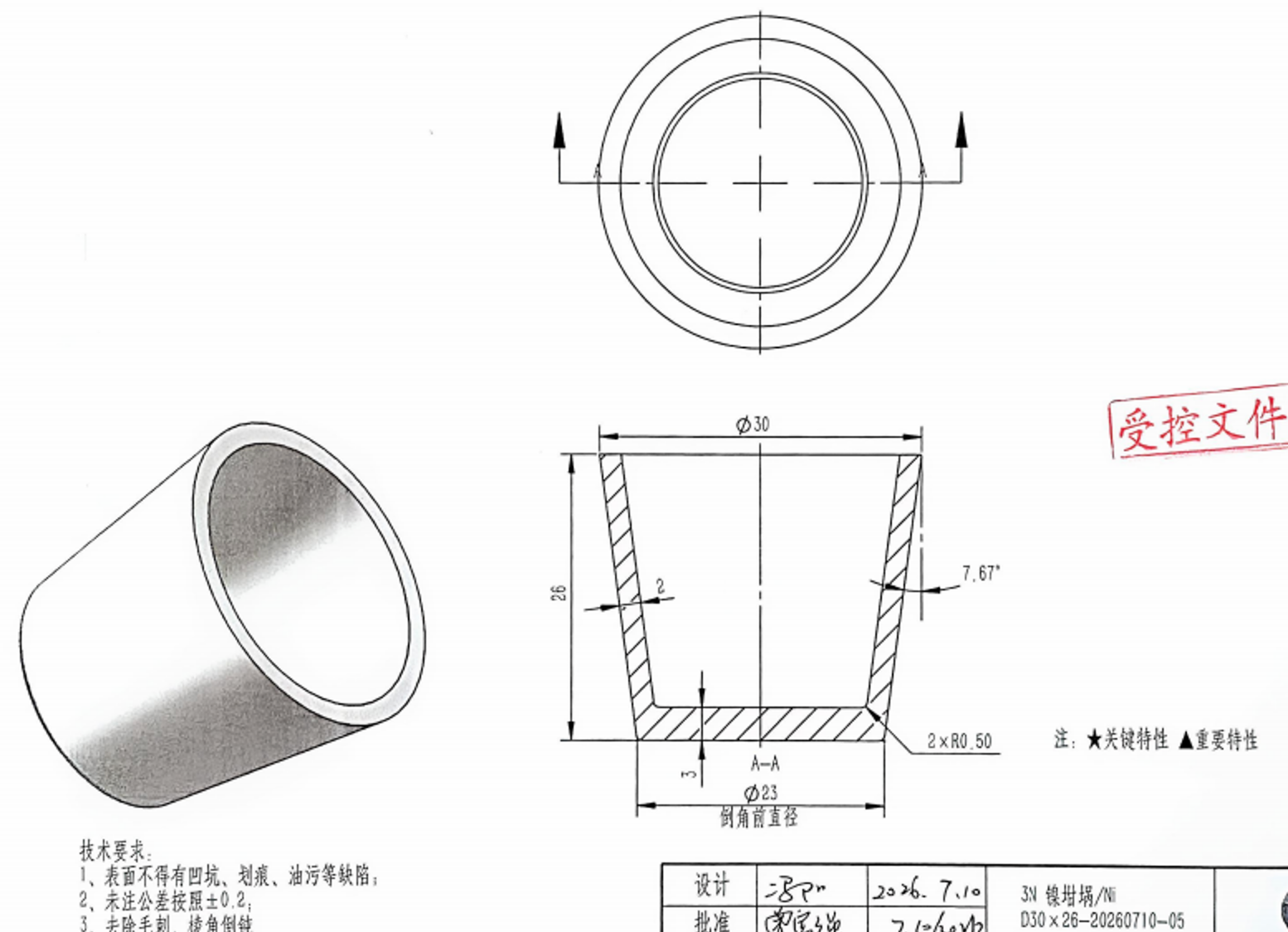
| Outer envelope | Diameter, height, flange/lip, bottom profile | Dimensional report or agreed sampling plan |
| Internal geometry | Opening, depth, taper, corner radii, usable fill line | Section dimensions and calculated capacity basis |
| Wall and base | Nominal thickness and minimum permitted value | Drawing tolerance and measurement method |
| Interfaces | Seating, retention, indexing, electrical or thermal contacts | Fit review against source documentation |
| Material | Nickel grade, purity basis, and permitted impurities | Supplier certificate scope |
| Surface | Finish, burr, edge-break, cleanliness, visible defects | Visual and surface criteria |
Material Compatibility Is an Application Question
A nickel crucible should not be selected solely because nickel can be fabricated into the required shape. Review possible alloying, wetting, dissolution, chemical reaction, vapor contamination, temperature, thermal cycling, and magnetic or electrical effects for the exact evaporant and source. The safe fill level and usable life also depend on the operating method.
The product page for a nickel crucible is the commercial owner. Related supply forms include nickel evaporation material and a nickel sputtering target; these are different products and should not be treated as interchangeable.
Capacity: Define the Calculation
Capacity may refer to the geometric cavity, a practical fill volume below the rim, or the amount permitted by the equipment procedure. State which definition applies. If capacity is calculated from a drawing, record the assumed radii and taper; if it is verified physically, define the verification medium and measurement uncertainty. Never infer charge mass from volume without the evaporant’s applicable bulk form and density basis.
Inspection and Packaging
- Verify the critical outer and seating dimensions against the approved drawing.
- Check opening, depth, wall/base minima, lip, edge break, burrs, dents, and cracks.
- Keep inspection coverage separate from general statements such as “precision made.”
- Protect thin walls and contact surfaces from point loads and abrasion during transport.
- Define cleaning state and packaging materials so they do not introduce residues important to vacuum service.
A photograph or shipping date is not a substitute for a dimensional inspection record. Regulatory or export requirements, if any, must be evaluated for the actual material, destination, end use, and shipment; no universal approval time is promised.
Copyable Custom Crucible RFQ
Part: custom nickel e-beam crucible. Source manufacturer/model: [ ]. Required nominal capacity and definition: [ ]. Outer envelope and interfaces: [attach drawing]. Nickel grade/purity and certificate needs: [ ]. Evaporant and operating constraints for compatibility review: [ ]. Critical tolerances and inspection report: [ ]. Cleaning and packaging: [ ]. Quantity: [ ]. Please identify feasibility, exclusions, information gaps, and estimated schedule in the quotation.Pre-Release Checklist
- One approved drawing revision owns all dimensions.
- Nominal volume and usable fill level are distinguished.
- Material identity and certificate scope are explicit.
- Evaporant/source compatibility has an identified owner.
- Critical dimensions have methods and acceptance limits.
- Cleaning, packaging, regulatory scope, and schedule are confirmed in writing.
Request a feasibility review with the source model, drawing, evaporant, quantity, and inspection requirements. TFM should confirm—rather than assume—material, tolerances, manufacturing route, documentation, and lead time.