
 MSDS File
Product Overview
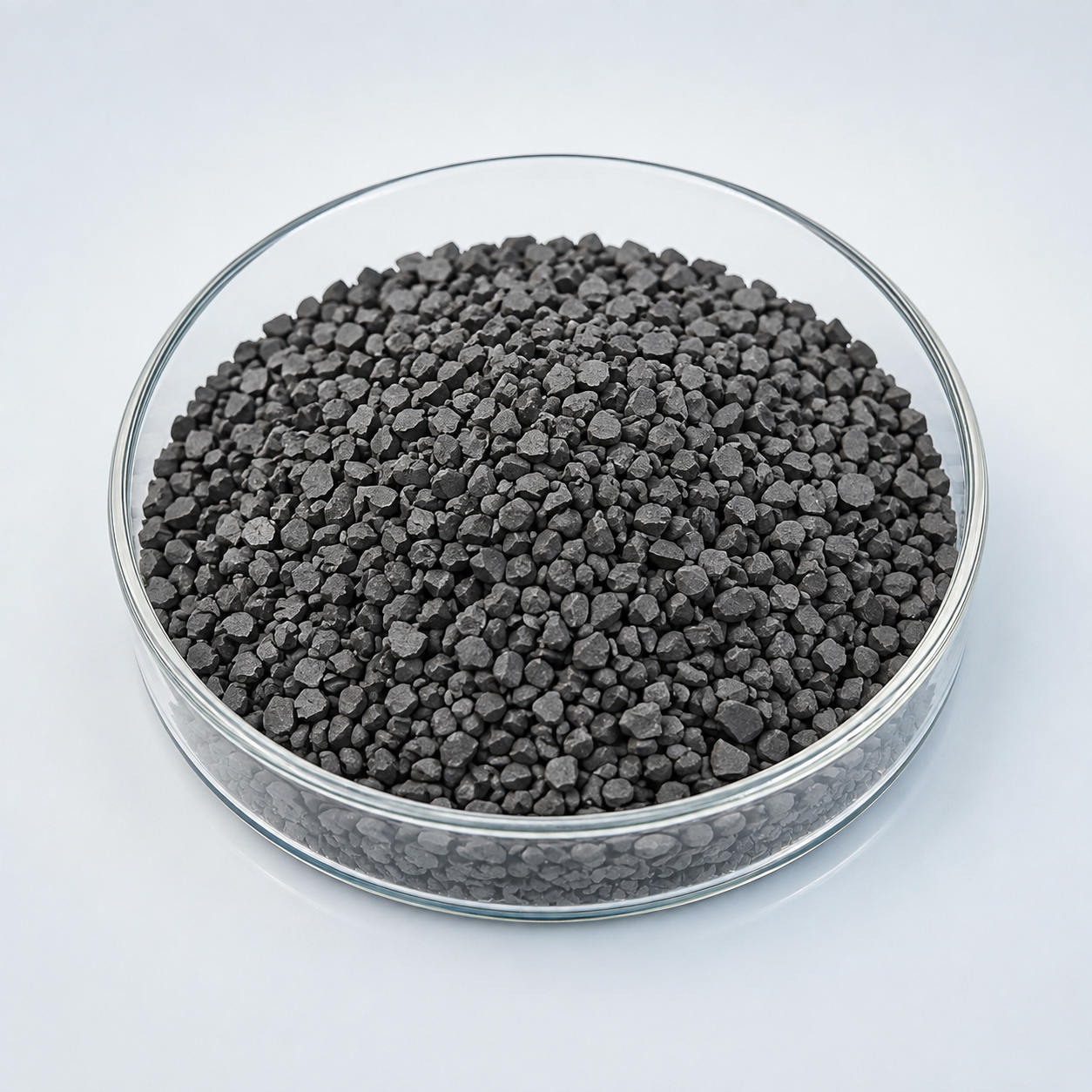
CdInTe4 Pellet Evaporation Material is supplied in pellet form to provide a compact, controlled charge for evaporation research involving complex or multicomponent materials. Pellet geometry can improve loading and handling, but it does not guarantee congruent evaporation. For multicomponent semiconductors and chalcogenides, the relative vapor pressures of the constituents, heating method, and deposition rate can influence film composition.
Evaporation Behavior and Process Considerations
Pellets should be loaded so that the charge is mechanically stable and heats uniformly. For complex materials, a slow preconditioning step can reduce trapped gas release and thermal shock. Because multicomponent pellets may not evaporate congruently, quartz-crystal rate monitoring alone should not be treated as proof of final film stoichiometry.
Technical Data
| Parameter | Typical Value / Range | Importance |
|---|---|---|
| Material | CdInTe₄ | Determines optical & electronic properties |
| Purity | 99.9% – 99.99% | Reduces contamination in deposited films |
| Form | Pellet | Ensures stable and clean evaporation |
| Pellet Size | 1–6 mm (custom available) | Compatible with various crucibles |
| Deposition Method | Thermal / E-beam evaporation | Matches standard vacuum systems |
| Moisture Sensitivity | Controlled handling required | Maintains material integrity |
| Material | Key Advantage | Typical Application |
|---|---|---|
| CdInTe₄ | Tuned optoelectronic properties | IR & semiconductor thin films |
| CdTe | Mature material system | Photovoltaics, detectors |
| InTe | Narrow bandgap | Specialized electronic films |
| ZnTe | Wide bandgap | Optoelectronic coatings |
| Question | Answer |
|---|---|
| Are CdInTe₄ pellets suitable for e-beam evaporation? | Yes, they are compatible with both thermal and e-beam evaporation systems. |
| Can pellet size be customized? | Yes, pellet dimensions can be tailored to your crucible or source design. |
| How is purity controlled? | High-purity raw materials and controlled synthesis are used. |
| What packaging is used? | Vacuum-sealed or inert-gas packaging to prevent oxidation and moisture uptake. |
| Is this material mainly for research use? | Yes, it is commonly used in R&D and pilot-scale thin-film development. |
Typical Thin-Film Applications
- Thin-film R&D requiring a composition-specific evaporation source
- Optical, semiconductor, electronic, energy, and advanced-material coating studies depending on the compound
- Custom PVD research using pellets, pieces, granules, or other source forms
Source Form and Ordering Considerations
For quotation, provide the material or formula, purity, desired source form and size, quantity, evaporation method if known, and any crucible, boat, or e-beam hearth constraints. For compound materials, include the target film composition or application when possible so that source form and process risk can be reviewed together. TFM can supply pellets, pieces, granules, tablets, or other custom forms subject to material manufacturability.
Frequently Asked Questions
Why is CdInTe4 Pellet supplied as an evaporation pellet?
Pelletizing provides a compact charge that is easier to load, handle, and heat than loose powder. It also helps reduce dust and movement inside the source holder.
Does a CdInTe4 Pellet pellet evaporate congruently?
Not necessarily. In multicomponent materials, individual elements can have different vapor pressures, so the film can drift from the nominal pellet composition during deposition.
Should complex evaporation pellets be preconditioned?
Yes. A slow preheating step can reduce trapped gas release, thermal shock, and sudden spitting before the substrate shutter is opened.
Is e-beam evaporation suitable for CdInTe4 Pellet pellets?
It can be, especially when localized heating is needed, but suitability depends on decomposition behavior, electrical/thermal properties, and the desired film composition.
How should the final film composition be controlled?
Use deposition-rate control together with post-deposition composition analysis. For strict composition tolerances, co-evaporation from separately controlled sources may be considered.
What dimensions can be customized for CdInTe4 Pellet pellets?
Pellet diameter, thickness, charge mass, and quantity can be reviewed according to the source pocket or crucible dimensions and material manufacturability.
Reviews
There are no reviews yet.