Quick answer: choosing a VO₂ sputtering target is only one part of producing a verified vanadium-dioxide film. The source route, oxygen activity, substrate temperature or post-anneal, film thickness, substrate and measurement method all affect which vanadium-oxide phase and thermochromic response are obtained. Start from the film acceptance criteria, then define the target, cathode, process window and verification plan together.
What a VO₂ Sputtering Target Can—and Cannot—Control
A ceramic VO₂ source provides vanadium and oxygen in a defined starting material, but it does not guarantee that the deposited film will be single-phase VO₂(M1), have a particular transition temperature or meet a specified optical or electrical response. Preferential sputtering, oxygen exchange with the plasma, substrate heating, bias, deposition rate and post-deposition treatment can all move the film away from the target’s bulk composition or phase.
VO₂ is especially process-sensitive because several stable vanadium oxides can form. Published sputtering studies identify two recurring requirements: controlling the oxygen/vanadium balance closely enough to avoid oxygen-poor or oxygen-rich competing phases, and supplying a thermal or energetic pathway that develops the required crystalline VO₂ phase. These requirements make a fixed “universal recipe” inappropriate across different tools.
Define the Film Requirement Before the Target
| Decision input | Why it changes source or process selection | Evidence to request |
|---|---|---|
| Required phase | VO₂(M1), mixed VOx or another vanadium-oxide phase requires different oxygen and thermal control. | XRD and Raman acceptance criteria; composition method and tolerance. |
| Optical response | Visible transmittance, near-infrared modulation and color depend on thickness, phase, stack and temperature. | Defined wavelength range, hot/cold measurement temperatures and stack geometry. |
| Electrical response | Transition temperature, hysteresis and resistance ratio depend on composition, crystallinity, stress and doping. | Temperature-dependent resistance method, heating/cooling rate and pass/fail limits. |
| Substrate thermal budget | A heat-sensitive substrate may require energetic deposition, a seed/buffer layer or a separate anneal strategy. | Maximum substrate temperature, allowable bias and post-anneal limits. |
| Tool and cathode | RF, pulsed-DC and HiPIMS tools have different target conductivity, power-delivery and reactive-gas behavior. | Cathode type, target dimensions, power mode, cooling and bonding limits. |
| Scale and uniformity | Coupon research and large-area coatings require different mapping and control plans. | Coated area, thickness map, composition map and edge-exclusion definition. |
Compare the Main Sputtering Source Routes
Ceramic VO₂ or VOx target
An oxide target can be useful when an RF-capable cathode is available and the development plan starts near an oxide composition. It does not remove the need to control oxygen activity or thermal history. The target’s electrical behavior, density, porosity, mechanical integrity and backing configuration must be compatible with the selected power mode and cathode.
Metallic vanadium with reactive oxygen
Reactive sputtering from metallic vanadium provides a wide composition-development range, but the process can be sensitive to target-surface oxidation and reactive-gas feedback. The useful window is tool-specific. Oxygen flow alone is not a transferable recipe because pumping speed, chamber history, target area, total pressure, power and feedback method change the target and plasma state.
Doped or co-sputtered VO₂-based films
Doping and multilayer designs are research routes for changing transition and optical behavior, but they introduce additional composition and uniformity variables. For example, one published study used controlled HiPIMS of vanadium with simultaneous pulsed-DC sputtering of tungsten to make W-doped VO₂-based coatings. That result is evidence for a specific stack and process—not a general specification for every VO₂ film.
Why Published Process Numbers Are Starting Evidence, Not Recipes
Bulk VO₂ is commonly associated with an insulator-to-metal transition near 68 °C, but thin-film transition behavior can shift with strain, crystallinity, grain structure, stoichiometry and dopants. Published HiPIMS work has demonstrated thermochromic VO₂ on amorphous glass at a 300 °C deposition temperature under that study’s pulsed reactive-gas control. Another study reported W-doped VO₂-based multilayers deposited at a 330 °C substrate-surface temperature. These examples show that lower-temperature routes are possible under controlled conditions; they do not establish a universal temperature, gas ratio or power density.
When transferring a literature process, record what the paper actually fixed: target material, power mode, target-to-substrate distance, pumping configuration, gas-control method, substrate, interlayers, bias, thickness and post-treatment. A number without this context is not an engineering specification.
A Measurement-First VO₂ Development Workflow
- Write the acceptance criteria. Define phase, thickness, optical and electrical measurements, temperature points and allowable non-uniformity.
- Choose one source route. Select ceramic-oxide, reactive metallic-vanadium or a controlled co-sputtering route based on the tool and required composition freedom.
- Confirm target/tool compatibility. Lock dimensions, usable area, backing or bonding, power mode, cooling and maximum power conditions with the cathode owner.
- Design a bounded process matrix. Vary only the parameters needed to find a stable phase window. Record chamber conditioning and target pre-sputter state.
- Verify composition and phase separately. Use an appropriate composition method together with XRD and/or Raman; do not infer phase from target labeling.
- Measure the functional response. Use temperature-dependent electrical and optical tests with documented heating and cooling conditions.
- Test repeatability. Repeat the selected condition across runs and target erosion state before treating it as a production window.
Common Failure Modes and What to Check
| Observed issue | Check first | Do not assume |
|---|---|---|
| No clear thermochromic transition | Phase by XRD/Raman, composition, crystallinity and measurement temperature range. | That target composition alone proves a VO₂(M1) film. |
| Large run-to-run shift | Chamber history, reactive-gas control, target conditioning, substrate temperature and film thickness. | That the same flow setting creates the same oxygen activity. |
| Particles or unstable discharge | Target surface state, arcing history, density/porosity, cooling, power ramp and chamber deposits. | That every particle originates from target chemistry. |
| Weak optical modulation | Phase fraction, thickness, substrate/stack optics and hot/cold measurement protocol. | That one wavelength represents total solar performance. |
| Transition temperature differs from a paper | Composition, dopant level, stress, crystallinity, thickness and test method. | That a literature value transfers unchanged to another tool. |
VO₂ Sputtering Target RFQ Checklist
- Requested source chemistry and whether substitutions or dopants are allowed.
- Required purity basis and the impurity elements that must be reported.
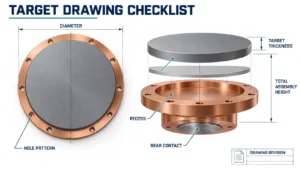
- Target diameter or length, thickness, tolerance, edge/chamfer requirements and usable area.
- Cathode model, power mode and any resistivity or conductivity constraint.
- Monolithic, bonded or backed construction; backing material and cooling interface.
- Maximum operating power or power density supplied by the cathode/tool owner.
- Requested evidence: composition report, density method, dimensional inspection, lot traceability and packaging.
- Substrate, maximum temperature, intended film thickness and phase/functional acceptance criteria.
- Whether the route uses inert or reactive gas and whether target conditioning requirements are known.
For commercial sourcing, review the existing Vanadium Dioxide Sputtering Target, compare the wider Sputtering Targets catalog, or send the cathode and film requirements for an RFQ review. Treat the final drawing, accepted specification and lot documentation—not this article—as the purchase and acceptance basis.
Evidence Boundary
This guide explains engineering decisions supported by published VO₂ sputtering research. It does not certify a particular TFM target lot, guarantee a deposited phase or film property, or replace tool-specific process development. Product purity, density, dimensions, bonding, inspection data and lead time must be confirmed in the quotation and applicable lot documents.
Primary Technical Sources
- J. Houška, “Design and reactive magnetron sputtering of thermochromic coatings,” Journal of Applied Physics 131 (2022), doi:10.1063/5.0084792.
- “Properties of thermochromic VO₂ films prepared by HiPIMS onto unbiased amorphous glass substrates at a low temperature of 300 °C,” Thin Solid Films 660 (2018), doi:10.1016/j.tsf.2018.06.057.
- T. Bárta et al., “Pulsed Magnetron Sputtering of Strongly Thermochromic VO₂-Based Coatings with a Transition Temperature of 22 °C onto Ultrathin Flexible Glass,” Coatings 10 (2020), doi:10.3390/coatings10121258.
- J.-L. Victor et al., “High quality thermochromic VO₂ thin films deposited at room temperature by balanced and unbalanced HiPIMS,” Solar Energy Materials and Solar Cells 227 (2021), doi:10.1016/j.solmat.2021.111113.