

To specify a multicomponent oxide sputtering target, start with the cation ratio and decide how to verify both the target and the deposited film. This guide covers those decisions for researchers developing complex oxide films and buyers ordering custom ceramic targets.
Why target and film compositions differ
Multicomponent oxide sputtering targets contain a defined nominal mixture of metal cations and oxygen. A film can differ from that mixture: sputtering yields, gas-phase transport, oxygen activity, substrate temperature, and post-deposition treatment all affect which species reach and remain on the substrate. The target specification therefore needs a separate plan for measuring film composition.
By varying cation ratios, researchers can investigate phase stability, electronic structure, magnetic interactions, optical response, and defect chemistry. Record the synthesis and deposition conditions for each sample so that the composition series can be compared.
A Lu-Ni-Co-Fe-Mn-Cr-O series needs defined cation ratios, a purity basis, geometry, density, phase requirements, and verification methods. The examples here show how to specify and compare such a series. Its crystal structure and functional properties still require experimental evidence.
Defining multicomponent oxide compositions
The three nominal Lu-based formulas represent a Mn-rich mixture, a more evenly distributed mixture, and an Fe-rich mixture. In each, the Ni, Co, Fe, Mn, and Cr fractions sum to one. Phase assemblages, oxidation states, and film properties remain experimental questions.
| Nominal formula | Nominal B-cation fraction | Composition comparison |
|---|---|---|
| Lu(Ni0.1Co0.1Fe0.1Mn0.6Cr0.1)O3 | Mn = 60% | Mn-rich composition |
| Lu(Ni0.15Co0.15Fe0.15Mn0.4Cr0.15)O3 | Mn = 40% | Intermediate composition |
| Lu(Ni0.05Co0.05Fe0.8Mn0.05Cr0.05)O3 | Fe = 80% | Fe-rich composition |
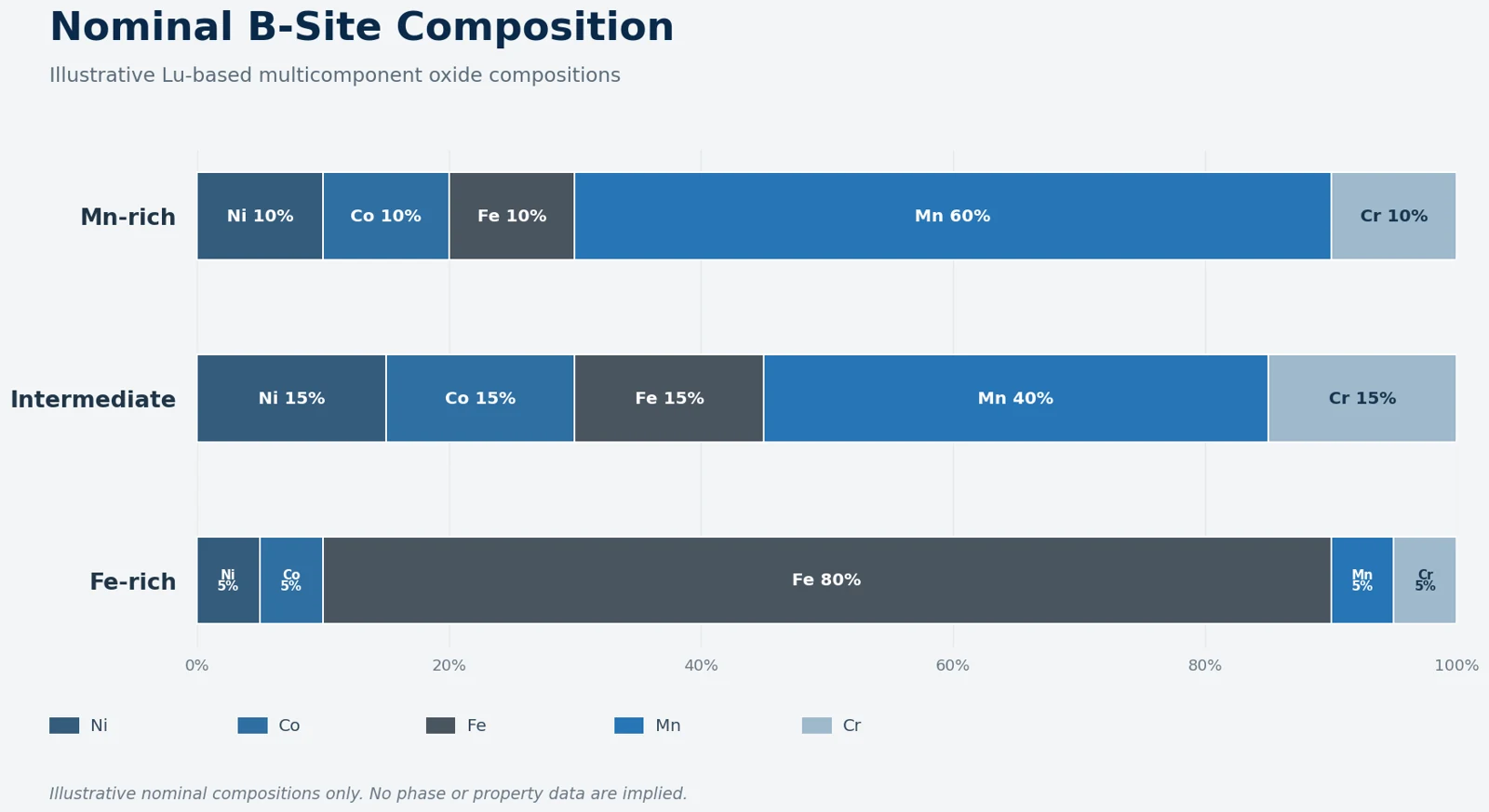
In this notation, Lu occupies the nominal A position and the Ni-Co-Fe-Mn-Cr mixture occupies the nominal B position. These are composition labels: an ABO3 formula alone does not demonstrate a perovskite structure, actual site occupancy, or a single phase.
State whether ratios are cation atomic fractions, oxide molar fractions, or mass fractions. For example, Mn = 0.60 means 60% of the nominal B cations, not 60% of all atoms or 60 wt%. With Lu:B = 1:1, it corresponds to 30% of all cations. Use XRD and, where needed, complementary characterization to assess phase identity and secondary phases within the methods' detection limits. Processing atmosphere, oxidation states, ionic size, and synthesis history can affect phase formation [1].
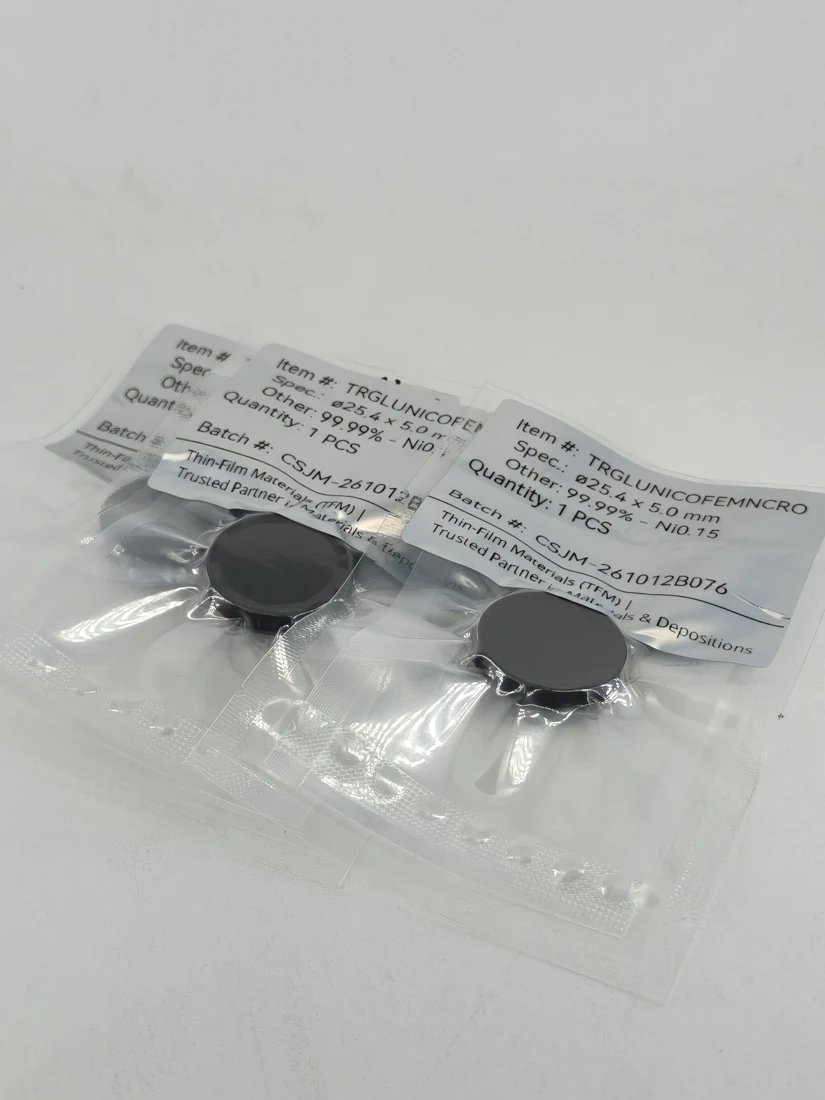
Multicomponent and high entropy oxide terminology
For an ideal random mixture on a single cation sublattice, Sconfig = -R Σ(xi ln xi), where xi is each species' site fraction and R is the gas constant. The values below are normalized per mole of nominal B sites and describe only that sublattice. They assume random occupation and are not measured entropies.
Multicomponent oxide and compositionally complex oxide are appropriate terms for these examples. To use a high-entropy classification, state the entropy definition and normalization. Entropy stabilization requires further thermodynamic evidence; element count and an ideal-mixing calculation alone cannot confirm a stable single phase [1].
| Ni / Co / Fe / Mn / Cr site fractions | Ideal Sconfig / R per mole of B sites |
|---|---|
| 0.1/0.1/0.1/0.6/0.1 | 1.2275 |
| 0.15/0.15/0.15/0.4/0.15 | 1.5048 |
| 0.05/0.05/0.8/0.05/0.05 | 0.7777 |
Calculated ideal B-sublattice mixing values. The nominal ratios sum to one; actual site disorder and phase constitution require characterization.
How cation ratios influence oxide properties
Crystal structure and phase stability
Ni, Co, Fe, Mn, and Cr differ in ionic size, accessible oxidation states, and coordination preferences. Their relative amounts can shift the balance among structures, distortions, and secondary phases. A Mn-rich target may therefore have a different phase assemblage from an Fe-rich target containing the same elements. Where phase identity is critical, agree on the XRD method and acceptance criterion before ordering.
Oxidation states and charge balance
For nominal LuBO3 with Lu3+, O2-, and fully occupied cation sites, charge neutrality requires an average B-cation valence of +3. The individual Ni, Co, Fe, Mn, and Cr valences can differ; their weighted average must satisfy the composition's charge balance.
Charge balance can change through coupled changes in cation valence and charged defects, including oxygen or cation vacancies. Local distortion can accompany these changes, but distortion by itself does not supply compensating charge. For LuBO3-δ with fixed Lu:B = 1:1 and full cation occupancy, the average B valence is 3 – 2δ. Oxygen content and valence therefore need independent verification when they are part of the research question.
Electrical magnetic and optical behavior
Cation ratios can affect metal-oxygen bonding, orbital occupancy, carrier localization, magnetic exchange, optical absorption, and defect energetics [1]. Conductivity, magnetic response, and optical performance must be measured for the intended film and processing conditions; the example formulas alone cannot predict them.
Stoichiometry during sputter deposition
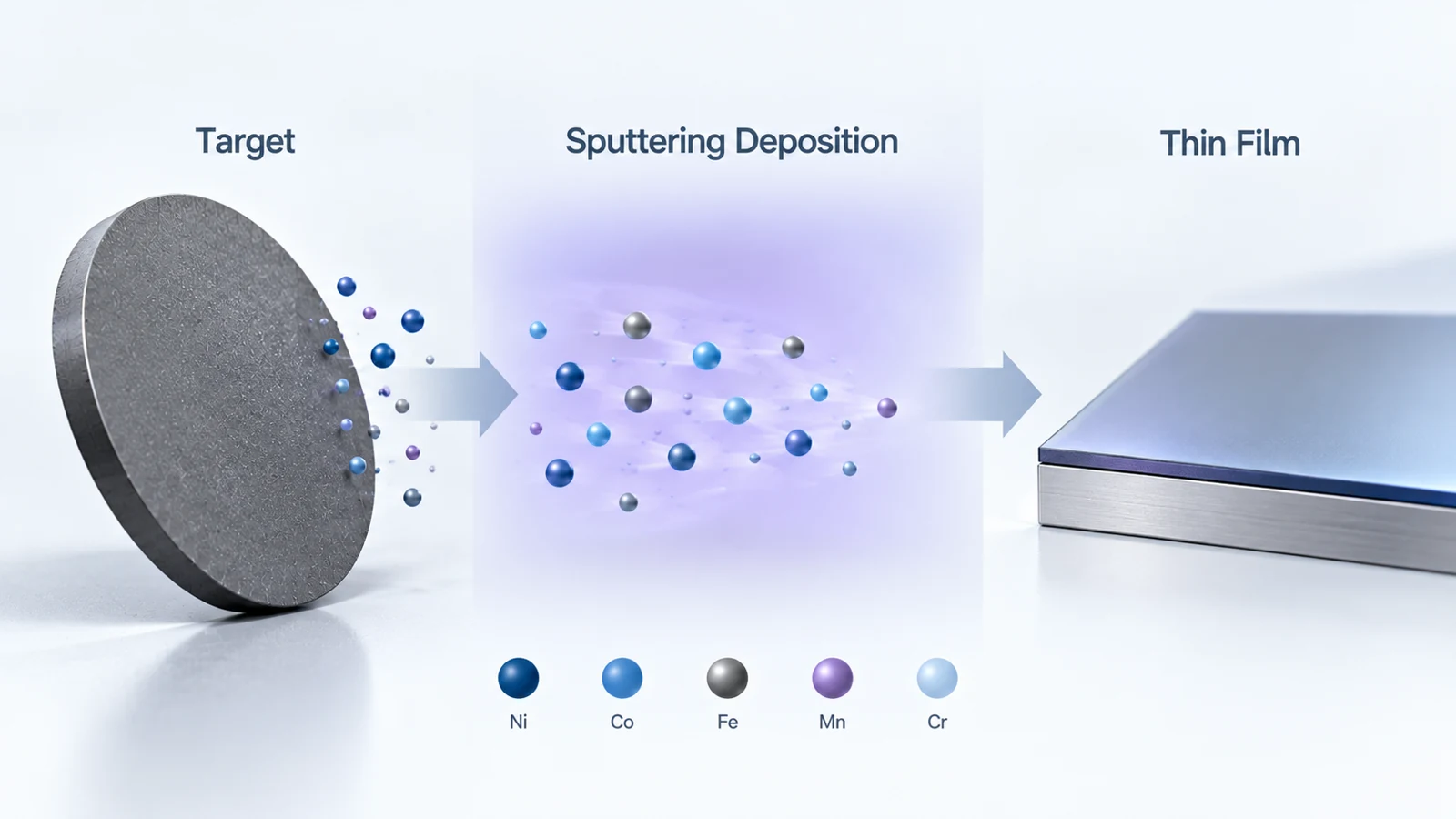
Keep separate records for the nominal target chemistry, measured target chemistry, and film composition. A bulk target certificate does not establish the deposited film's cation ratio or oxygen content.
For systems such as indium gallium zinc oxide targets, state the intended cation ratio explicitly and use the same normalization when comparing target and film measurements.
Elemental sputtering and transport
Sputtering yields and emission distributions can vary by element. Gas-phase scattering, re-sputtering, and losses during film growth can then shift the ratios incorporated into the film. Both the direction and extent of a deviation depend on the material and deposition conditions.
Tao et al. studied NdBa2Cu3O7-x films deposited from a compound target by inverted cylindrical sputtering. Moving the substrate reduced thickness and composition deviations [2]. Their result demonstrates geometry-dependent transfer in that system, without quantifying the behavior of the Lu-based examples here.
Oxygen partial pressure
Oxygen partial pressure can affect oxygen vacancies, cation oxidation states, target surface chemistry, deposition rate, and film phase. To interpret composition changes, record it together with total pressure, gas flows, power conditions, and substrate temperature.
Musil et al. discuss oxygen supply and process stability in reactive magnetron sputtering [3]. A preformed oxide target presents a different starting condition, though oxygen-sensitive films can still need control of the Ar/O2 mixture. Determine the process window for the intended material and tool.
Substrate temperature and annealing
Substrate temperature affects surface mobility and nucleation. Annealing afterward can change crystallinity, phase fractions, oxygen content, cation distribution, and defects. Film comparisons need a record of the annealing atmosphere, temperature, and duration.
Compare the measured target composition with the as-deposited film, then check for changes after annealing. These separate measurements help trace deviations to target preparation, deposition, or post-deposition treatment.
Specifying custom oxide sputtering targets
Begin with the formula, ratio basis, and acceptance measurements. TFM's ceramic sputtering target catalog provides material families to reference during an RFQ.
Custom target RFQ checklist
- Nominal formula, ratio basis, and any critical per-element tolerance
- Purity basis and named impurity limits, separate from intentional constituents
- Target drawing or dimensions, tolerances, cathode model, and quantity
- Measured density and method, or a defined porosity requirement, if critical
- Phase identity and XRD acceptance criteria, when required
- Backing plate drawing and bonding requirements, if needed
- Sampling plan, agreed analytical methods, and lot-linked documentation
| Parameter | What to Specify | Why It Matters |
|---|---|---|
| Nominal chemistry | Full formula and cation atomic, oxide molar, or mass basis | Makes the composition interpretable |
| Composition tolerance | Per-element limits and reporting basis | Defines acceptable deviation |
| Purity | Metals or other stated basis and named impurity limits | Separates intentional constituents from impurities |
| Geometry and source | Drawing, tolerances, and cathode model | Defines the mechanical interface |
| Density and porosity | Measured value and method; reference density if relative | Makes densification criteria comparable |
| Phase requirement | Required phases and agreed XRD criterion | Separates chemistry from structure |
| Surface condition | Required finish and inspection method | Defines an inspectable surface requirement |
| Backing and bonding | Plate drawing, finished height, and reviewed bond system | Defines support, cooling, and installed fit |
| Verification | Sampling, analytical methods, limits, and lot identity | Connects acceptance evidence to the supplied target |
| Quantity | Pieces for each composition and revision | Keeps a composition series traceable |
Composition-specific examples include barium cerium yttrium zirconate targets and Pr0.7Ca0.3MnO3 targets. For either material, confirm the required ratio, phase, dimensions, and acceptance evidence for the order.
For mechanical details, use the sputtering target drawing checklist to distinguish target thickness from finished assembly height and define the cathode interface.
When a backing plate is needed, review target bonding and backing plate requirements alongside target brittleness, cooling, and mounting geometry. Specify a bonding method only after checking its suitability for the assembly.
Verifying composition phase and density
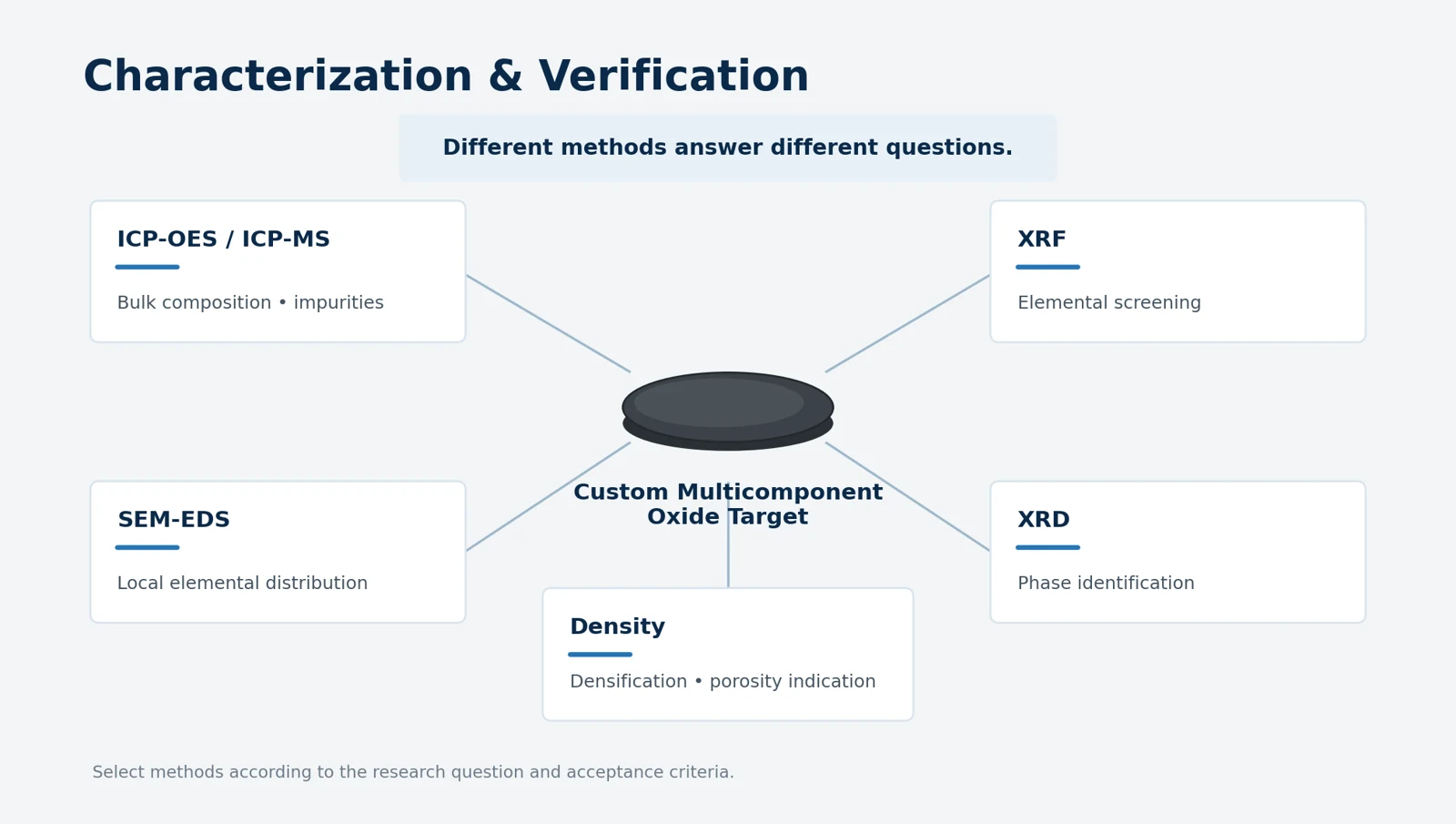
No single measurement covers composition, phase identity, local elemental distribution, and density. ICP-OES or ICP-MS with suitable sample preparation, or calibrated XRF, can assess elemental chemistry. SEM-EDS examines local distribution; XRD identifies crystalline phases. For each required measurement, agree on sampling, calibration, the reporting basis, and acceptance limits.
| Method | Primary Use | Important Limitation |
|---|---|---|
| ICP-OES / ICP-MS | Quantitative elemental composition and trace impurities | Validated preparation and calibration are required; no phase identity |
| XRF | Bulk elemental composition where suitable | Matrix, calibration, and element range limit accuracy |
| SEM-EDS | Local elemental distribution and segregation screening | Samples local regions; quantification depends on calibration and conditions |
| XRD | Phase identification and crystallographic analysis | Minor or amorphous phases may be missed; not a bulk cation-ratio measurement |
| Density measurement | Densification and porosity-related assessment | Method and reference density must be stated; does not prove phase purity |
XPS probes surface chemical states. XANES can provide element-specific information about oxidation state and local environment. Neither is a universal direct measure of bulk oxygen stoichiometry, so choose an oxygen-analysis method that suits the material, sample form, and required uncertainty.
Frequently asked questions
Can a multicomponent oxide target be customized
You can propose a custom nominal cation ratio for review. Whether it is feasible depends on precursor compatibility, phase formation, densification, machining, and the agreed composition tolerance. Confirm the achievable specification and verification plan before ordering.
Will the film match the target composition
The film can differ because sputtering, transport, re-sputtering, oxygen activity, and substrate conditions affect incorporation. Compare target and film measurements on the same reporting basis when composition is critical.
How does oxygen pressure affect oxide deposition
It can change oxygen content, cation valence, phase formation, and deposition behavior. Determine an acceptable range experimentally for the material, chamber, and required film properties.
What purity and density should the RFQ specify
Specify the impurities that matter to the experiment and whether purity is reported on a metals basis or another basis. State the density measurement method and acceptance limit as well. If you use a percentage of theoretical density, include the reference density and phase assumption.
How should a custom composition be verified
Agree on representative sampling and validated analytical methods. ICP or calibrated XRF can address bulk elemental ratios; SEM-EDS examines local variation, and XRD assesses crystalline phases. Oxygen content and oxidation state may need additional measurements.
Preparing a composition controlled experiment
- Compare nominal ratios, target measurements, and film measurements using a consistent basis.
- Record deposition and annealing conditions for every composition in the series.
- Put critical chemistry, dimensions, phase criteria, density, bonding, and verification requirements into the RFQ.
Request a custom oxide target review
Send the nominal formula, ratio basis, purity requirement, drawing, quantity, bonding needs, and acceptance measurements through the TFM contact form or email sales@thinfilmmaterials.com. Include the cathode model and any existing target or backing plate drawing so TFM can review feasibility and quotation requirements.
Technical references
[1] Liu, C. et al. “Advances in high entropy oxides: synthesis, structure, properties and beyond.” Progress in Materials Science 148 (2025), 101385. DOI: 10.1016/j.pmatsci.2024.101385.
[2] Tao, B.W. et al. “Uniformity and stoichiometry of large-area multicomponent oxide thin films deposited by sputtering.” Thin Solid Films 485 (2005), 47-52. DOI: 10.1016/j.tsf.2005.03.013.
[3] Musil, J. et al. “Reactive magnetron sputtering of thin films: present status and trends.” Thin Solid Films 475 (2005), 208-218. DOI: 10.1016/j.tsf.2004.07.041.