A sputtering target certificate of analysis (CoA) is useful only when you can connect its reported results to the material you ordered and the requirements you agreed with the supplier. For procurement and incoming inspection, the key questions are: Does this document identify the correct target and lot? What does the stated purity include? And does the documentation address your specified acceptance criteria?
This guide explains how to review a sputtering target CoA using TFM’s public HfO2 CoA example and material-specific documentation guidance. Treat the examples as reference points—not as a promise that every target order includes the same reports or acceptance limits.

1. Match the certificate to the ordered target
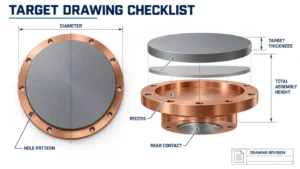
Start with identity and traceability before reviewing the purity figure. TFM’s public HfO2 sputtering target CoA example includes product identity, target dimensions, backing plate and keeper details, and a lot number.
Compare those entries with your purchase order and agreed specification. For receiving inspection, use a checklist such as the following:
| Item to review | What to compare |
|---|---|
| Product identity | The material named on the certificate versus the material ordered. |
| Lot number | The certificate’s lot reference versus the identifiers supplied with the shipment. |
| Target dimensions | The listed dimensions versus the agreed drawing or purchase specification. |
| Backing plate and keeper details | The listed configuration versus the ordered assembly, where applicable. |
| Purity and impurity results | The reported values and reporting basis versus your agreed chemical requirements. |
If identifiers or configurations do not match, ask the supplier to resolve the discrepancy before using the certificate as acceptance evidence. A purity result alone does not resolve an identity mismatch.
2. Establish what the purity percentage means
Do not compare purity percentages without first checking their reporting basis. TFM’s niobium sputtering target guidance describes different possible bases, including Nb only, Nb plus Ta, or a basis excluding gaseous impurities. It also notes that critical impurity limits need to be specified separately.
For a niobium target, ask whether tantalum is included in the stated purity and whether gaseous impurities are excluded. If the certificate does not make that basis clear, request clarification rather than assuming that two identical percentages describe equivalent material.
For other materials, apply the same review principle: ask the supplier to define what is included in—and excluded from—the reported purity. Record that definition alongside the numerical requirement in your purchasing specification.
3. Read the impurity table, not just the headline number
The public HfO2 CoA example lists 99.99% purity and total impurities below 100 ppm, along with an impurity table. These values belong to that product-specific example; they are not universal acceptance limits for sputtering targets.
Review any reported impurity entries against your agreed requirements. In particular, distinguish an overall purity or total-impurity requirement from limits on individual impurities that matter to your application.
- Check the units shown for each result and requirement.
- Identify any separately specified impurity limits.
- Compare each relevant reported result with its corresponding limit.
- Ask for clarification if an entry, notation, or reporting basis is ambiguous.
- Do not treat an unlisted impurity as a confirmed zero result.
Where your specification requires a result that is absent from the certificate, flag the documentation gap rather than inferring compliance from the headline purity.
4. Separate CoA information from supporting reports
A chemical purity entry should not be used as a substitute for other documentation requested in the purchase specification. For example, TFM’s germanium sputtering target documentation can include a CoA, dimensional inspection report, resistivity report, lot traceability, and bonding record when specified.
If your order calls for dimensional inspection, resistivity information, or a bonding record, check that the corresponding documentation has been supplied and can be associated with the ordered material. Do not assume these reports accompany every order.
For a broader review beyond certificate reading, see how to evaluate high-purity sputtering target quality.
5. Resolve missing information before acceptance
Make your review actionable by recording each unresolved item and the clarification needed. Useful supplier questions include:
- Which lot does this certificate cover?
- What is the basis of the stated purity?
- Are the separately specified impurity limits addressed in the supplied results?
- Which supporting reports were included in the order requirements, and have they been supplied?
- Can any mismatch in dimensions or assembly details be explained or corrected?
The same checklist can help before placing an order. Specify the purity basis, critical impurity limits, required identifiers, and supporting reports in advance so that both purchasing and receiving teams know what documentation to expect.
CoA review: the practical takeaway
Read a sputtering target purity certificate as evidence against an agreed specification—not as a standalone assurance based on one percentage. Match the material and lot, establish the purity basis, review relevant impurity results, and confirm any separately requested reports. If the supplied documentation leaves a requirement unresolved, seek clarification before making an acceptance decision.