
Introduction
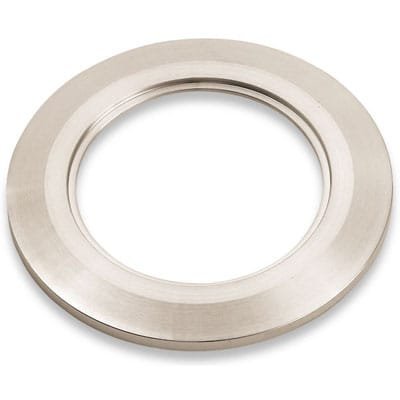
Bored KF (QF) HV Stainless Steel Flanges (Inch Tube) are precision vacuum components designed to connect inch-sized tubing to standard KF/QF high-vacuum flange systems. These flanges are widely used in laboratory vacuum setups, semiconductor processing equipment, thin film deposition systems, and analytical instruments where quick assembly and reliable vacuum sealing are required.
The bored flange design allows the flange to be welded directly onto vacuum tubing, creating a strong and leak-tight connection that integrates seamlessly with KF quick-clamp fittings. This configuration simplifies system assembly while maintaining high vacuum performance and mechanical stability.
Detailed Description
Bored KF (QF) HV Stainless Steel Flanges are manufactured from high-quality stainless steel—typically 304 or 316L stainless steel—to provide excellent corrosion resistance, mechanical strength, and vacuum compatibility. The flange features a central bore specifically machined to match inch-based vacuum tubing, allowing the tube to be inserted and welded directly to the flange.
Once welded, the flange forms a permanent and vacuum-tight connection between the tubing and the KF vacuum system. This design eliminates the need for additional adapters and helps maintain smooth internal flow paths within the vacuum line.
The KF (Klein Flange) / QF (Quick Flange) system is widely used in high-vacuum applications due to its convenience and reliability. The sealing mechanism uses a centering ring with an elastomer O-ring, typically made from Viton or other vacuum-compatible materials, and is secured using a quick-release clamp. This design allows vacuum components to be assembled or disassembled rapidly without specialized tools.
Bored KF flanges are commonly used when constructing custom vacuum lines or integrating tubing into existing vacuum systems. Their compact design and standardized dimensions ensure compatibility with most vacuum components used in research laboratories and industrial equipment.
These flanges are available in multiple sizes corresponding to standard KF flange dimensions such as KF16, KF25, KF40, and KF50, and the bore size is matched to the appropriate inch tube diameter.
Applications
Bored KF (QF) HV Stainless Steel Flanges are widely used in vacuum systems across many industries:
Thin film deposition systems – vacuum chambers for sputtering and evaporation processes.
Semiconductor manufacturing equipment – vacuum piping connections in fabrication systems.
Analytical instruments – mass spectrometers, electron microscopes, and surface analysis systems.
Research laboratory vacuum setups – modular vacuum lines used in experimental environments.
Cryogenic and gas handling systems – vacuum-compatible tubing connections.
Vacuum furnaces and coating equipment – integration of tubing into vacuum assemblies.
Technical Parameters
| Parameter | Typical Value / Range | Importance |
|---|---|---|
| Material | 304 / 316L Stainless Steel | Provides corrosion resistance and vacuum compatibility |
| Flange Type | KF / QF Standard | Compatible with standard quick-clamp vacuum systems |
| Tube Compatibility | Inch Tube Sizes | Designed for welding to inch-diameter vacuum tubing |
| Surface Finish | Vacuum-grade machined finish | Minimizes outgassing and contamination |
| Vacuum Range | Rough to High Vacuum | Suitable for laboratory and industrial vacuum systems |
Comparison with Related Vacuum Flanges
| Flange Type | Key Advantage | Typical Application |
|---|---|---|
| Bored KF (QF) Flange | Direct weld connection to tubing | Laboratory and modular vacuum systems |
| Standard KF Flange | Simple quick-clamp assembly | General vacuum equipment |
| CF (ConFlat) Flange | Ultra-high vacuum sealing | UHV systems and research instruments |
| ISO-K Flange | Large-diameter vacuum lines | Industrial vacuum systems |
FAQ
| Question | Answer |
|---|---|
| What does “bored KF flange” mean? | It means the flange has a central bore designed to accept vacuum tubing so that the tube can be welded directly to the flange. |
| Which tubing sizes are compatible? | The bore is typically matched to standard inch tube sizes used in vacuum systems. |
| What sealing method does KF use? | KF flanges use a centering ring with an elastomer O-ring and a quick clamp to form a vacuum-tight seal. |
| Are different materials available? | Yes, most flanges are made from 304 stainless steel, while 316L stainless steel can be provided for enhanced corrosion resistance. |
| What vacuum range are these flanges suitable for? | KF flanges are commonly used in rough vacuum, medium vacuum, and high-vacuum systems. |
Packaging
Our Bored KF (QF) HV Stainless Steel Flanges are carefully cleaned and packaged to meet vacuum system cleanliness standards. Each component is individually sealed in protective packaging to prevent contamination and mechanical damage during storage and transportation. All items are clearly labeled for easy identification and quality traceability.
Conclusion
Bored KF (QF) HV Stainless Steel Flanges (Inch Tube) provide a reliable and convenient solution for integrating inch-sized tubing into KF vacuum systems. Their robust stainless steel construction, compatibility with standard quick-clamp fittings, and weldable design make them ideal for laboratory vacuum systems, semiconductor equipment, and thin film deposition systems.
With precision machining, vacuum-grade materials, and customizable dimensions, these flanges ensure dependable performance in both research and industrial vacuum environments.
For detailed specifications and a quotation, please contact us at sales@thinfilmmaterials.com.
Ordering Table
| Flange Size/OD | Type | Flange Material | Drawing | Part Number |
| KF10 (1.18" OD) | Bored | 304L SS |

| QF10-025-SBB |
| KF10 (1.18" OD) | Bored | 304L SS |
| QF10-050-SBB |
| KF16 (1.18" OD) | Bored | 304L SS |
| QF16-025-SBB |
| KF16 (1.18" OD) | Bored | 304L SS |
| QF16-037-SBB |
| KF16 (1.18" OD) | Bored | 304L SS |
| QF16-050-SBB |
| KF16 (1.18" OD) | Bored | 304L SS |
| QF16-075-SBB |
| KF25 (1.57" OD) | Bored | 304L SS |
| QF25-025-SBB |
| KF25 (1.57" OD) | Bored | 304L SS |
| QF25-037-SBB |
| KF25 (1.57" OD) | Bored | 304L SS |
| QF25-050-SBB |
| KF25 (1.57" OD) | Bored | 304L SS |
| QF25-075-SBB |
| KF25 (1.57" OD) | Bored | 304L SS |
| QF25-100-SBB |
| KF40 (2.16" OD) | Bored | 304L SS |
| QF40-025-SBB |
| KF40 (2.16" OD) | Bored | 304L SS |
| QF40-037-SBB |
| KF40 (2.16" OD) | Bored | 304L SS |
| QF40-050-SBB |
| KF40 (2.16" OD) | Bored | 304L SS |
| QF40-075-SBB |
| KF40 (2.16" OD) | Bored | 304L SS |
| QF40-100-SBB |
| KF40 (2.16" OD) | Bored | 304L SS |
| QF40-150-SBB |
| KF50 (2.95" OD) | Bored | 304L SS |
| QF50-025-SBB |
| KF50 (2.95" OD) | Bored | 304L SS |
| QF50-050-SBB |
| KF50 (2.95" OD) | Bored | 304L SS |
| QF50-075-SBB |
| KF50 (2.95" OD) | Bored | 304L SS |
| QF50-100-SBB |
| KF50 (2.95" OD) | Bored | 304L SS |
| QF50-150-SBB |
| KF50 (2.95" OD) | Bored | 304L SS |
| QF50-200-SBB |
Accessories Table
| Description | For | Per Package | Part Number | Price |
| Cast Clamps (SS) | KF10, KF16 Flanges | 1 | QF16-075-CS | $62.25 |
| Cast Clamps (SS) | KF25 Flanges | 1 | QF25-100-CS | $68.85 |
| Cast Clamps (SS) | KF40 Flanges | 1 | QF40-150-CS | $75.00 |
| Cast Clamps (SS) | KF50 Flanges | 1 | QF50-200-CS | $90.00 |
| Cast Clamps (Aluminum) | KF10, KF16 Flanges | 1 | QF16-075-C | $6.95 |
| Cast Clamps (Aluminum) | KF25 Flanges | 1 | QF25-100-C | $8.80 |
| Cast Clamps (Aluminum) | KF40 Flanges | 1 | QF40-150-C | $10.15 |
| Cast Clamps (Aluminum) | KF50 Flanges | 1 | QF50-200-C | $16.60 |
| Lever Clamps (Aluminum) | KF10, KF16 Flanges | 1 | QF16-075-CHA | $52.85 |
| Lever Clamps (Aluminum) | KF25 Flanges | 1 | QF25-100-CHA | $75.00 |
| Lever Clamps (Aluminum) | KF40 Flanges | 1 | QF40-150-CHA | $87.65 |
| Centering Ring (SS with Fluorocarbon O-Ring) | KF10 Flanges | 1 | QF10-050-SRV | $7.75 |
| Centering Ring (SS with Fluorocarbon O-Ring) | KF16 Flanges | 1 | QF16-075-SRV | $8.55 |
| Centering Ring (SS with Fluorocarbon O-Ring) | KF25 Flanges | 1 | QF25-100-SRV | $11.25 |
| Centering Ring (SS with Fluorocarbon O-Ring) | KF40 Flanges | 1 | QF40-150-SRV | $13.50 |
| Centering Ring (SS with Fluorocarbon O-Ring) | KF50 Flanges | 1 | QF50-200-SRV | $19.50 |
| Description | For | Per Package | Part Number | Price |

Reviews
There are no reviews yet.