
Introduction
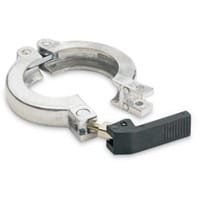
KF (QF) HV Lever Clamps made from aluminum and polymer are practical vacuum hardware components designed for quick, reliable connection of KF flange systems in high-vacuum applications. These clamps are widely used where fast assembly, frequent maintenance, and secure sealing are important. Compared with more conventional fastening methods, lever clamps simplify installation and removal, making them especially useful in laboratory systems, pilot equipment, and production lines that require regular access to the vacuum chamber or piping network.
Detailed Description
KF (QF) HV Lever Clamps are engineered to join two KF flanges together with a centering ring and O-ring, creating a dependable vacuum seal with minimal installation effort. The lever-style mechanism allows operators to secure or release the connection rapidly without the need for extensive tooling, which helps reduce downtime during cleaning, component replacement, or system reconfiguration.
The aluminum body offers a good balance of strength, low weight, and corrosion resistance, making the clamp easy to handle while still providing the mechanical support needed for stable flange connections. The polymer lever or grip section improves usability by enhancing operator comfort and helping with quick manual actuation. This combination of aluminum and polymer is particularly suitable for vacuum environments where clean handling, repeatable clamping force, and convenient maintenance are priorities.
In real vacuum systems, the quality of a lever clamp affects more than just assembly speed. A well-machined clamp helps maintain even compression on the flange connection, which supports sealing performance and reduces the chance of leaks caused by uneven loading. For systems that are opened and closed frequently, lever clamps can also improve workflow efficiency while reducing wear associated with repeated use of standard nut-and-bolt style connections.
These KF (QF) HV Lever Clamps are typically compatible with standard KF flange sizes and are used together with centering rings, O-rings, and other KF vacuum fittings. They are suitable for a broad range of rough vacuum and high-vacuum systems in research, industrial coating, analytical instrumentation, and general vacuum processing.
Applications
KF (QF) HV Lever Clamps are commonly used in the following areas:
Vacuum coating systems for fast connection of pumps, chambers, and gas lines
Laboratory vacuum setups where components are frequently removed or reconfigured
Analytical instruments such as mass spectrometry and leak detection systems
Semiconductor and thin film equipment requiring clean, modular vacuum connections
R&D and pilot-scale vacuum systems where rapid maintenance access is important
General industrial vacuum lines for pumps, traps, gauges, and valve assemblies
Technical Parameters
| Parameter | Typical Value / Range | Importance |
|---|---|---|
| Material | Aluminum body + Polymer lever/grip | Combines low weight, durability, and user-friendly handling |
| Standard | KF / QF vacuum flange compatible | Ensures fit with common vacuum hardware systems |
| Nominal Sizes | KF10 – KF50 | Covers common small to medium vacuum line connections |
| Operation | Quick lever-lock mechanism | Enables fast installation and removal |
| Application Pressure | Rough vacuum to high vacuum | Suitable for a wide range of vacuum systems |
| Reusability | Repeated opening and closing | Supports maintenance-intensive applications |
| Surface Condition | Machined, clean vacuum hardware finish | Helps ensure proper fit and reliable clamping |
| Compatible Components | KF flanges, centering rings, O-rings | Required for complete sealed connection |
Comparison with Related Materials
| Material / Type | Key Advantage | Typical Application |
|---|---|---|
| KF (QF) HV Lever Clamps (Aluminum & Polymer) | Fast manual operation and lightweight handling | Lab systems, frequently opened vacuum lines |
| Standard KF Clamp | Simple and widely used | General-purpose vacuum connections |
| Stainless Steel KF Clamp | Higher durability and chemical resistance | More demanding industrial environments |
| Hinged KF Clamp | Easy installation with compact structure | Routine vacuum assembly work |
FAQ
| Question | Answer |
|---|---|
| Are these lever clamps compatible with standard KF fittings? | Yes. They are designed for standard KF (QF) flange systems and are used with matching centering rings and seals. |
| What is the main benefit of a lever clamp? | The main advantage is faster installation and removal, which is useful for systems requiring frequent maintenance or reconfiguration. |
| Can these clamps be reused many times? | Yes. They are intended for repeated use under normal vacuum hardware operating conditions. |
| Are aluminum and polymer suitable for vacuum service? | Yes. This combination is commonly used for lightweight, easy-to-handle clamp assemblies in vacuum systems. |
| Which flange sizes are typically available? | Typical sizes range from KF10 to KF50, with other options depending on system requirements. |
Packaging
Our KF (QF) HV Lever Clamps (Aluminum & Polymer) are meticulously tagged and labeled externally to ensure efficient identification and maintain high standards of quality control. We take great care to prevent any potential damage during storage and transportation, ensuring the products arrive in perfect condition.
Conclusion
KF (QF) HV Lever Clamps made from aluminum and polymer provide a convenient and efficient solution for connecting KF vacuum flanges in high-vacuum systems. Their lightweight construction, quick-release design, and compatibility with standard KF hardware make them a practical choice for laboratories, coating systems, analytical equipment, and general vacuum applications.
For detailed specifications and a quotation, please contact us at [sales@thinfilmmaterials.com].
Ordering Table
| Drawing | Flange OD | Material | Part Number |
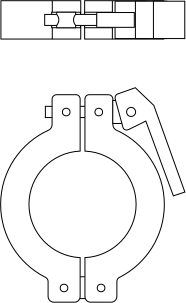
| KF10-KF16 | Aluminum | QF16-075-CHA |
|
| KF25 | Aluminum | QF25-100-CHA |
|
| KF40 | Aluminum | QF40-150-CHA |
|
| KF10-KF16 | Polymer | QF16-075-CHP |
|
| KF25 | Polymer | QF25-100-CHP |
|
| KF40 | Polymer | QF40-150-CHP |
|
| KF50 | Polymer | QF50-200-CHP |


Reviews
There are no reviews yet.