
Introduction
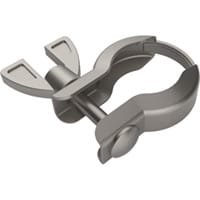
KF (QF) HV Horseshoe (Spring Clamps) with Wing Nut are essential vacuum hardware components designed to connect KF (Quick Flange) vacuum fittings quickly and securely. These clamps are widely used in high vacuum (HV) systems where fast assembly, reliable sealing, and easy maintenance are required.
The horseshoe-shaped clamp combined with a spring-loaded mechanism and wing nut tightening system allows vacuum connections to be installed or removed without special tools. This makes them highly suitable for laboratory vacuum setups, research systems, and industrial vacuum equipment such as thin film deposition systems, vacuum pumps, and analytical instruments.
Detailed Description
KF (also known as QF) flange systems are standardized vacuum connection solutions commonly used in high vacuum environments ranging from rough vacuum down to approximately 10⁻⁸ mbar. The KF horseshoe clamp plays a critical role in securing two KF flanges together with a centering ring and O-ring seal.
The horseshoe-shaped clamp body is typically manufactured from stainless steel or zinc-plated steel, offering high mechanical strength and corrosion resistance. A spring mechanism provides constant tension during operation, ensuring consistent clamping force and maintaining vacuum integrity even under vibration or thermal cycling.
The integrated wing nut fastener allows operators to tighten or release the clamp quickly by hand, eliminating the need for additional tools. This design is particularly convenient in systems that require frequent assembly or maintenance.
KF horseshoe clamps are compatible with standard KF flange sizes such as KF10, KF16, KF25, KF40, and KF50, making them a versatile component in modular vacuum systems. When used with a centering ring and elastomer O-ring (commonly Viton®), they form a reliable vacuum seal suitable for many laboratory and industrial applications.
Applications
KF horseshoe spring clamps are widely used across vacuum technology fields:
Vacuum pump connections in laboratory and industrial systems
Thin film deposition equipment, including sputtering and evaporation systems
Semiconductor processing equipment
Mass spectrometers and analytical instruments
Research laboratory vacuum systems
General high-vacuum piping and component connections
Technical Parameters
| Parameter | Typical Value / Range | Importance |
|---|---|---|
| Clamp Type | Horseshoe spring clamp with wing nut | Enables quick manual tightening |
| Compatible Flanges | KF (QF) standard sizes | Ensures system compatibility |
| Material | Stainless steel / Zinc-plated steel | Provides strength and corrosion resistance |
| Sealing Method | Centering ring with elastomer O-ring | Ensures leak-tight vacuum sealing |
| Operating Vacuum Range | Atmospheric to ~10⁻⁸ mbar | Suitable for high vacuum systems |
| Typical Sizes | KF10 – KF50 | Covers common laboratory vacuum connections |
Comparison with Related Vacuum Clamps
| Clamp Type | Key Advantage | Typical Application |
|---|---|---|
| KF Horseshoe Clamp with Wing Nut | Quick manual operation and strong spring tension | Laboratory vacuum systems |
| KF Quick Clamp | Fast installation with simple design | General vacuum connections |
| ISO Clamp | Larger flange connections with higher conductance | Large vacuum chambers |
FAQ
| Question | Answer |
|---|---|
| What is the purpose of the spring in the horseshoe clamp? | The spring maintains constant clamping force, helping ensure a reliable vacuum seal even during vibration or thermal changes. |
| Are these clamps compatible with all KF flanges? | Yes. They are designed to work with standard KF (QF) flange sizes such as KF16, KF25, KF40, and KF50. |
| Do the clamps require tools for installation? | No. The wing nut design allows the clamp to be tightened or loosened by hand. |
| What sealing components are required with the clamp? | A centering ring and O-ring seal are required between the KF flanges to create a vacuum-tight connection. |
| What materials are commonly used for the clamps? | Most clamps are made from stainless steel or zinc-plated steel to provide durability and corrosion resistance. |
Packaging
Our KF (QF) HV Horseshoe (Spring Clamps) with Wing Nut are meticulously tagged and labeled externally to ensure efficient identification and maintain high standards of quality control. Each clamp is carefully packaged in protective materials and sealed packaging to prevent surface damage or contamination during storage and transportation.
Conclusion
KF (QF) HV Horseshoe (Spring Clamps) with Wing Nut provide a simple and reliable solution for connecting KF vacuum flanges in high vacuum systems. Their durable construction, spring-loaded clamping mechanism, and tool-free operation make them ideal for laboratory and industrial vacuum setups.
With compatibility across standard KF flange sizes and dependable sealing performance, these clamps remain an essential component for efficient vacuum system assembly and maintenance.
For detailed specifications and a quotation, please contact us at sales@thinfilmmaterials.com.
Ordering Table
| Drawing | Flange OD | Material | Dim A | Dim B | Dim C | Part Number |
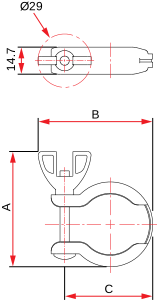
| KF10-KF16 | Stainless Steel | 2.17 | 2.13 | 1.57 | QF16-075-HC |
|
| KF25 | Stainless Steel | 2.48 | 2.44 | 1.89 | QF25-100-HC |
|
| KF40 | Stainless Steel | 3.03 | 2.99 | 2.44 | QF40-150-HC |
|
| KF50 | Stainless Steel | 3.78 | 3.90 | 3.31 | QF50-200-HC |

Reviews
There are no reviews yet.