
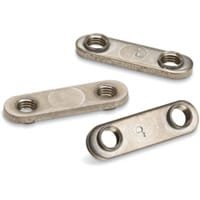
Imperial Plate Nuts (Clearance Flanges)
TFM’s Imperial Plate Nuts (Clearance Flanges) are precision-engineered components designed for use in ultra-high vacuum (UHV), semiconductor, and industrial vacuum systems. These plate nuts provide a reliable and reusable fastening solution for flange assemblies with clearance holes, ensuring strong mechanical connections and consistent sealing performance.
Key Features
Designed for Clearance Flanges
Specifically manufactured for use with clearance flange systems, TFM’s Imperial Plate Nuts (Clearance Flanges) are ideal for applications where flange holes are not threaded. These nuts support bolt pass-through from the mating flange, creating secure joints that can withstand repeated assembly.Imperial Thread Sizing
Offered in standard imperial sizes such as ¼-20 and 10-32, these plate nuts pair perfectly with TFM’s vented or standard hex bolts in inch-based flange setups.Durable Stainless Steel Construction
Built from corrosion-resistant 304 or 316 stainless steel, these nuts deliver high mechanical strength and vacuum compatibility. Their performance remains stable under high heat, pressure, and UHV conditions.Floating Nut Design for Easy Installation
The floating plate design allows slight movement of the nut for bolt-hole alignment. This reduces installation errors, speeds up assembly, and minimizes cross-threading during equipment servicing or flange changes.Cleanroom & Vacuum Compatible
TFM provides Imperial Plate Nuts (Clearance Flanges) cleaned and vacuum-sealed upon request, making them ready for cleanroom use and critical UHV applications.
Applications
UHV and Vacuum Flange Assemblies
Essential for use in systems utilizing clearance holes, including ConFlat-style flanges or custom vacuum chamber designs.Semiconductor and Thin Film Equipment
Utilized in plasma chambers, PVD tools, and other semiconductor processing environments where precise, clean fastening is required.Research and Laboratory Vacuum Systems
Commonly used in experimental vacuum chambers or beamline equipment where modular flange connections are necessary.Industrial and Aerospace Systems
Durable enough for high-vibration environments and industrial-scale vacuum systems that require imperial-threaded fasteners.
Specifications
Threads: UNC (¼-20, 10-32, etc.)
Materials: 304 or 316 stainless steel
Style: Floating nut plate
Configuration: For use with bolts and clearance hole flanges
Options: Cleaned, vacuum-packaged versions available
Why TFM?
TFM’s Imperial Plate Nuts (Clearance Flanges) are the trusted choice for professionals working in precision vacuum, aerospace, and semiconductor industries. With robust performance, repeatable installation, and UHV compatibility, these nuts ensure your flange assemblies are built to the highest standards.
Ordering Table
| Drawing | Flange OD | Per Package | Thread Size | Dim A | Dim B | Dim C | Part Number |
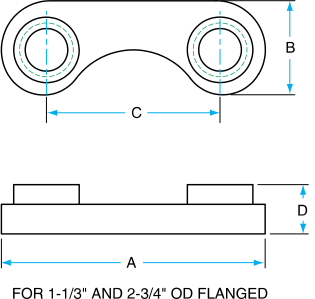
| DN16CF (1.33" OD) | 24 | #8-32 | 0.80 | 0.30 | 0.53 | PN-0133 |
|
| DN35CF-DN40CF (2.75" OD) | 24 | 1/4-28 | 1.66 | 0.50 | 1.16 | PN-0275 |
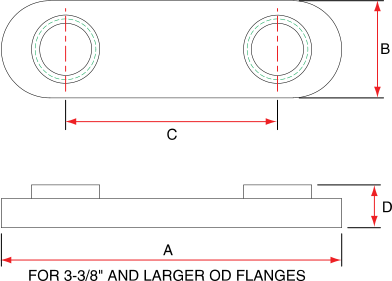
| DN50CF (3.375" OD) | 24 | 5/16-24 | 1.75 | 0.50 | 1.09 | PN-0337 |
|
| DN63CF (4.50" OD) | 24 | 5/16-24 | 2.03 | 0.50 | 1.39 | PN-0450 |
|
| DN100CF (6.00" OD) | 24 | 5/16-24 | 1.64 | 0.50 | 1.00 | PN-0600 |
|
| DN160CF (8.00" OD) | 24 | 5/16-24 | 1.75 | 0.50 | 1.12 | PN-0800 |
|
| DN200CF (10.00" OD) | 24 | 5/16-24 | 1.75 | 0.50 | 1.19 | PN-1000 |


Reviews
There are no reviews yet.