
Introduction
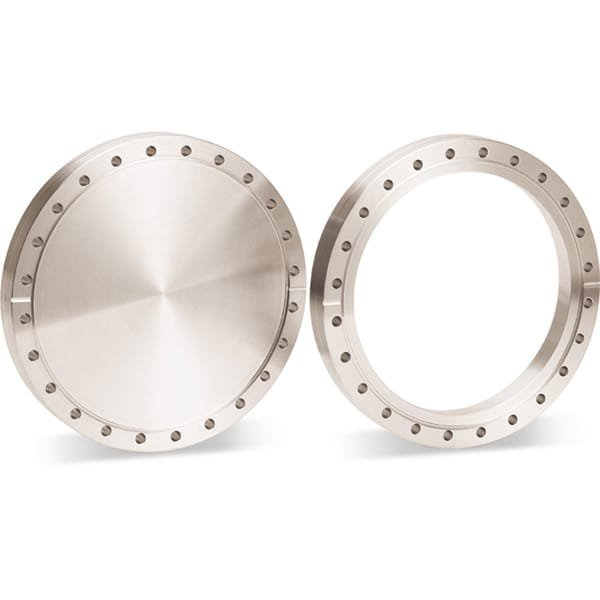
DN100CF (6.00″ OD) 316LN Stainless Steel Standard ConFlat® (CF) UHV Flanges are widely used in ultra-high vacuum systems where leak-tight performance, thermal stability, and long-term reliability are critical. Designed for demanding scientific and industrial environments, these flanges provide a robust metal-to-metal seal that supports pressures down to the UHV range, making them a cornerstone component in modern vacuum engineering.
Detailed Description
The DN100CF flange features a precision-machined knife-edge sealing surface that compresses an oxygen-free copper gasket to create a reliable, bakeable, and repeatable vacuum seal. The 6.00″ outer diameter conforms to international CF standards, ensuring full interchangeability with other DN100CF components such as nipples, reducers, tees, and valves.
Manufactured from 316LN stainless steel, this flange offers enhanced mechanical strength and improved resistance to corrosion and intergranular attack compared with standard 304L or 316L grades. The low-carbon, nitrogen-strengthened composition minimizes outgassing and maintains structural integrity during repeated high-temperature bake-out cycles—an essential requirement for UHV and clean vacuum applications. Tight flatness and concentricity tolerances ensure uniform gasket compression and consistent sealing performance across multiple assembly cycles.
Applications
DN100CF 316LN SS Standard ConFlat® Flanges are commonly used in:
Ultra-high vacuum (UHV) chambers
Semiconductor fabrication and process tools
Thin film deposition systems (sputtering, evaporation, ALD, CVD)
Surface science and analytical instruments
Accelerators and beamline equipment
Research laboratories and pilot-scale vacuum systems
Their standardized geometry allows seamless integration into complex vacuum assemblies requiring stable, contamination-free connections.
Technical Parameters
| Parameter | Typical Value / Range | Importance |
|---|---|---|
| Nominal Size | DN100CF | Ensures compatibility with CF standard components |
| Outer Diameter | 6.00″ (≈152.4 mm) | Matches industry-standard flange dimensions |
| Material | 316LN Stainless Steel | Superior strength, corrosion resistance, low outgassing |
| Sealing Type | Knife-edge with copper gasket | Reliable UHV metal-to-metal seal |
| Bolt Pattern | Standard CF configuration | Uniform clamping and repeatable sealing |
| Surface Condition | Vacuum-cleaned, machined finish | Reduces contamination and virtual leaks |
Comparison with Related CF Flanges
| Material Grade | Key Advantage | Typical Use Case |
|---|---|---|
| DN100CF 316LN SS | Higher strength, better bake-out stability | UHV and high-temperature systems |
| DN100CF 316L SS | Cost-effective, good corrosion resistance | General high-vacuum applications |
| DN100CF 304L SS | Widely available, economical | Non-critical vacuum setups |
FAQ
| Question | Answer |
|---|---|
| Is the DN100CF flange fully interchangeable with other CF components? | Yes, it follows standard CF dimensions and bolt patterns. |
| What gasket is required for sealing? | Oxygen-free copper gaskets are recommended for UHV performance. |
| Can the flange withstand high bake-out temperatures? | Yes, 316LN SS is suitable for repeated high-temperature bake-outs. |
| Are custom machining options available? | Custom thickness, port modifications, and special finishes can be provided. |
| How is the flange supplied? | Individually cleaned, protected, and packaged for vacuum use. |
Packaging
Our DN100CF (6.00″ OD) 316LN SS Standard ConFlat® Flanges are clearly labeled for easy identification and traceability. Each flange is carefully protected to prevent damage to the knife-edge during storage and transportation, ensuring it arrives ready for immediate installation.
Conclusion
DN100CF (6.00″ OD) 316LN SS Standard ConFlat® (CF) UHV Flanges deliver dependable sealing performance, excellent material stability, and full standards compatibility for advanced vacuum systems. They are a trusted choice for researchers and engineers who require consistent UHV integrity and long service life.
For detailed specifications and a quotation, please contact us at sales@thinfilmmaterials.com.
Ordering Table
| Flange Size/OD | Type | Flange Material | Part Number |
| Fixed | 316LN SS | 316LN SS | F0600N000NLN |
| Fixed Tapped | 316LN SS | 316LN SS | F0600N000NMLN |
| Rotatable | 316LN SS | 316LN SS | F0600N000RLN |
| Rotatable Tapped | 316LN SS | 316LN SS | F0600N000RMLN |
| Rotatable Tapped | 316LN SS | 316LN SS | F0600N000RTLN |
| Fixed Tapped | 316LN SS | 316LN SS | F0600N000TLN |
| Fixed | 316LN SS | 316LN SS | F0600N400NLN |
| Fixed Tapped | 316LN SS | 316LN SS | F0600N400NMLN |
| Rotatable | 316LN SS | 316LN SS | F0600N400RLN |
| Rotatable Tapped | 316LN SS | 316LN SS | F0600N400RMLN |
| Rotatable Tapped | 316LN SS | 316LN SS | F0600N400RTLN |
| Fixed Tapped | 316LN SS | 316LN SS | F0600N400TLN |

Reviews
There are no reviews yet.