Generic selectors
Exact matches only
Search in title
Search in content
Post Type Selectors

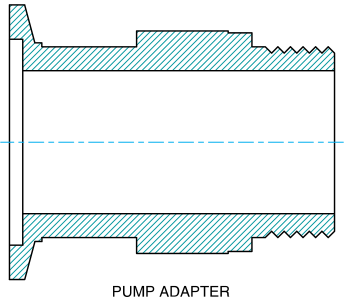
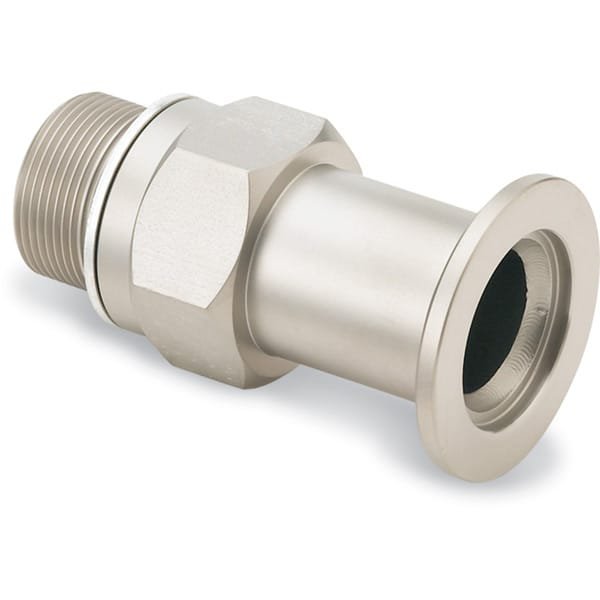
KF (QF) to Welch Pump Adapters

Introduction

KF (QF) to Welch Pump Adapters provide a reliable and convenient interface between ISO-KF (Quick Flange) vacuum systems and Welch vacuum pumps. These adapters are designed to simplify pump integration, enabling fast, leak-tight connections without modifying existing equipment. They are widely used in laboratories, semiconductor tools, and industrial vacuum setups where compatibility, cleanliness, and ease of installation are essential.

Detailed Description

Welch vacuum pumps are commonly equipped with proprietary inlet connections or threaded ports, while many modern vacuum systems rely on standardized ISO-KF flanges. KF (QF) to Welch Pump Adapters bridge this gap by converting the pump inlet to a KF-compatible interface.

The KF side connects using a standard centering ring, elastomer O-ring, and clamp, allowing tool-free assembly and quick disconnection. The Welch pump side is precision-machined to match specific pump inlet geometries, ensuring a secure mechanical fit and reliable vacuum sealing. This design minimizes leak paths, reduces installation time, and allows pumps to be easily swapped or serviced.

Adapters are typically manufactured from stainless steel or aluminum. Stainless steel versions offer superior corrosion resistance, mechanical strength, and vacuum cleanliness, while aluminum adapters provide lightweight handling and cost efficiency. Smooth internal surfaces help maintain good conductance and reduce turbulence in the foreline.

Applications

KF (QF) to Welch Pump Adapters are commonly used in:

  • Rough and medium vacuum systems

  • Welch rotary vane and dry vacuum pumps

  • Laboratory vacuum stations

  • Thin film deposition and coating equipment

  • Leak detection and vacuum diagnostics

  • Temporary or modular vacuum setups

Technical Parameters

ParameterTypical Value / RangeImportance
Flange StandardKF16 / KF25 / KF40 / KF50Ensures ISO-KF system compatibility
Pump InterfaceWelch pump inlet (model-specific)Guarantees proper mechanical fit
Material304 / 316L Stainless Steel, AluminumDetermines durability and cleanliness
Sealing MethodKF centering ring with O-ringEnables quick, reliable sealing
Operating PressureAtmosphere to ~10⁻³ mbarSuitable for foreline applications
TemperatureLimited by O-ring materialDefines safe operating range

Comparison with Related Adapters

Adapter TypeKey AdvantageTypical Application
KF (QF) to Welch Pump AdapterDirect pump compatibilityWelch pump forelines
KF to Hose NozzleFlexible hose connectionTemporary vacuum lines
KF to Threaded AdapterThreaded port conversionInstrument connections

FAQ

QuestionAnswer
Are KF and QF the same standard?Yes, KF and QF are commonly used interchangeably for ISO-KF flanges.
Do I need a clamp and centering ring?Yes, standard KF hardware is required on the flange side.
Are adapters specific to pump models?Yes, the Welch side is typically matched to specific pump inlets.
Can custom adapters be supplied?Yes, custom dimensions and configurations are available.
Is this suitable for high vacuum?These adapters are mainly used for rough and medium vacuum forelines.

Packaging

Each KF (QF) to Welch Pump Adapter is cleaned, capped, and individually packaged to prevent contamination. Protective cushioning and clear labeling ensure safe transportation and easy identification.

Conclusion

KF (QF) to Welch Pump Adapters offer a practical and dependable solution for integrating Welch vacuum pumps into ISO-KF vacuum systems. With quick-connect installation, reliable sealing, and multiple material options, these adapters simplify system setup and improve flexibility in laboratory and industrial vacuum applications.

For detailed specifications and a quotation, please contact us at sales@thinfilmmaterials.com.

Ordering Table

Flange Size/OD Type Drawing Thread Size Fitting Part Number
KF16 (1.18" OD) New-Style Tooltip 3/4-20 Welch: 1399, 1400, 1405 (Old Style) QF16-075-W1N
KF16 (1.18" OD) Old-Style Tooltip 5/8-18 Welch: 1399, 1400, 1410 QF16-075-WP1
KF16 (1.18" OD) Old-Style Tooltip 3/4-20 Welch: 1405 QF16-075-WP2
KF25 (1.57" OD) New-Style Tooltip 1-20 Welch: 1373, 1376, 1380, 1402, 1405 QF25-100-W1N
KF25 (1.57" OD) Old-Style Tooltip 1-20 Welch: 1380, 1402, 1403, 8806, 8811, 8816, 8821 QF25-100-WP1
KF40 (2.16" OD) New-Style Tooltip 1-3/4-20 Welch: 1397 QF40-150-W2N
KF40 (2.16" OD) Old-Style Tooltip 1-1/2-20 Welch: 1373, 1376, 8831 QF40-150-WP1
KF40 (2.16" OD) Old-Style Tooltip 1-3/4-20 Welch: 1374, 1397, 8851 QF40-150-WP2

Reviews

There are no reviews yet.

Be the first to review “KF (QF) to Welch Pump Adapters”

Your email address will not be published. Required fields are marked *

FAQ

Tube fittings are designed for tubes (measured by outside diameter and wall thickness) used in high-pressure and instrumentation applications, whereas pipe fittings are for pipes (identified by nominal pipe size) primarily used in fluid transport.


Common valve types include ball valves, gate valves, check valves, butterfly valves, and globe valves. Each serves a specific function—from quick shutoff (ball/gate valves) to flow regulation (globe valves).

 
  • For tubing, measure the outside diameter; for pipes, refer to the nominal pipe size (using conversion charts if needed). Always match the valve or fitting size to your pipe’s dimensions and flow requirements.

  • Frequently used thread types include NPT (National Pipe Tapered), BSP (British Standard Pipe), and UNC, along with slip-fit options that rely on compression or fusion rather than threads.

Interchangeability depends on manufacturer specifications and certification. Always verify compatibility via manufacturer guides or certified interchangeability charts.

 
  • A coupling is a short, straight fitting used to join two pipes or tubes. It provides a secure, leak-tight connection and can sometimes serve to extend or repair piping runs.

Consider valve type, pressure and temperature ratings, material compatibility with your fluid, actuation method (manual or automatic), and maintenance requirements.

 
  • Valves regulate flow by opening, closing, or partially obstructing the pathway. Their mechanisms (such as the rotation of a ball or the linear movement of a gate) determine the speed and precision of flow control.

  • A flange is a flat, circular component used to connect pipes, valves, or other equipment. Bolted together with gaskets, flanges provide a secure, leak-proof joint that facilitates both assembly and maintenance.

  • Manual valves require physical operation via handles or levers, whereas actuated valves use mechanisms—pneumatic, electric, or hydraulic—to open and close automatically or remotely.

  • Issues include leaks caused by improper installation, over-tightening, degraded seals, material incompatibility, and fatigue from repeated cycling. Regular inspection and proper installation practices help mitigate these problems.

Regular maintenance involves periodic inspections, cleaning or replacing worn seals, ensuring proper torque during installation, and adhering to manufacturer guidelines and local plumbing codes to preserve system integrity.


Shopping Cart
Scroll to Top