There is no universally best evaporation-material form. Pellets, granules, pieces, rods, and shaped starter sources can all work when their dimensions, heating behavior, and chemistry match the evaporation source. Start with the source geometry and heating method, then specify the material form.
This guide explains how to compare evaporation pellets, rods, pieces, and related charge forms for resistance-heated and electron-beam evaporation. It is intended for engineers, researchers, and technical buyers preparing a material specification. It does not replace the evaporator manufacturer’s operating limits or material-specific process qualification.
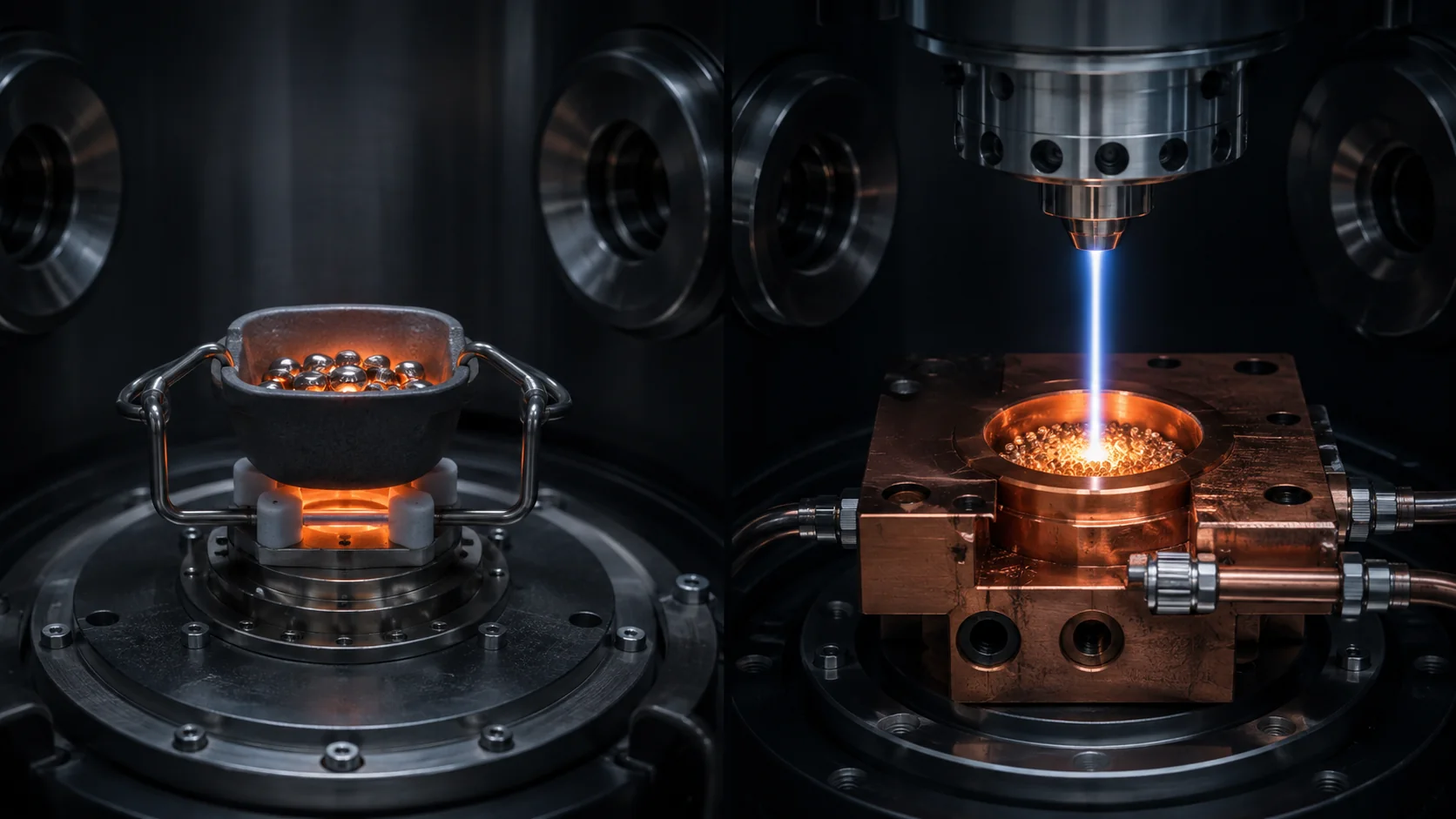
Quick comparison: pellets, granules, pieces, and rods
| Material form | Useful when | Confirm before ordering |
|---|---|---|
| Pellets | A repeatable charge mass and compact loading geometry are important | Pellet diameter and length, pocket or boat dimensions, ramp procedure, and whether the material melts, sublimes, or decomposes |
| Granules or small pieces | The charge must fill a crucible, hearth pocket, basket, or boat without a dedicated feeder | Size range, fines limit, packing, exposed sharp edges, conditioning procedure, and spitting risk |
| Rods | The source accepts a rod, cane, or controlled feed geometry | Diameter, length, holder or feeder design, clearance, orientation, and electrical or thermal contact |
| Shaped starter source or slug | An e-beam hearth uses a fitted initial charge or the process benefits from a consolidated source | Pocket profile, liner, clearance from cooled walls, usable fill level, and replenishment method |
| Powder | The equipment and procedure are designed for a fine charge | Particle-size distribution, dust containment, outgassing, loading method, and risk of material movement under vacuum or beam exposure |
Start with the evaporation source, not the catalog form
A form that is convenient to manufacture is not automatically suitable for a deposition system. Source geometry determines how the charge is supported, heated, contained, and replenished. The first procurement question should therefore be: What source will hold and heat the material?

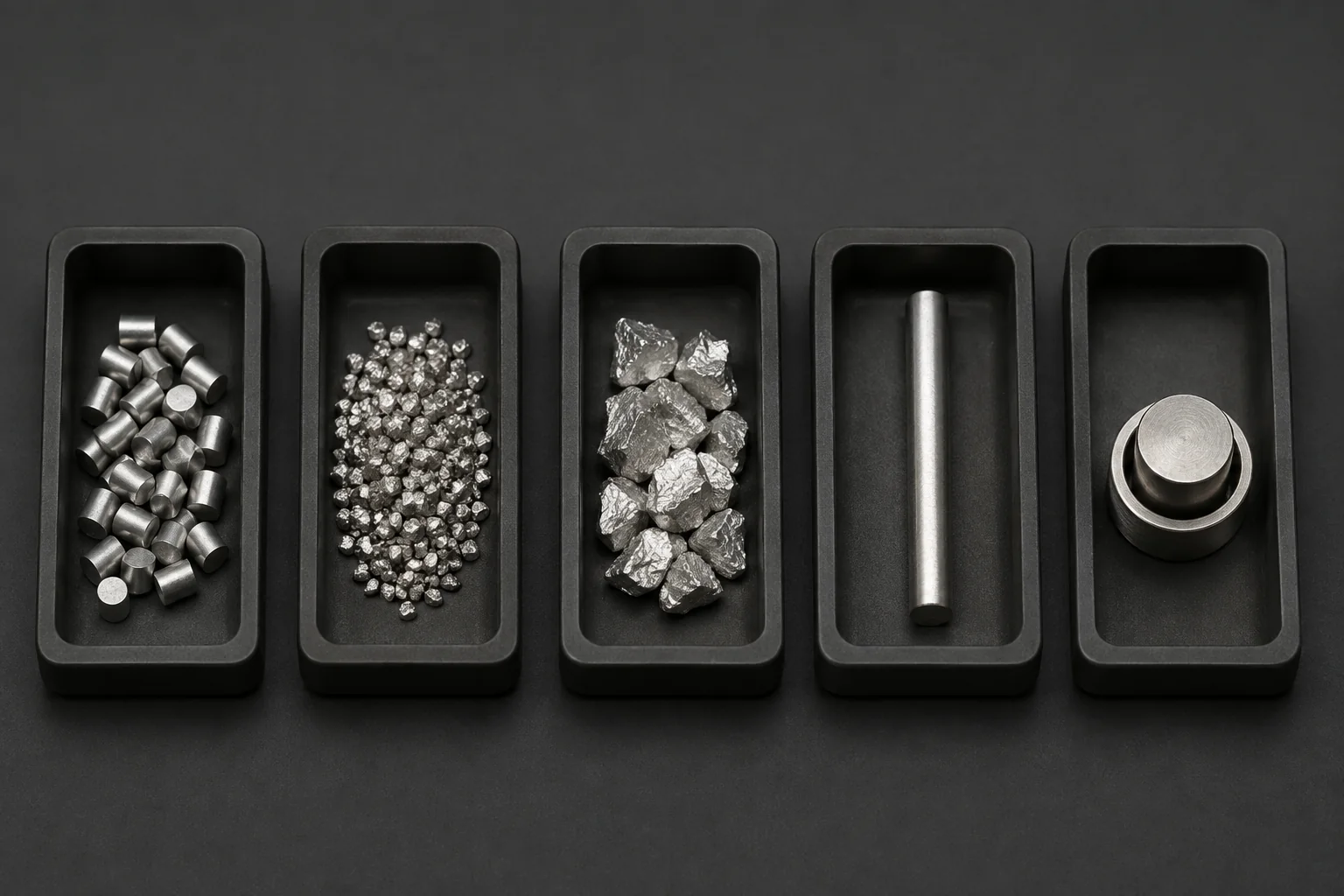
Direct resistance heating
In direct resistance heating, current passes through a refractory-metal source such as a filament, basket, boat, or box. The evaporant is placed on or in that heated source. Because the material and hot source can be in direct contact, wetting, alloying, or chemical reaction may affect the process. Source shape also matters: a basket can hold pieces, while a boat or baffled box can contain a different charge geometry.
For this route, do not choose pellets or pieces from shape alone. Check the heater material, available current, charge volume, operating orientation, and the evaporant’s behavior at the required vapor-producing temperature. TFM’s evaporation boat sources, crucible heaters, and other evaporation source families illustrate why source geometry must be part of the material specification.
Indirect resistance heating
Indirectly heated sources place the evaporant in a crucible that is heated by a separate element. The crucible separates the charge from the heater and adds thermal mass. This can support steadier thermal conditions, but the crucible material, wall thickness, geometry, and heater capacity become part of the compatibility decision.
Measure the usable inside dimensions rather than relying only on the nominal crucible volume. Pellets, granules, or pieces need to load without damaging the crucible, bridging above the intended fill zone, or preventing the source from being assembled correctly. Review the available evaporation crucible geometries and confirm material compatibility separately.
Electron-beam evaporation
An e-beam source directs a focused electron beam onto the evaporant in a water-cooled hearth or a hearth liner. This concentrated heating method can process materials that are difficult to evaporate with resistance heating. It also makes the charge profile, beam position, conditioning cycle, and liner selection important.
Technical guidance from equipment and source suppliers describes e-beam charges in several forms, including powder, granules, lumps, and shaped starter sources. That variety is useful, but it is not evidence that every form works equally well for every material. A new charge commonly requires controlled ramp and soak steps. Some evaporants can spit during heating, and a liner can still react with the material even when the hearth itself is water cooled.
What each material form changes
Evaporation pellets
Pellets provide defined individual dimensions and make it easier to count, weigh, and repeat a charge. Their regular shape can simplify packing in small pockets or crucibles. Those benefits do not guarantee a stable melt or a particle-free film. Pellet density, surface condition, contact between pellets, void space, and the material’s phase behavior all influence conditioning.
Specify pellet diameter, length or thickness, dimensional tolerance if it matters to loading, total mass, purity basis, and packaging. Avoid stating only “pellets” when the source has a narrow pocket or a controlled fill-height requirement.
Granules and irregular pieces
Granules and pieces can fill a range of source shapes and may be practical when the material is difficult to machine into a regular form. Their performance depends on the supplied size distribution and loading procedure. A wide distribution can change packing density from one charge to another. Fines can introduce handling and contamination concerns. Large pieces may create voids or concentrate the initial heat load.
A useful specification gives a minimum and maximum piece size, identifies whether fines are acceptable, and states the usable pocket or crucible dimensions. “Small pieces” is not a complete purchasing description.
Rods, canes, and starter sources
Rods can be used where the source or process is designed around a rod geometry. A shaped starter source is different: it is prepared to fit a particular e-beam hearth profile and can provide a consolidated initial charge. In either case, the drawing matters. Diameter alone is rarely enough. Length, end shape, taper, holder contact, feed mechanism, pocket profile, and cold-wall clearance may all control fit.
Material-specific behavior can override general form preferences. For example, published supplier guidance for e-beam evaporation of zirconium recommends a fitted starter source or rod instead of assuming that loose pellets will consolidate uniformly. Treat such guidance as material- and system-specific, not as a rule for all evaporants.
Powder
Powder can be appropriate in a qualified setup, but it adds variables that are less important for consolidated forms. Particle size, fines, adsorbed moisture, dust control, packing, and movement during pump-down or heating can affect loading and conditioning. Specify the particle-size range and handling method, and confirm that the equipment procedure explicitly supports powder.
Six checks before selecting a form
- Record the source geometry. Include the manufacturer and model when available, source type, pocket or crucible drawing, usable dimensions, orientation, liner, and fill limit.
- Check the available heating range. For resistance heating, record the safe current and source limits. For e-beam equipment, record the relevant gun and hearth configuration. Do not select a method from melting point alone; vapor pressure and decomposition or sublimation behavior also matter.
- Review material interactions. Confirm whether the evaporant can wet, alloy with, dissolve, or react with the boat, crucible, hearth, or liner under the intended conditions.
- Define the charge geometry. Set a usable size range, total charge mass, fill height, and any clearance needed for assembly or cooling.
- Plan conditioning and replenishment. State whether the process uses a fresh loose charge, a pre-melt, a fitted starter source, or make-up material. Include ramp and soak constraints from the operating procedure.
- Specify chemistry and documentation. Give the material identity, composition for alloys or compounds, required purity, restricted impurities if relevant, lot size, and the documentation required for receiving inspection.
Common selection shortcuts that fail
- “Pellets always evaporate more cleanly.” Regular geometry can improve loading repeatability, but it does not remove material-specific spitting, outgassing, decomposition, or source-reaction risks.
- “Pieces are only for low-precision work.” Properly specified pieces can be suitable in qualified processes. The relevant questions are size control, cleanliness, conditioning, and source compatibility.
- “Rods are automatically best for production.” A rod is useful only when the source accepts and heats it correctly. Many production e-beam systems use hearth charges or starter sources instead.
- “The highest purity solves source compatibility.” Purity and compatibility are different specifications. A high-purity material can still react with the selected boat or liner.
- “Melting point determines the source.” Source selection also depends on vapor pressure, heat transfer, reaction with containment materials, decomposition or sublimation, required rate, charge volume, and equipment limits.
RFQ checklist for evaporation materials
A specification-ready request reduces back-and-forth and makes compatibility review possible. Include:
- Material name and chemical formula or alloy composition
- Required purity and any impurity limits that matter to the process
- Preferred form: pellets, granules, pieces, powder, rod, slug, or starter source
- Dimensions, size range, tolerance, and quantity
- Evaporation method: direct resistance, indirect resistance, e-beam, or another method
- Source, crucible, liner, or hearth material and usable dimensions
- Equipment manufacturer and model when disclosure is possible
- Whether the charge is new, pre-melted, continuously fed, or replenished between runs
- Packaging, handling, and documentation requirements
- Known process constraints or prior failure mode, without including confidential data
Browse TFM’s evaporation materials and evaporation sources. For a specification review, send the material requirement and source dimensions. Availability, final dimensions, composition, purity, and documentation should be confirmed for the specific quotation.
Frequently asked questions
Can the same evaporation material be supplied in more than one form?
Often, yes. The technically suitable options depend on how the material can be produced, handled, and heated. Confirm the available forms and dimensions for the exact material rather than assuming that every catalog form is available.
Do pellets prevent spitting in e-beam evaporation?
No. Pellet geometry can make charging more repeatable, but spitting can also be influenced by trapped gas, surface condition, voids, moisture, rapid heating, beam position, material behavior, and the conditioning cycle.
Are rods used only for electron-beam evaporation?
No. “Rod” can describe the evaporant form, a feedstock geometry, or part of a thermal source design. The holder, feeder, and heating mechanism determine how a rod is used.
How should I choose a crucible or hearth liner?
Use the equipment documentation and material-compatibility data for the intended temperature and vacuum conditions. Confirm geometry, electrical behavior where relevant, thermal limits, and possible reactions with the evaporant. A familiar liner material is not automatically compatible with every charge.
Technical references
- Kurt J. Lesker Company, Evaporation Sources Technical Notes – heating methods, thermal sources, e-beam sources, and crucible liners.
- JEOL, Electron Beam Source for Evaporation – e-beam source structure, direct heating, water-cooled crucibles, and liner-interaction caution.
- ITL Vacuum Components, Evaporation Source Selection Guide – source selection factors including power-supply capacity, vapor temperature, coating thickness, and spitting control.
- Kurt J. Lesker Company, starter source or rod for e-beam evaporation of zirconium – a material-specific example showing why loose pellets are not always the best charge form.