
Introduction
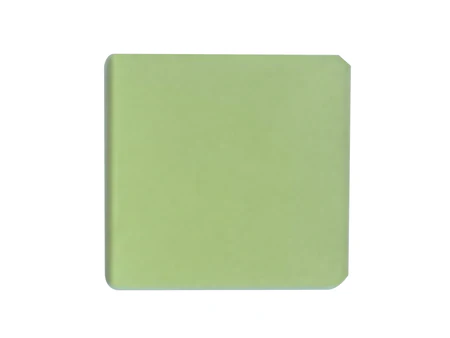
Dysprosium Scandate (DyScO₃) Substrate is a high-quality orthorhombic perovskite oxide single crystal widely used for epitaxial growth of advanced functional thin films. Owing to its excellent lattice matching with many perovskite oxides, DyScO₃ substrates are particularly valuable in strain engineering, ferroelectric enhancement, and complex oxide heterostructure development.
In modern oxide electronics and spintronic research, subtle lattice mismatch plays a decisive role in tuning polarization, magnetic ordering, and carrier mobility. DyScO₃ provides a reliable platform for achieving controlled strain states that cannot be realized with conventional substrates such as SrTiO₃ or LaAlO₃.
Detailed Description
Dysprosium Scandate (DyScO₃) crystallizes in an orthorhombically distorted perovskite structure, offering pseudocubic lattice parameters highly compatible with a wide range of perovskite thin films. Its carefully controlled lattice constants enable tensile or compressive strain engineering in epitaxial films.
Key material characteristics include:
Orthorhombic perovskite structure
Excellent lattice compatibility with ABO₃ oxides
High crystalline uniformity
Low dislocation density
Thermal stability during high-temperature deposition
DyScO₃ Substrate is typically grown using advanced crystal growth techniques to ensure structural homogeneity. After slicing, substrates undergo precision chemo-mechanical polishing to achieve epi-ready surfaces with ultra-low roughness. Post-polishing annealing can further produce atomically defined step-terrace morphology suitable for high-quality epitaxial film growth.
Available orientations commonly include (110), (101), and (001), depending on strain engineering requirements. Orientation selection significantly influences the film’s structural distortion and functional properties.
Applications
Dysprosium Scandate Substrate is widely used in research laboratories and advanced materials development:
Ferroelectric thin films (e.g., BaTiO₃, PbTiO₃)
Multiferroic materials research
High-mobility oxide heterostructures
Strain-engineered superconducting films
Spintronic and magnetic oxide systems
Correlated electron materials
Advanced perovskite oxide electronics
Its ability to impose controlled lattice strain makes DyScO₃ particularly valuable for enhancing ferroelectric polarization and stabilizing novel structural phases in thin films.
Technical Parameters
| Parameter | Typical Value / Range | Importance |
|---|---|---|
| Crystal Structure | Orthorhombic Perovskite | Enables strain engineering |
| Orientation | (110), (101), (001) | Controls strain state |
| Surface Finish | SSP / DSP (Epi-ready optional) | Influences epitaxial quality |
| Surface Roughness | < 0.5 nm (epi-ready) | Ensures uniform film growth |
| Size | 5×5 mm – 20×20 mm (custom) | Matches deposition systems |
| Thickness | 0.5 mm – 1.0 mm | Mechanical stability |
| Thermal Stability | Suitable for >800°C deposition | Compatible with oxide growth |
Comparison with Related Materials
| Material | Key Advantage | Typical Application |
|---|---|---|
| Dysprosium Scandate | Excellent strain control for perovskites | Ferroelectric & multiferroic films |
| SrTiO₃ | Cubic perovskite standard substrate | General oxide epitaxy |
| LaAlO₃ | Good lattice match for selected oxides | High-mobility interfaces |
| GdScO₃ | Alternative strain engineering option | Tunable oxide thin films |
Compared with SrTiO₃, DyScO₃ provides stronger anisotropic strain effects. Compared with LaAlO₃, it offers reduced twin domain formation in certain epitaxial systems.
FAQ
| Question | Answer |
|---|---|
| Why choose DyScO₃ over SrTiO₃? | DyScO₃ enables precise strain engineering due to its orthorhombic lattice distortion. |
| Can specific orientations be supplied? | Yes, standard orientations such as (110), (101), and (001) are available upon request. |
| Is the surface suitable for high-quality epitaxy? | Epi-ready polishing ensures ultra-smooth surfaces for thin film deposition. |
| Does DyScO₃ tolerate high deposition temperatures? | Yes, it is stable under typical oxide thin film growth temperatures. |
| How are substrates packaged? | Each substrate is individually protected in clean, labeled packaging to prevent contamination and mechanical damage. |
Packaging
Our Dysprosium Scandate Substrate products are meticulously tagged and labeled externally to ensure efficient identification and maintain high standards of quality control. We take great care to prevent any potential damage during storage and transportation, ensuring the substrates arrive in perfect condition.
Conclusion
Dysprosium Scandate (DyScO₃) Substrate offers a powerful platform for strain-engineered oxide thin film research and next-generation functional materials development. With high crystalline quality, customizable orientations, and epi-ready surface preparation, it supports demanding applications in ferroelectricity, spintronics, and correlated electron systems.
For detailed specifications and a quotation, please contact us at sales@thinfilmmaterials.com.
Reviews
There are no reviews yet.