
Introduction
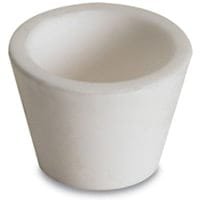
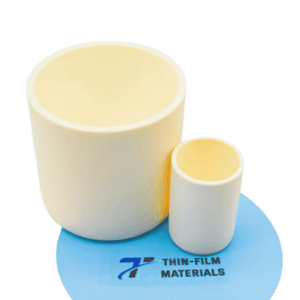
Aluminum Oxide (Al₂O₃) E Beam Crucibles are high-purity ceramic containers designed for electron beam evaporation systems. In high-vacuum thin film deposition, crucible materials must withstand extreme localized heating, rapid thermal cycling, and chemical interaction with molten source materials. Alumina offers a balanced combination of thermal stability, electrical insulation, and chemical inertness, making it one of the most widely used crucible materials in E-beam evaporation.
For research laboratories and industrial coating lines alike, Aluminum Oxide E Beam Crucibles provide a dependable solution for evaporating metals, oxides, and specialty materials.
Detailed Description
Aluminum Oxide, commonly known as alumina (Al₂O₃), is a dense ceramic material characterized by high melting temperature (over 2000°C), excellent electrical insulation, and strong resistance to chemical attack. In E-beam evaporation, where the electron beam locally melts the source material, the crucible must remain dimensionally stable and resist contamination.
High-quality alumina crucibles are typically manufactured through precision ceramic forming and high-temperature sintering to achieve:
High purity grades (typically ≥99% Al₂O₃)
Dense microstructure with low open porosity
Smooth inner surface to reduce material trapping
Consistent wall thickness for uniform heat distribution
These features help maintain evaporation stability and minimize particle generation during deposition. Alumina crucibles are compatible with most standard multi-pocket copper hearth liners and can be supplied in various pocket geometries, including cylindrical, conical, and custom cavity designs.
Because alumina is electrically insulating, it prevents unintended current flow within the evaporation assembly and contributes to stable beam focusing.
Applications
Aluminum Oxide E Beam Crucibles are widely used in:
Metal Evaporation
Suitable for evaporating materials such as aluminum, gold, silver, and chromium.Oxide & Dielectric Deposition
Used for evaporating oxide compounds where chemical compatibility is required.Optical Coating Production
Thin films for lenses, mirrors, and optical filters.Semiconductor Fabrication
Deposition of contact layers and dielectric films.R&D Thin Film Studies
Academic and industrial laboratories performing material development.High-Vacuum Coating Systems
Compatible with standard electron beam evaporators and multi-pocket hearths.
Technical Parameters
| Parameter | Typical Value / Range | Importance |
|---|---|---|
| Material | ≥99% Aluminum Oxide (Al₂O₃) | Ensures chemical stability |
| Maximum Service Temp. | >1800°C (vacuum environment) | Withstands E-beam heating |
| Density | ≥3.7 g/cm³ | Improves structural strength |
| Inner Diameter | Custom (e.g., 10–50 mm) | Matches hearth pocket size |
| Wall Thickness | 1 – 5 mm | Affects durability & heat resistance |
| Shape | Cylindrical / Conical / Custom | Adapts to source material geometry |
Comparison with Related Materials
| Material | Key Advantage | Typical Application |
|---|---|---|
| Aluminum Oxide (Al₂O₃) | Cost-effective, chemically stable | General metal & oxide evaporation |
| Boron Nitride (BN) | Excellent non-wetting property | Reactive metals |
| Graphite | High thermal conductivity | High-temperature metal evaporation |
| Zirconia (ZrO₂) | Higher thermal shock resistance | Specialized oxide processes |
Alumina crucibles are often selected when a stable, economical, and chemically inert ceramic solution is required.
FAQ
| Question | Answer |
|---|---|
| Can the crucible size be customized? | Yes, inner diameter, height, and wall thickness can be tailored to your E-beam system. |
| Is alumina suitable for reactive materials? | It is chemically stable for many metals and oxides; for highly reactive materials, alternative ceramics may be recommended. |
| What purity level is recommended? | ≥99% alumina is standard for vacuum evaporation to minimize contamination. |
| Are multi-pocket configurations supported? | Yes, crucibles can be supplied to fit standard multi-pocket copper hearths. |
| How are they packaged? | Individually packed with protective cushioning and export-grade cartons to prevent cracking during transport. |
Packaging
Our Aluminum Oxide E Beam Crucibles are meticulously tagged and labeled externally to ensure efficient identification and maintain high standards of quality control. We take great care to prevent any potential damage during storage and transportation, ensuring the crucibles arrive in perfect condition.
Conclusion
Aluminum Oxide E Beam Crucibles deliver reliable performance in demanding electron beam evaporation environments. With high thermal resistance, chemical stability, and customizable geometries, they support consistent thin-film deposition across semiconductor, optical, and research applications.
For detailed specifications and a quotation, please contact us at sales@thinfilmmaterials.com.
Aluminum Oxide E Beam Crucibles
Compare related evaporation crucibles in the full collection.
Reviews
There are no reviews yet.