
Introduction
Magnetic oxide thin films have become one of the most important research directions in modern materials science and nanoelectronics. Among the many ferrite materials studied for advanced electronic devices, cobalt ferrite (CoFe₂O₄) stands out due to its exceptional magnetic properties, chemical stability, and multifunctional behavior. In particular, thin films deposited from CoFe₂O₄ sputtering targets are widely used in the development of spintronic devices, magnetoelectric heterostructures, magnetic sensors, and multifunctional oxide electronics.
CoFe₂O₄ belongs to the family of spinel ferrites, a class of magnetic oxides that exhibit ferrimagnetic behavior and excellent structural stability. Its high magnetocrystalline anisotropy, large coercivity, and strong magnetostrictive response make it especially attractive for thin-film technologies that rely on precise control of magnetic properties at the nanoscale.
With the rapid development of physical vapor deposition (PVD) technologies such as RF magnetron sputtering and pulsed laser deposition, researchers can now fabricate highly controlled cobalt ferrite thin films with tailored magnetic and structural characteristics. The performance of these films strongly depends on the quality and stoichiometric control of the sputtering target material.
This article explores the role of CoFe₂O₄ sputtering targets in thin film deposition, focusing on their importance in spintronics, magnetoelectric devices, and multifunctional oxide thin films, as well as the key material properties that make cobalt ferrite one of the most widely studied magnetic oxide materials today.
Crystal Structure and Magnetic Properties of CoFe₂O₄
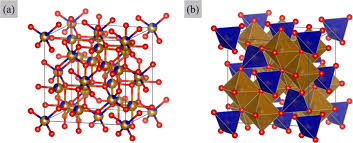
Cobalt ferrite has a spinel crystal structure, typically written as:
CoFe₂O₄
The spinel structure can be described as a cubic lattice where metal cations occupy two different types of sites:
- Tetrahedral (A) sites
- Octahedral (B) sites
In cobalt ferrite, the cation distribution is typically described as an inverse spinel structure, where:
- Fe³⁺ ions occupy tetrahedral sites
- Co²⁺ and Fe³⁺ ions occupy octahedral sites
This cation arrangement results in strong superexchange interactions between magnetic ions, which produce ferrimagnetic ordering within the material.
Key Magnetic Properties
CoFe₂O₄ exhibits several remarkable magnetic characteristics:
| Property | Typical Value |
|---|---|
| Curie Temperature | ~793 K |
| Magnetocrystalline Anisotropy | Very high |
| Coercivity | High |
| Magnetostriction | Strong |
| Chemical Stability | Excellent |
The high magnetocrystalline anisotropy of cobalt ferrite makes it particularly useful for magnetic storage and spin-dependent electronic devices. At the same time, its large magnetostriction coefficient enables strong coupling between magnetic and mechanical properties, which is critical for magnetoelectric devices.
Another advantage of CoFe₂O₄ is its excellent chemical and thermal stability, allowing thin films to maintain their properties even under harsh operating conditions.
Manufacturing High-Density CoFe₂O₄ Sputtering Targets
The performance of sputtered thin films is strongly influenced by the microstructure and purity of the sputtering target. Therefore, producing high-density cobalt ferrite sputtering targets requires precise control of powder synthesis, ceramic processing, and sintering conditions.
Powder Preparation
The process typically begins with high-purity oxide powders:
Cobalt oxide (CoO or Co₃O₄)
Iron oxide (Fe₂O₃)
These powders are carefully mixed according to the stoichiometric ratio required to form CoFe₂O₄. Advanced synthesis techniques such as:
solid-state reaction
can be used to achieve highly homogeneous precursor powders.
Ceramic Sintering
After powder preparation, the material is compacted and sintered at high temperatures, typically between 1200°C and 1400°C.
The sintering process must achieve:
- high density (usually >95% theoretical density)
- phase purity
- uniform grain structure
- minimal porosity
A dense sputtering target helps maintain stable plasma conditions during sputtering and reduces particle generation.
Target Bonding
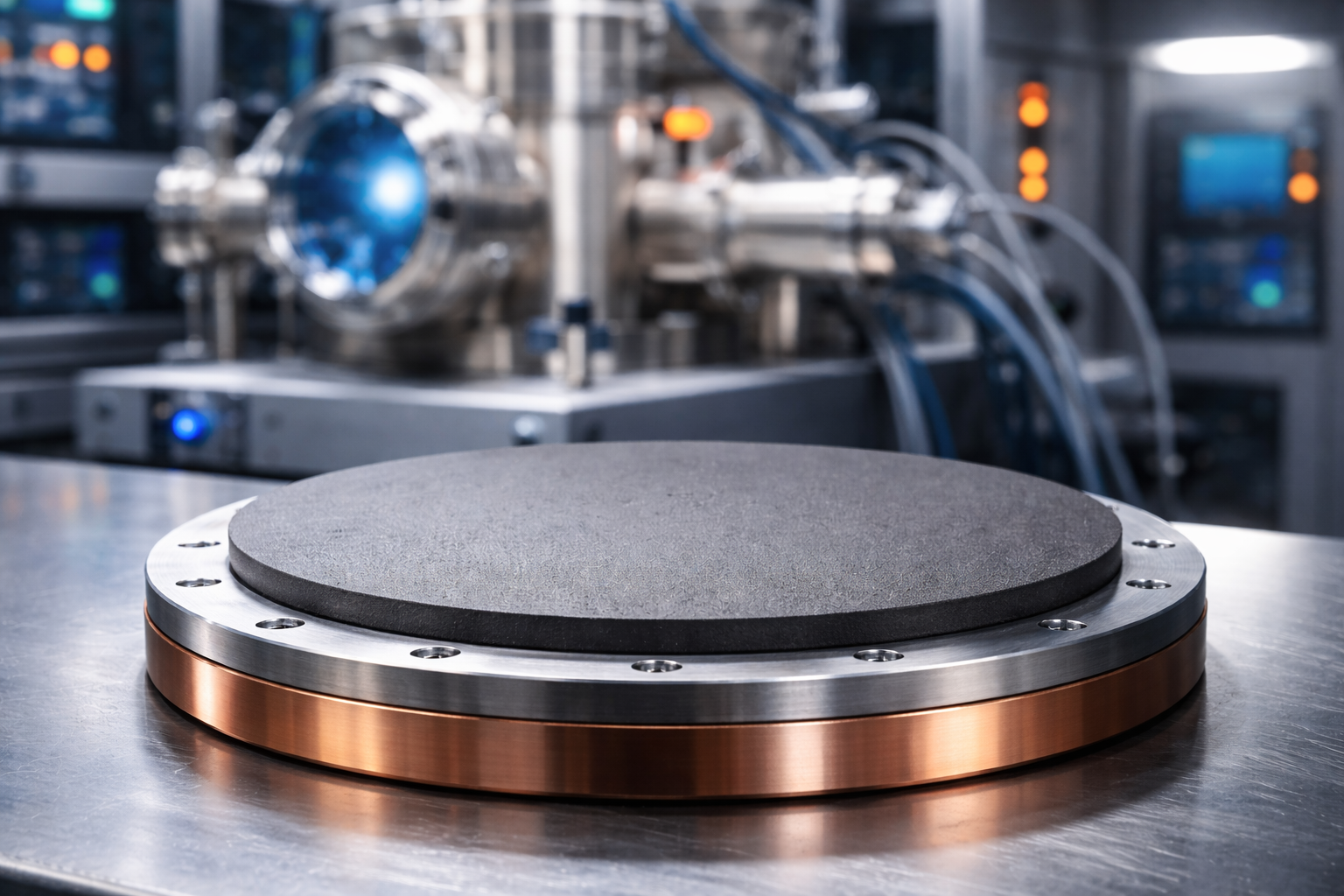
For larger sputtering targets, ceramic cobalt ferrite disks are often bonded to metallic backing plates, typically made from:
- copper
- titanium
Bonding improves heat transfer during sputtering and reduces the risk of target cracking under thermal stress.
Deposition of CoFe₂O₄ Thin Films
Thin films of cobalt ferrite are typically deposited using physical vapor deposition techniques.
RF Magnetron Sputtering
Because CoFe₂O₄ is an insulating oxide, RF magnetron sputtering is commonly used.
Typical deposition parameters include:
| Parameter | Typical Range |
|---|---|
| RF Power | 50–300 W |
| Substrate Temperature | 300–700°C |
| Oxygen Partial Pressure | Controlled |
| Deposition Rate | 0.1–1 nm/s |
The oxygen environment plays a critical role in maintaining proper stoichiometry and preventing oxygen deficiency in the deposited films.
Substrate Selection
The crystalline quality of CoFe₂O₄ films depends strongly on the substrate used.
Common substrates include:
- MgO
- SrTiO₃
- MgAl₂O₄
- sapphire
- silicon (with buffer layers)
These substrates provide suitable lattice matching for epitaxial growth of ferrite films.
CoFe₂O₄ Thin Films in Spintronic Devices
Spintronics is a rapidly growing field of electronics that exploits not only the charge of electrons but also their spin state. Magnetic oxide thin films play a key role in this technology.
Cobalt ferrite has been extensively investigated for spintronic applications due to:
- high spin polarization
- strong magnetic anisotropy
- robust ferrimagnetism
Spin Filter Devices
CoFe₂O₄ thin films can function as spin filters, allowing electrons with one spin orientation to pass through while blocking others.
This property enables devices such as:
- spin valves
- magnetic tunnel junctions
- spin transistors
Spin filtering is particularly important for developing next-generation memory technologies, including spin-transfer torque magnetic random access memory (STT-MRAM).
Magnetoelectric Heterostructures Based on CoFe₂O₄
One of the most exciting applications of cobalt ferrite thin films is in magnetoelectric composite structures.
These systems combine:
- a magnetostrictive material (such as CoFe₂O₄)
- a piezoelectric material (such as BaTiO₃)
When an electric field is applied to the piezoelectric layer, it produces mechanical strain. This strain is transferred to the cobalt ferrite layer, which changes its magnetic state.
Such coupling enables electric-field control of magnetism, which is a key concept for future low-power electronic devices.
Common Magnetoelectric Systems
Examples include:
- CoFe₂O₄ / BaTiO₃
- CoFe₂O₄ / Pb(Zr,Ti)O₃ (PZT)
- CoFe₂O₄ / PMN-PT
These structures are widely studied for:
- magnetoelectric sensors
- energy-efficient memory
- tunable microwave devices
Magnetic Sensors and MEMS Devices
Thin films derived from CoFe₂O₄ sputtering targets are also important in magnetic sensing technologies.
Their strong magnetic response and mechanical robustness allow them to be used in:
- magnetic field sensors
- magnetoresistive devices
- microelectromechanical systems (MEMS)
For example, magnetostrictive cobalt ferrite films can be integrated into MEMS structures to create high-sensitivity magnetic detectors.
Microwave and RF Applications
Ferrite materials are widely used in microwave and radio frequency electronics due to their magnetic permeability and low electrical conductivity.
CoFe₂O₄ thin films are useful for:
- microwave absorbers
- RF inductors
- electromagnetic interference shielding
Their high resistivity helps minimize eddy current losses, which is particularly important for high-frequency applications.
Advantages of CoFe₂O₄ Sputtering Targets
High-quality cobalt ferrite sputtering targets offer several advantages in thin film deposition:
Excellent Magnetic Properties
The intrinsic magnetic characteristics of CoFe₂O₄ enable thin films with strong anisotropy and stable ferrimagnetic behavior.
Chemical Stability
Cobalt ferrite is resistant to oxidation and corrosion, making it suitable for long-term device operation.
High Thermal Stability
Thin films maintain their properties even at elevated temperatures.
Compatibility with Oxide Electronics
CoFe₂O₄ integrates well with many oxide materials used in modern electronic devices.
Future Outlook
As research continues to explore multifunctional oxide materials, cobalt ferrite is expected to remain a key component in emerging technologies.
Future applications may include:
- voltage-controlled spintronic devices
- neuromorphic computing hardware
- advanced magnetic sensors
- energy-efficient memory technologies
Advances in thin film deposition techniques and materials engineering will further improve the performance of cobalt ferrite thin films and expand their use in next-generation electronic systems.
Conclusion
CoFe₂O₄ sputtering targets play a crucial role in the fabrication of advanced magnetic oxide thin films used in spintronics, magnetoelectric devices, and multifunctional electronic systems. The combination of strong ferrimagnetism, high magnetocrystalline anisotropy, and exceptional chemical stability makes cobalt ferrite one of the most valuable materials in modern thin-film research.
By enabling the deposition of high-quality cobalt ferrite thin films through techniques such as RF magnetron sputtering, CoFe₂O₄ targets support the development of innovative technologies ranging from magnetic sensors to energy-efficient memory devices.
As the demand for multifunctional oxide materials continues to grow, high-purity and high-density CoFe₂O₄ sputtering targets will remain essential materials for both academic research and industrial thin-film production.
For detailed specifications or a quotation, please contact sales@thinfilmmaterials.com.