

Introduction
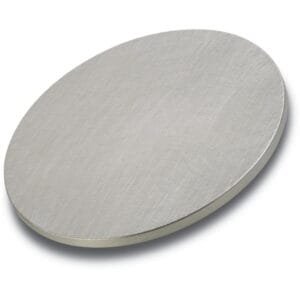
Arsenic Telluride (As₂Te₃) Sputtering Target is a chalcogenide compound material widely used in infrared optics, phase-change technologies, and advanced semiconductor research. Known for its narrow band gap, high refractive index, and strong infrared transparency, As₂Te₃ plays a key role in optoelectronic and memory-related thin film applications. As a sputtering target, As₂Te₃ enables controlled deposition of uniform chalcogenide films with stable electrical and optical properties.
Detailed Description
Our Arsenic Telluride Sputtering Targets are fabricated from high-purity arsenic and tellurium using carefully controlled synthesis and consolidation processes to ensure accurate stoichiometry and structural homogeneity. Precise As:Te ratio control is critical, as slight deviations can significantly affect crystallization behavior, electrical resistivity, and optical transmission in the deposited films.
The targets are processed to achieve high density and a uniform microstructure, minimizing particle generation and improving plasma stability during sputtering. Due to the semiconducting nature of As₂Te₃, RF sputtering is typically recommended to ensure stable deposition and consistent film composition. Custom sizes, thicknesses, and optional bonding to metallic backing plates are available to accommodate various sputtering systems and thermal management requirements.
Applications
Arsenic Telluride Sputtering Targets are commonly used in:
Infrared optical coatings and waveguides
Phase-change memory (PCM) research
Chalcogenide-based optoelectronic devices
Infrared detectors and sensors
Optical data storage materials
Academic and industrial R&D in chalcogenide semiconductors
Technical Parameters
| Parameter | Typical Value / Range | Importance |
|---|---|---|
| Chemical Composition | As₂Te₃ | Determines phase-change and IR properties |
| Purity | 99.9% – 99.99% | Reduces defect-related absorption |
| Diameter | 25 – 200 mm (custom available) | Compatible with sputtering systems |
| Thickness | 3 – 6 mm | Influences target lifetime |
| Density | ≥ 95% theoretical | Improves plasma stability |
| Sputtering Mode | RF sputtering | Suitable for semiconducting compounds |
| Bonding | Unbonded / Cu backing (optional) | Enhances heat dissipation |
Comparison with Related Materials
| Material | Key Advantage | Typical Application |
|---|---|---|
| As₂Te₃ | High refractive index & IR transparency | IR optics & PCM |
| Ge–Sb–Te (GST) | Established phase-change material | Memory devices |
| As₂Se₃ | Broader IR transmission range | Optical waveguides |
| Te-based alloys | Fast crystallization | Data storage |
FAQ
| Question | Answer |
|---|---|
| Can the target size be customized? | Yes, diameter, thickness, and bonding options are available. |
| Is RF sputtering required? | Yes, As₂Te₃ is typically deposited using RF sputtering. |
| Are bonded targets available? | Yes, metallic backing plates can be supplied upon request. |
| How is the target packaged? | Vacuum-sealed with protective cushioning and export-grade cartons or crates. |
Packaging
Our Arsenic Telluride Sputtering Targets are meticulously tagged and vacuum-sealed to prevent oxidation and contamination. Protective export-grade packaging ensures safe transport and storage stability.
Conclusion
Arsenic Telluride (As₂Te₃) Sputtering Target provides a reliable solution for depositing high-performance chalcogenide thin films with excellent infrared and phase-change properties. With controlled composition, high density, and flexible customization options, it is well suited for advanced optoelectronic and memory device research.
For detailed specifications and a quotation, please contact us at sales@thinfilmmaterials.com
Reviews
There are no reviews yet.