
 MSDS File
Product Overview
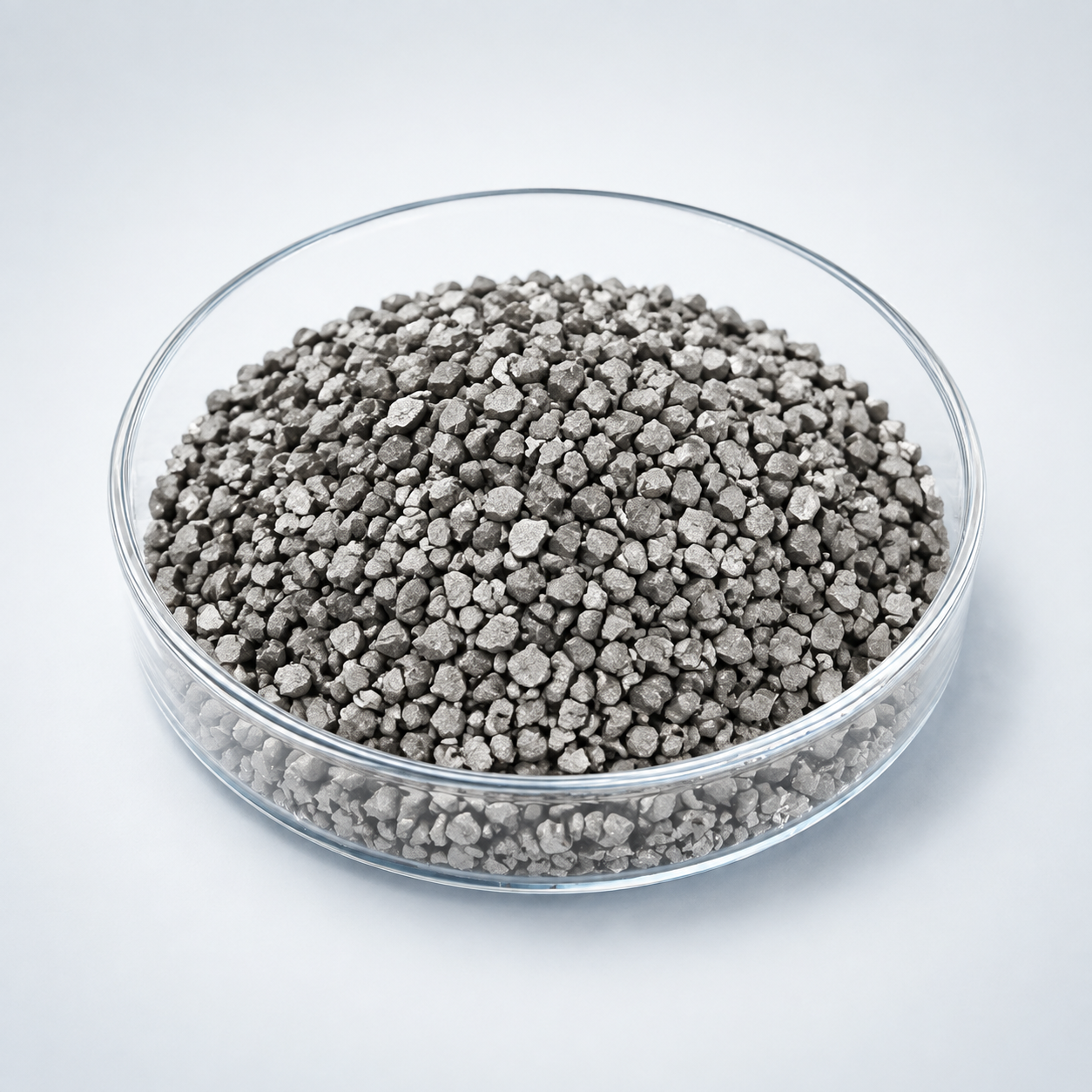
Chromium Nickel Evaporation Materials (Cr/Ni) is an alloy evaporation material intended for depositing multi-element metallic films. Unlike a pure element, an alloy may not evaporate congruently because its constituents can have different vapor pressures. As a result, source composition, evaporation method, deposition rate, and film-composition verification should be considered together; for very composition-sensitive films, co-evaporation from separate sources may be evaluated.
Evaporation Behavior and Process Considerations
Different alloying elements may evaporate at different rates because their vapor pressures are not identical. This can cause the source surface and deposited film to drift away from the nominal alloy composition during a run. For demanding composition control, film analysis, source replenishment strategy, or co-evaporation from separately controlled sources may be more reliable than assuming one alloy charge will evaporate congruently.
Technical Data
| Parameter | Typical Value / Range | Importance |
|---|---|---|
| Purity | 99.9% – 99.99% | Ensures film quality and reduces contamination |
| Forms Available | Pellets, granules, custom pieces | Compatible with e-beam and thermal evaporation |
| Size Range | 1 – 20 mm (pellets/granules) | Affects evaporation rate stability |
| Evaporation Method | Thermal / Electron beam | Enables flexible coating processes |
| Composition | Cr-Ni alloys (custom ratios) | Tailors film hardness and conductivity |
| Material | Key Advantage | Typical Application |
|---|---|---|
| Chromium Nickel (Cr-Ni) | Balanced corrosion resistance & mechanical strength | Protective & optical coatings |
| Pure Chromium | Excellent hardness & oxidation resistance | Decorative & wear coatings |
| Pure Nickel | High conductivity & ductility | Electronic & magnetic films |
| Nickel Iron (Ni-Fe) | Soft magnetic properties | Magnetic thin films |
| Question | Answer |
|---|---|
| Can the Cr:Ni ratio be customized? | Yes, alloy composition can be tailored for specific thin film performance. |
| What deposition methods are compatible? | Suitable for thermal and electron beam evaporation systems. |
| How are these materials packaged? | Vacuum-sealed with inert gas protection, then packed in export-safe cartons or crates. |
| What purity levels are offered? | Typically 3N (99.9%) to 4N (99.99%) depending on requirements. |
| Which industries benefit most? | Semiconductor, optics, aerospace, automotive, and renewable energy. |
Typical Thin-Film Applications
- Composition-tuned alloy films for electrical, magnetic, optical, or mechanical functionality
- Multilayer and thin-film metallization studies
- R&D where alloy ratio or co-evaporation strategy is part of the process design
Source Form and Ordering Considerations
For quotation, provide material, purity, source form, particle or piece size, quantity, evaporation method, and any boat, basket, crucible, or e-beam hearth constraints. If the material will be used for a specific coating stack, sharing the intended film thickness or deposition application can help with source-form selection and packaging recommendations.
Frequently Asked Questions
Will Chromium Nickel evaporate with the same composition as the bulk alloy?
Not necessarily. Alloy constituents can have different vapor pressures, so the vapor and deposited film may become enriched in the more volatile component as evaporation proceeds.
When is co-evaporation preferable to using a Chromium Nickel alloy source?
Co-evaporation can be preferable when precise film composition must be maintained independently because separate source rates can be controlled and adjusted during deposition.
Can Chromium Nickel be evaporated by electron beam?
Often yes, especially when the alloy requires high source temperature. The actual behavior depends on melting, segregation, evaporation rate, and whether the constituents remain sufficiently mixed in the melt.
How should film composition be verified for Chromium Nickel?
For composition-critical films, analytical verification such as EDS, XRF, XPS, or another appropriate method should be used rather than assuming the film exactly matches the source alloy.
What source form is suitable for Chromium Nickel evaporation?
Pieces, pellets, or granules may be supplied depending on the source holder. A stable charge geometry helps reduce movement and sudden changes in the heated surface.
What should I include in a Chromium Nickel evaporation-material RFQ?
Specify alloy ratio, purity basis, source form and size, quantity, evaporation method, and the required film-composition tolerance if it is important.
Reviews
There are no reviews yet.