

Introduction
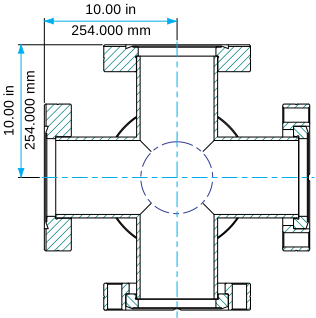
Conflat (CF) UHV 5-Way Standard Crosses are precision-machined vacuum components designed for ultra-high vacuum (UHV) systems requiring multiple orthogonal ports. Featuring knife-edge Conflat (CF) flanges, these crosses ensure leak-tight metal-to-metal sealing with copper gaskets, supporting vacuum levels down to 10⁻¹¹ mbar or lower.
5-way CF crosses are widely used in research laboratories, thin film deposition systems, surface science experiments, and semiconductor processing equipment where flexible port configuration and reliable sealing performance are critical.
Detailed Description
CF UHV 5-Way Standard Crosses are typically manufactured from high-quality 304L or 316L stainless steel with vacuum-grade finishing. The precision-machined knife-edge flange design compresses a soft copper gasket to form a permanent, bakeable seal capable of withstanding high-temperature degassing cycles.
Structural features include:
Five CF flange ports arranged in orthogonal configuration
Precision-machined knife edges for reliable sealing
Vacuum-cleaned and degreased surfaces
Smooth internal bore for optimized gas conductance
High structural rigidity for heavy instrument mounting
Available flange sizes commonly include:
CF16
CF35
CF63
CF100
CF160
Custom combinations (e.g., mixed port sizes)
These crosses allow integration of gauges, viewports, sputtering sources, manipulators, and pumping lines in compact UHV assemblies. Their symmetric geometry simplifies chamber layout and system alignment.
Applications
Conflat (CF) UHV 5-Way Standard Crosses are widely used in:
Ultra-high vacuum research systems
Thin film deposition chambers (PVD, sputtering, evaporation)
Surface analysis equipment (XPS, AES, SEM interfaces)
Semiconductor processing systems
Particle accelerators and beamlines
Cryogenic and superconducting experiments
Custom-built vacuum manifolds
Their multi-port design enables efficient distribution of instrumentation and pumping lines in complex vacuum systems.
Technical Parameters
| Parameter | Typical Value / Range | Importance |
|---|---|---|
| Material | 304L / 316L Stainless Steel | Ensures corrosion resistance & vacuum compatibility |
| Flange Type | CF (Conflat) Knife-Edge | Provides metal-to-metal UHV sealing |
| Leak Rate | ≤ 1 × 10⁻¹⁰ mbar·L/s | Ensures ultra-high vacuum integrity |
| Bakeout Temperature | Up to ~450°C (gasket dependent) | Supports UHV degassing procedures |
| Surface Finish | Vacuum cleaned | Minimizes outgassing |
| Port Configuration | 5-way standard cross | Enables multi-directional system integration |
Custom port sizes, mixed flange configurations, and special finishes can be provided upon request.
Comparison with Related Vacuum Components
| Component | Key Advantage | Typical Application |
|---|---|---|
| CF 5-Way Cross | Multi-port UHV connection | Research & deposition systems |
| CF 4-Way Cross | Simpler configuration | Compact manifolds |
| CF Tee | 3-port distribution | Linear vacuum lines |
| ISO-K Cross | Quick clamp assembly | High vacuum (not UHV) |
Compared to ISO-K systems, CF crosses provide superior sealing performance for true UHV applications due to metal gasket sealing technology.
FAQ
| Question | Answer |
|---|---|
| What gasket is used for sealing? | Oxygen-free high conductivity (OFHC) copper gaskets are typically used. |
| Are mixed flange sizes available? | Yes, customized port combinations can be manufactured. |
| Is the component suitable for UHV bakeout? | Yes, CF components are bakeable to high temperatures. |
| What material grade is recommended? | 304L and 316L stainless steel are standard for UHV compatibility. |
| Are cleaning and leak testing provided? | Yes, vacuum cleaning and helium leak testing can be supplied upon request. |
Packaging
Our Conflat (CF) UHV 5-Way Standard Crosses are meticulously tagged and labeled externally to ensure efficient identification and maintain high standards of quality control. Each unit is carefully packaged with protective flange covers and cushioning materials to prevent damage during storage and transportation.
Conclusion
Conflat (CF) UHV 5-Way Standard Crosses provide robust, leak-tight multi-port connectivity for advanced vacuum systems. With precision machining, high-quality stainless steel construction, and reliable knife-edge sealing, they are ideal for demanding ultra-high vacuum applications in research and industrial environments.
For detailed specifications and a quotation, please contact us at sales@thinfilmmaterials.com.
Ordering Table
| Flange Size/OD | Flange Material | Drawing | Part Number |
| DN25CF (2.13" OD) | 304L SS |

| C5-0133 |
| DN50CF (3.38" OD) | 304L SS |
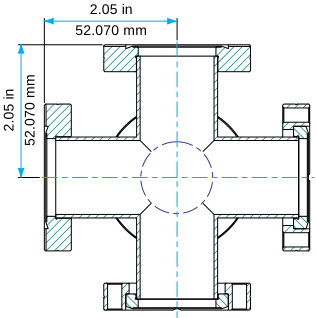
| C5-0212 |
| DN63CF (4.50" OD) | 304L SS |

| C5-0275 |
| DN100CF (6.00" OD) | 304L SS |
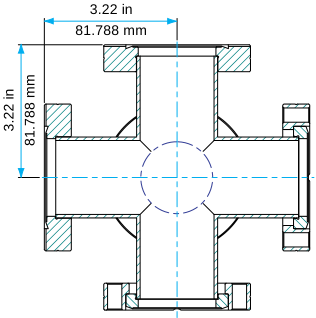
| C5-0337 |
| DN125CF (6.75" OD) | 304L SS |

| C5-0450 |
| DN160CF (8.00" OD) | 304L SS |
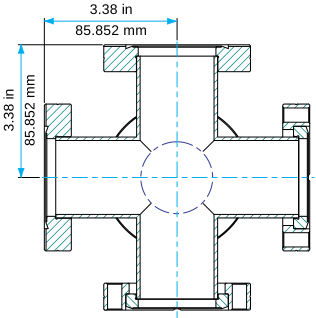
| C5-0450S |
| DN275CF (13.25" OD) | 304L SS |
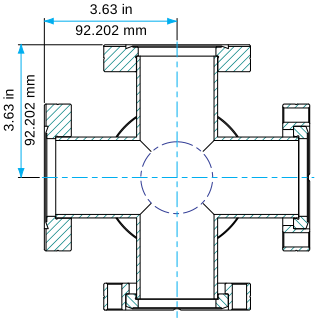
| C5-0462 |
| DN25CF (2.13" OD) | 304L SS |
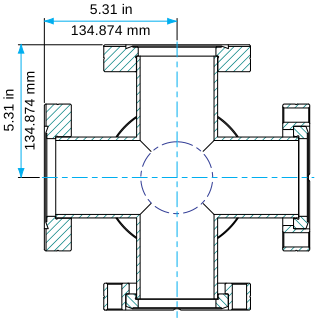
| C5-0600 |
| DN63CF (4.50" OD) | 304L SS |

| C5-0600S |
| DN125CF (6.75" OD) | 304L SS |
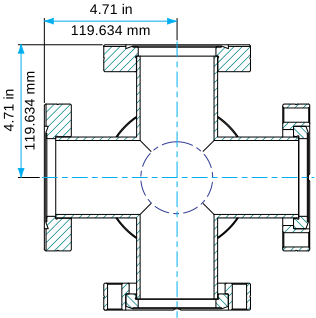
| C5-0675 |
| DN275CF (13.25" OD) | 304L SS |
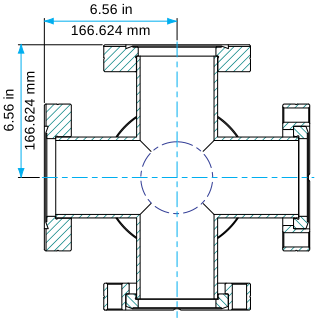
| C5-0800 |
| DN63CF (4.50" OD) | 304L SS |
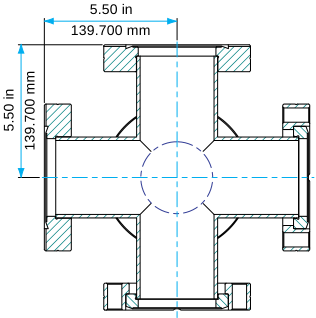
| C5-0800S |
| DN275CF (13.25" OD) | 304L SS |
| C5-1000 |
| DN275CF (13.25" OD) | 304L SS |
| C5-1325 |


Reviews
There are no reviews yet.