
Introduction
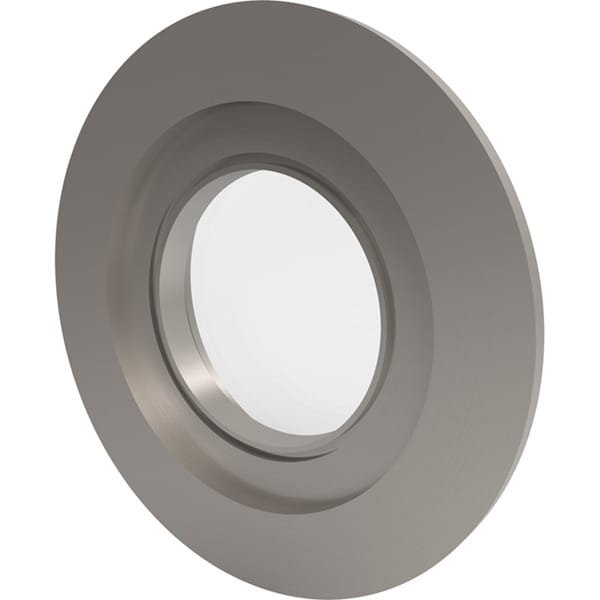
KF Flanged Sapphire Viewports are high-performance optical windows designed for vacuum systems that require excellent optical clarity, mechanical strength, and chemical durability. By combining ISO-KF quick-connect flanges with sapphire optical windows, these viewports provide reliable visual access and optical transmission for rough to high-vacuum applications in laboratory, semiconductor, and industrial environments.
Detailed Description
Sapphire viewports utilize single-crystal aluminum oxide (Al₂O₃) as the window material. Sapphire is valued for its exceptional hardness, high thermal stability, and wide optical transmission range, extending from ultraviolet (UV) through visible to infrared (IR). Compared with standard glass or quartz, sapphire offers significantly higher mechanical strength and scratch resistance, making it ideal for demanding vacuum conditions.
The KF flange design allows fast installation and removal using standard clamps and centering rings, enabling flexible system configuration and easy maintenance. The sapphire window is typically brazed or sealed into a stainless steel housing, ensuring vacuum integrity and long-term stability. High-quality sealing methods minimize outgassing and ensure consistent optical performance during vacuum operation and moderate bake-out cycles.
These viewports are suitable for visual inspection, optical diagnostics, laser alignment, and process monitoring. Their compact design makes them especially useful in space-constrained vacuum setups.
Applications
KF Flanged Sapphire Viewports are widely used in:
Laboratory and research vacuum systems
Semiconductor and thin-film deposition equipment
Optical diagnostics and laser alignment
Plasma observation and process monitoring
Leak detection and system inspection
Educational and industrial vacuum setups
Technical Parameters
| Parameter | Typical Value / Range | Importance |
|---|---|---|
| Window Material | Sapphire (single crystal Al₂O₃) | High strength and optical clarity |
| Flange Standard | KF16 / KF25 / KF40 | Compatible with ISO-KF systems |
| Optical Transmission | UV–Visible–IR | Supports optical monitoring |
| Body Material | 304 / 316L Stainless Steel | Vacuum compatibility and durability |
| Sealing Method | Brazed or metal-sealed assembly | Ensures leak-tight performance |
| Operating Pressure | Atmosphere to high vacuum | Suitable for most KF applications |
| Temperature | Limited by seal design | Supports moderate bake-out |
Comparison with Other Viewport Materials
| Viewport Material | Key Advantage | Typical Application |
|---|---|---|
| Sapphire | High strength, scratch resistant | Optical diagnostics |
| Fused Quartz | Good UV transmission | General observation |
| Borosilicate Glass | Cost-effective | Low-demand vacuum viewing |
FAQ
| Question | Answer |
|---|---|
| Why choose sapphire over quartz? | Sapphire offers higher mechanical strength and scratch resistance. |
| Are KF clamps and centering rings required? | Yes, standard KF hardware is needed for installation. |
| Can these viewports handle laser exposure? | Yes, sapphire is well suited for laser alignment and diagnostics. |
| Are custom sizes available? | Custom flange sizes and window thicknesses can be supplied. |
| Are they suitable for high vacuum? | Yes, within the limits of KF sealing systems. |
Packaging
Our KF Flanged Sapphire Viewports are carefully cleaned, capped, and packaged with protective materials to prevent scratches and contamination. Each unit is clearly labeled to ensure safe handling, storage, and transportation.
Conclusion
KF Flanged Sapphire Viewports provide a durable and optically superior solution for viewing and diagnostic access in vacuum systems. Their combination of sapphire’s exceptional material properties and the convenience of KF flanges makes them ideal for laboratory, semiconductor, and industrial vacuum applications.
For detailed specifications and a quotation, please contact us at sales@thinfilmmaterials.com.
Charts

Ordering Table
| Drawing | Flange / Mounting | Window Material | View Area | Window Thickness | Flange Material | Sleeve Material | Thermal Range | Parallelism | Surface Finish | Transmission | Orientation | PartNumber |

| KF16 (1.18" OD) | UV Sapphire | 0.60 | 0.062 | 304L SS | Kovar | -100C to 450C | <3 Arc Minutes | 50/20 Scratch-Dig | 50%@250nm (External) | 0-90 Deg | QF16-075-VPS |
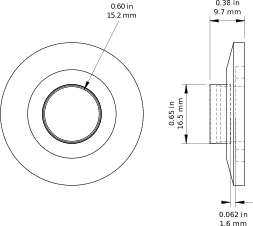
| KF25 (1.57" OD) | UV Sapphire | 0.60 | 0.062 | 304L SS | Kovar | -100C to 450C | <3 Arc Minutes | 50/20 Scratch-Dig | 50%@250nm (External) | 0-90 Deg | QF25-100-VPS |
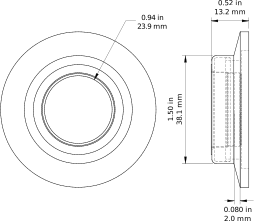
| KF40 (2.16" OD) | UV Sapphire | 0.94 | 0.080 | 304L SS | Kovar | -100C to 450C | <3 Arc Minutes | 50/20 Scratch-Dig | 50%@250nm (External) | 0-90 Deg | QF40-150-VPS |
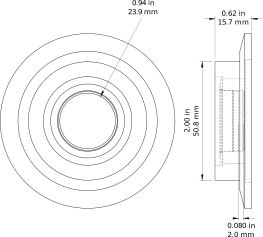
| KF50 (2.95" OD) | UV Sapphire | 0.94 | 0.080 | 304L SS | Kovar | -100C to 450C | <3 Arc Minutes | 50/20 Scratch-Dig | 50%@250nm (External) | 0-90 Deg | QF50-200-VPS |

Reviews
There are no reviews yet.