
Introduction
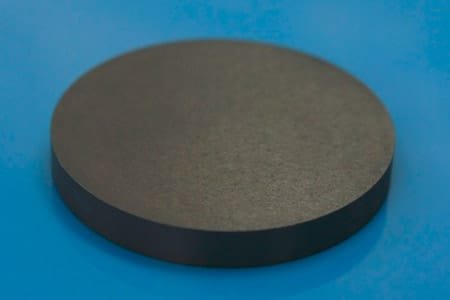
Lanthanum Calcium Manganate sputtering targets are advanced perovskite oxide materials widely used in functional thin-film research and oxide electronics. By partially substituting lanthanum with calcium, this manganite system exhibits tunable electrical conductivity and magnetic behavior, making it highly valuable for spintronic devices, magnetoresistive components, and correlated-electron oxide studies. These targets provide a stable and reproducible material source for high-quality oxide thin-film deposition.
Detailed Description
Lanthanum Calcium Manganate, typically expressed as La₁₋ₓCaₓMnO₃, is a mixed-valence manganese oxide with a perovskite crystal structure. Calcium substitution modifies the Mn³⁺/Mn⁴⁺ ratio, directly influencing charge transport, magnetic ordering, and phase behavior. This compositional flexibility allows researchers to tailor film properties for specific electronic and magnetic functions.
Our Lanthanum Calcium Manganate sputtering targets are manufactured from high-purity oxide precursors using carefully controlled solid-state synthesis and high-temperature sintering processes. The resulting targets feature high density, uniform composition, and good mechanical integrity, which are essential for stable sputtering rates and consistent film stoichiometry.
These ceramic targets are compatible with RF sputtering and pulsed-DC sputtering systems commonly used for complex oxide deposition. Planar disc targets are available in standard diameters, with optional bonding to copper or other backing plates to enhance heat dissipation and reduce thermal stress during operation. Custom compositions, calcium doping levels, dimensions, and bonding solutions can be supplied to support both research and pilot-scale production.
Applications
Lanthanum Calcium Manganate sputtering targets are primarily used in:
Magnetoresistive and spintronic thin films
Oxide electronics and correlated electron systems
Magnetic sensors and functional magnetic layers
Electrodes and buffer layers in oxide heterostructures
Perovskite oxide research and development
Academic and industrial thin-film R&D
Technical Parameters
| Parameter | Typical Value / Range | Importance |
|---|---|---|
| Chemical Formula | La₁₋ₓCaₓMnO₃ | Defines electrical & magnetic behavior |
| Purity | 99.9% – 99.99% | Reduces impurity-related defects |
| Ca Doping (x) | 0.1 – 0.4 (custom) | Tunes conductivity and magnetism |
| Crystal Structure | Perovskite oxide | Enables functional properties |
| Diameter | 1″ – 4″ (custom available) | Fits standard sputtering cathodes |
| Thickness | 3 – 6 mm | Influences target lifetime |
| Density | ≥ 95% of theoretical | Ensures stable sputtering performance |
| Backing Plate | Optional Cu / Al | Improves thermal management |
Comparison with Related Materials
| Material | Key Advantage | Typical Application |
|---|---|---|
| Lanthanum Calcium Manganate | Tunable magnetic & electronic properties | Spintronics, magnetoresistance |
| Lanthanum Strontium Manganate | Higher conductivity | Oxide electrodes, spintronics |
| Lanthanum Manganate | Insulating, antiferromagnetic | Fundamental oxide studies |
| Strontium Ruthenate | Metallic oxide electrode | Ferroelectric thin films |
FAQ
| Question | Answer |
|---|---|
| Can the calcium content be customized? | Yes, Ca doping levels can be tailored to specific requirements. |
| Is RF sputtering required? | Yes, RF or pulsed-DC sputtering is recommended for this ceramic target. |
| Do you offer bonded targets? | Yes, indium-bonded or elastomer-bonded options are available. |
| What density can be achieved? | Typical density exceeds 95% of theoretical density. |
Packaging
Our Lanthanum Calcium Manganate Sputtering Targets are meticulously tagged and labeled externally to ensure efficient identification and strict quality control. Each target is vacuum-sealed and protected with shock-absorbing materials to prevent damage or contamination during storage and transportation.
Conclusion
Lanthanum Calcium Manganate sputtering targets offer reliable composition control, high density, and stable sputtering behavior for advanced magnetic and electronic oxide thin films. With flexible doping options and robust manufacturing quality, they are an excellent choice for research and specialized device fabrication.
For detailed specifications and a quotation, please contact us at sales@thinfilmmaterials.com.
Reviews
There are no reviews yet.