
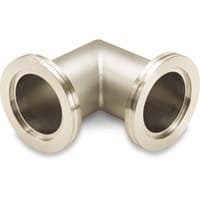
Miter 90° Elbows (ISO-K HV)
Introduction
Miter 90° Elbows (ISO-K HV) are precision-engineered vacuum components designed to change the direction of ISO-K high-vacuum piping by 90 degrees. These elbows are an essential part of vacuum plumbing systems, ensuring efficient space utilization and consistent flow without compromising vacuum integrity. They are commonly used in high and ultra-high vacuum (HV/UHV) systems across research, semiconductor, and industrial applications.
Detailed Description
Miter 90° elbows are constructed from high-quality stainless steel—typically 304L or 316L—for superior corrosion resistance, vacuum compatibility, and mechanical durability. The mitered geometry allows for a clean, sharp directional transition while maintaining consistent internal surface finish and cross-sectional area.
The ISO-K (also known as ISO Large Flange) standard uses clamp-style flanges for rapid assembly and disassembly. Each elbow is precisely welded, helium-leak tested, and internally polished to achieve high vacuum performance.
Key Features:
High-quality stainless steel (304L / 316L).
Miter-welded construction with smooth internal surfaces.
Compatible with ISO-K clamps and centering rings.
Leak-tested for HV/UHV performance.
Available in multiple diameters and custom lengths.
Applications
Miter 90° Elbows (ISO-K HV) are widely used in:
Vacuum coating systems – thin film deposition and sputtering setups.
Semiconductor process chambers – gas and vacuum distribution.
Analytical instruments – mass spectrometers, electron microscopes.
Research laboratories – beamlines and vacuum test systems.
Industrial vacuum systems – general-purpose vacuum plumbing.
Technical Parameters
| Parameter | Typical Value / Range | Importance |
|---|---|---|
| Material | Stainless Steel 304L / 316L | Corrosion-resistant and vacuum compatible |
| Angle | 90° (Miter Type) | Enables directional flow change |
| Flange Type | ISO-K (Clamp) | Quick assembly/disassembly |
| Diameter Range | DN63 – DN500 | Fits most HV pipelines |
| Leak Rate | ≤ 1×10⁻⁹ mbar · L/s | Ensures high vacuum integrity |
| Surface Finish | ≤ Ra 0.8 μm (internal) | Minimizes gas entrapment |
| Bakeout Temperature | Up to 200 °C (304L) | Suitable for HV cleaning cycles |
Comparison with Related Components
| Component Type | Key Advantage | Typical Use |
|---|---|---|
| Miter 90° Elbow (ISO-K HV) | Space-efficient sharp turn | Compact vacuum systems |
| Radius Elbow (ISO-K HV) | Reduced flow turbulence | High-flow lines |
| ISO-K Straight Tube | Direct linear connections | Standard vacuum lines |
| KF 90° Elbow (Small Flange) | Lightweight, compact design | Small-scale setups |
FAQ
| Question | Answer |
|---|---|
| What’s the difference between ISO-K and ISO-F flanges? | ISO-K uses clamps for quick connections, while ISO-F uses bolts. |
| Are these elbows UHV compatible? | Yes, with electropolished interior and proper sealing materials. |
| Can custom lengths or angles be made? | Yes, 45°, 60°, and custom miter angles are available on request. |
| What sealing method is used? | Centering rings with Viton, NBR, or metal O-rings depending on application. |
| Are elbows cleaned for vacuum use? | Yes, all elbows are degreased, particle-cleaned, and vacuum-packaged. |
Packaging
Each Miter 90° Elbow (ISO-K HV) is individually bagged in a clean environment to prevent contamination. Components are protected with end caps, foam inserts, and packed in sturdy export-grade boxes.
Conclusion
The ISO-K HV Miter 90° Elbow combines precision welding, corrosion resistance, and high-vacuum reliability, offering dependable performance for modern vacuum systems. Its modular flange design enables easy integration and maintenance while maintaining excellent sealing performance.
For specifications, dimensions, and quotations, please contact us at [sales@thinfilmmaterials.com].
Ordering Table
| Flange Size/OD | Type | Flange Material | Drawing | Nominal Tube OD | Dim A | Part Number |
| ISO63-K (3.74" OD) | Elbow, 90 Degree Mitered | 304L SS |

| 2-1/2 | 3.46 | QF63-E90K |
| ISO80-K (4.33" OD) | Elbow, 90 Degree Mitered | 304L SS |

| 3 | 3.86 | QF80-E90K |
| ISO100-K (5.12" OD) | Elbow, 90 Degree Mitered | 304L SS |

| 4 | 4.25 | QF100-E90K |
| ISO160-K (7.09" OD) | Elbow, 90 Degree Mitered | 304L SS |

| 6 | 5.43 | QF160-E90K |
| ISO200-K (9.45" OD) | Elbow, 90 Degree Mitered | 304L SS |

| 8 | 6.61 | QF200-E90K |
| ISO250-K (11.42" OD) | Elbow, 90 Degree Mitered | 304L SS |

| 10 | 8.19 | QF250-E90K |


Reviews
There are no reviews yet.