
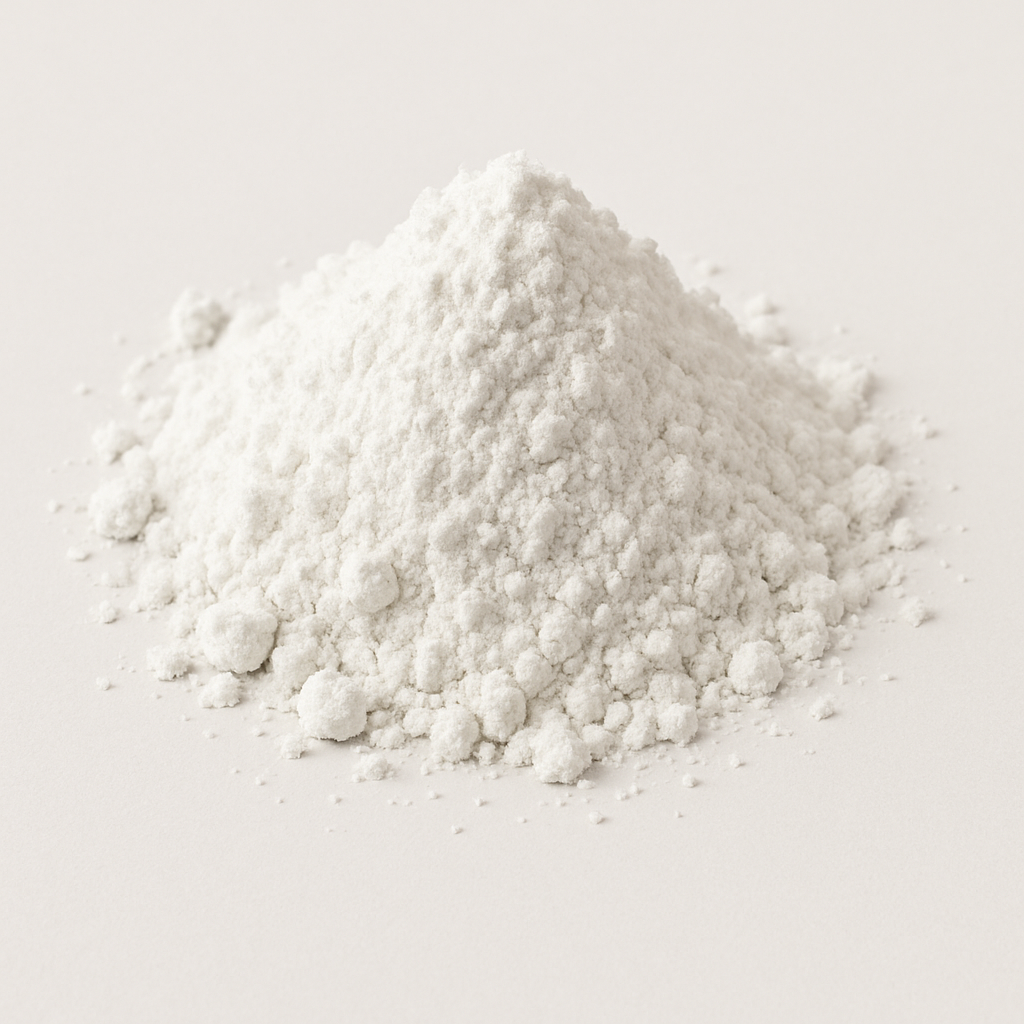
Yttrium(III) Oxide Powder
Introduction
Yttrium(III) Oxide Powder (Y₂O₃) is a high-performance ceramic material widely used in the fields of electronics, optics, and advanced coatings. Known for its high melting point, excellent thermal stability, and superior transparency in infrared and visible ranges, it plays a key role in next-generation technologies.
Detailed Description
Yttrium(III) Oxide is a white, odorless, fine powder composed of yttrium ions in a stable trivalent oxidation state. Produced with purities ranging from 99.9% (3N) to 99.999% (5N), Y₂O₃ ensures minimal impurities for high-end applications.
The powder features:
High thermal stability (melting point ~2,410 °C), making it suitable for refractory ceramics.
Low optical absorption in the visible and near-infrared spectrum, enabling use in optical coatings.
Chemical resistance, ensuring durability in harsh environments.
Uniform particle distribution (commonly in the 100 nm – 10 µm range), which improves sinterability and coating quality.
Applications
Yttrium(III) Oxide Powder is used across a range of industries, including:
Optics: Fabrication of transparent ceramics, laser crystals, and optical lenses.
Electronics: Gate dielectrics, insulating layers, and thin-film deposition.
Phosphors: Host material for rare-earth-doped phosphors in display and lighting technologies.
Ceramics: Additive in high-performance ceramic materials for aerospace and defense.
Coatings: Protective coatings for corrosion and wear resistance.
Technical Parameters
| Parameter | Typical Value / Range | Importance |
|---|---|---|
| Purity | 99.9% – 99.999% | High purity ensures performance in optical/electronic devices |
| Particle Size | 100 nm – 10 µm | Smaller particles enhance sintering and uniformity |
| Appearance | White fine powder | Consistency indicates stability |
| Melting Point | ~2410 °C | High melting point allows refractory applications |
| Density | 5.01 g/cm³ | Important for structural and ceramic uses |
Comparison with Related Materials
| Material | Key Advantage | Typical Application |
|---|---|---|
| Yttrium Oxide (Y₂O₃) | High thermal stability, IR transparency | Optical ceramics, coatings |
| Zirconium Oxide (ZrO₂) | High toughness, fracture resistance | Structural ceramics |
| Aluminum Oxide (Al₂O₃) | Cost-effective, high hardness | Refractories, abrasives |
FAQ
| Question | Answer |
|---|---|
| What purity levels are available? | Standard grades include 3N (99.9%), 4N (99.99%), and 5N (99.999%). |
| Can Y₂O₃ be used for optical coatings? | Yes, it provides high transparency and low absorption in visible/IR ranges. |
| Is particle size customizable? | Yes, nano-scale to micron-sized powders are available. |
| How is it packaged? | Vacuum-sealed bottles or bags, protected with moisture-proof materials. |
| Which industries use Y₂O₃ the most? | Optics, electronics, ceramics, phosphors, and aerospace. |
Packaging
Yttrium(III) Oxide Powder is packaged in airtight, moisture-proof containers, typically in vacuum-sealed bags or bottles. For bulk shipments, export-grade drums or cartons are used to ensure safe handling and storage.
Conclusion
Yttrium(III) Oxide Powder is an essential advanced material, enabling breakthroughs in optics, electronics, ceramics, and protective coatings. Its high purity, stability, and versatility make it an indispensable choice for both research and industrial applications.
For detailed specifications and a quotation, please contact us at [sales@thinfilmmaterials.com].

Reviews
There are no reviews yet.