Introduction
In high-temperature engineering, precision matters as much as power. Whether inside a vacuum chamber depositing nanometer-scale thin films, a research instrument probing surface reactions, or a specialized thermal analysis system, the heating element must deliver rapid response, clean operation, and reliable thermal stability.
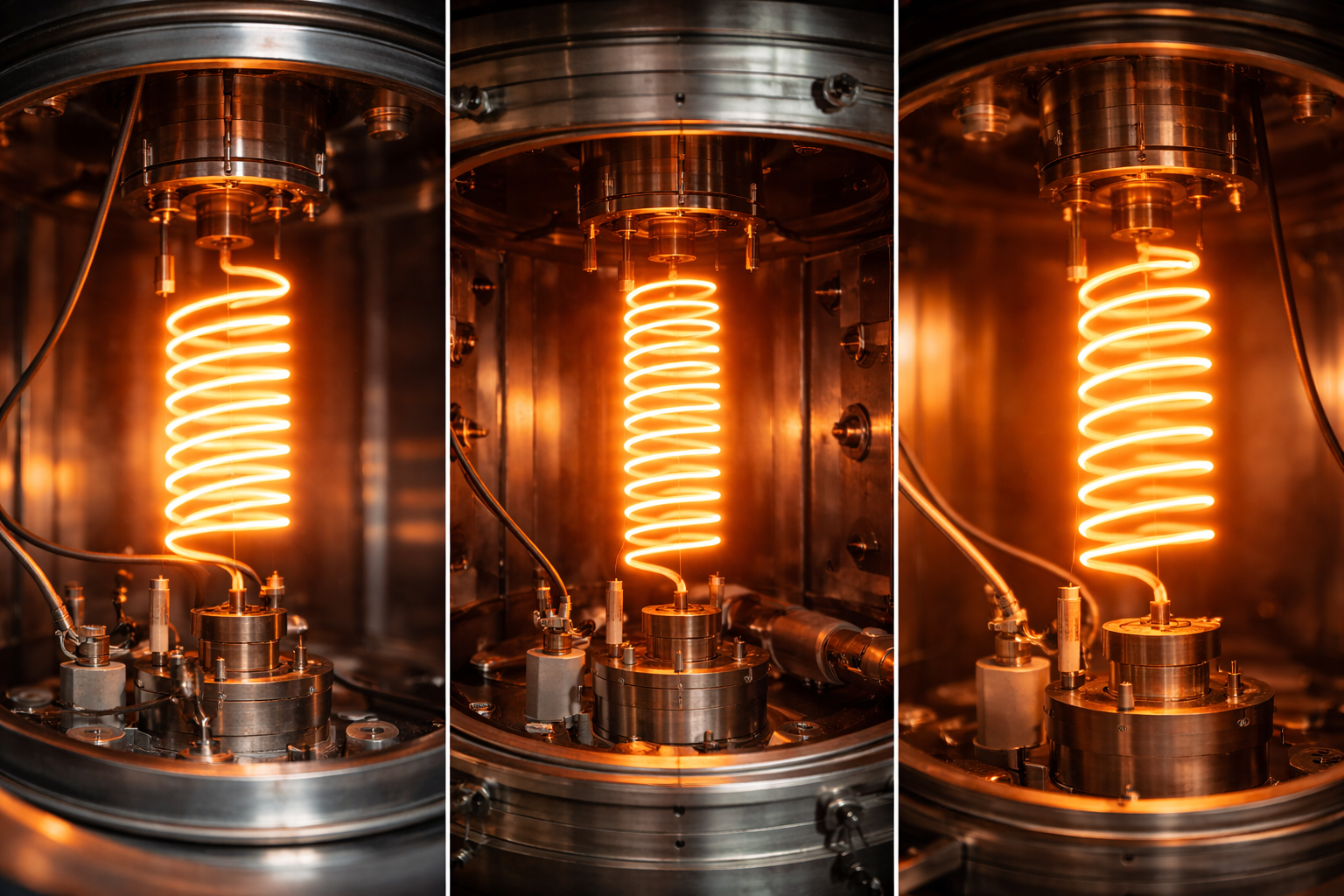
Thermal Filament Spiral Heaters occupy a unique position in this landscape. Despite their simple appearance—a carefully formed spiral of high-melting-point metal wire—they are indispensable in applications where conventional heaters fall short. Their ability to reach extreme temperatures quickly, operate reliably in vacuum or controlled atmospheres, and provide finely tunable heat output makes them a cornerstone of advanced scientific and industrial systems.
This article explores the major application scenarios of thermal filament spiral heaters in depth, explaining not only where they are used, but why they are chosen, how they are integrated, and what engineering advantages they offer across different industries.
1. Fundamentals of Thermal Filament Spiral Heaters
1.1 What Is a Thermal Filament Spiral Heater?
A thermal filament spiral heater consists of a metal filament formed into a helical or spiral geometry and heated by electrical resistance. Common filament materials include:
- Tungsten (W)
- Molybdenum (Mo)
- Tantalum (Ta)
- Rhenium (Re) and W-Re alloys
These materials are selected for their extremely high melting points, low vapor pressure at elevated temperatures, and stability in vacuum environments.
1.2 Why the Spiral Geometry Matters
The spiral form is not cosmetic—it is a deliberate engineering choice that provides several critical advantages:
- Extended effective length within a compact footprint
- Lower operating voltage for a given power level
- More uniform temperature distribution
- Improved mechanical flexibility to accommodate thermal expansion
This geometry allows the heater to reach temperatures exceeding 2000 °C while maintaining structural integrity.
2. Dominant Application Area: Vacuum Evaporation and Thin Film Deposition
2.1 Thermal Evaporation in PVD Systems
One of the most important application fields for thermal filament spiral heaters is physical vapor deposition (PVD), particularly thermal evaporation systems. In these systems, heat must be delivered efficiently in high vacuum, where convection is absent and conduction is limited.
Spiral filament heaters are used to:
- Heat evaporation boats or crucibles
- Directly evaporate low-melting-point materials
- Provide radiant heating to substrates or source materials
2.2 Process Control Advantages
Compared with bulk resistive heaters or ceramic heating elements, spiral filament heaters offer:
- Extremely fast thermal response, enabling precise control of evaporation rate
- Smooth power-to-temperature behavior, ideal for closed-loop control
- Minimal contamination, critical for optical and semiconductor coatings
These characteristics are particularly valuable in applications such as:
- Optical coatings
- OLED fabrication
- Laboratory-scale compound semiconductor research
3. Semiconductor Manufacturing and Microelectronics
3.1 Localized Heating in Precision Processes
In semiconductor R&D and specialty manufacturing tools, thermal filament spiral heaters are often used for localized or auxiliary heating, rather than full-wafer batch processing. Typical uses include:
- Substrate pre-heating before deposition
- Rapid thermal conditioning of masks or carriers
- Controlled heating in vacuum or inert gas environments
Because the heaters have low thermal mass, they allow fast temperature ramps without overshoot—an important requirement for temperature-sensitive processes.
3.2 Cleanliness and Compatibility
High-purity filament materials release negligible contaminants under vacuum, making them suitable for environments where metallic or particulate contamination must be minimized. This makes spiral filament heaters a practical choice for:
- Advanced lithography support tools
- Experimental semiconductor processes
- Device prototyping platforms
4. Research, Laboratories, and Scientific Instrumentation
4.1 High-Temperature Materials Research
In materials science laboratories, spiral filament heaters are widely used to induce or study high-temperature phenomena, including:
- Phase transitions
- Surface reconstruction
- High-temperature diffusion and reactions
Their ability to deliver stable, repeatable temperatures in ultra-high-vacuum (UHV) systems makes them ideal for fundamental research.
4.2 In-Situ Heating for Analytical Instruments
Many modern analytical tools integrate in-situ heating capabilities. Spiral filament heaters are commonly found in:
- XPS and UPS systems
- Surface science chambers
- Specialized SEM or TEM sample holders
Their compact size, minimal magnetic interference, and controllable heat output allow them to be integrated directly into measurement environments without compromising data quality.
5. Industrial Vacuum Furnaces and Thermal Processing Equipment
5.1 Small-Scale and Precision Heating Applications
While large industrial vacuum furnaces often rely on graphite or massive resistive elements, spiral filament heaters excel in small-scale or precision thermal processing, such as:
- Local annealing of critical components
- Heat treatment of small, high-value parts
- Experimental furnace designs
They are particularly useful where fast cycling, low energy consumption, and tight temperature control are required.
5.2 Advantages over Conventional Heating Elements
Compared with traditional ceramic or graphite heaters, spiral filament heaters offer:
- Faster start-up and cool-down
- Reduced thermal inertia
- Greater design flexibility
These features reduce processing time and increase system efficiency in specialized industrial settings.
6. Gas Analysis, Mass Spectrometry, and Sensor Systems
6.1 Thermal Activation and Gas Processing
In gas analysis and vacuum diagnostics, spiral filament heaters are often used for:
- Gas cracking or dissociation
- Sample conditioning
- Ion source or emitter heating
Their ability to reach high temperatures quickly improves system response time and measurement sensitivity.
6.2 Stability in Analytical Environments
Because the filament temperature can be precisely controlled, spiral heaters support consistent operating conditions—an essential requirement for analytical repeatability in mass spectrometry and gas sensing systems.
7. Radiative Heat Sources and Calibration Applications
7.1 Infrared and Broadband Radiation Sources
At high temperatures, metal filaments act as efficient broadband radiative emitters. Spiral filament heaters are therefore used as:
- Infrared radiation sources
- Calibration references for optical sensors
- Test sources in thermal imaging systems
Their predictable emission characteristics make them valuable in both industrial and research calibration setups.
8. Material Selection and Application Matching
The choice of filament material has a direct impact on heater performance and lifetime:
| Filament Material | Key Properties | Typical Applications |
|---|---|---|
| Tungsten (W) | Highest melting point, low vapor pressure | Vacuum evaporation, UHV research |
| Molybdenum (Mo) | Good ductility, easier fabrication | Medium-high temperature heaters |
| Tantalum (Ta) | Excellent chemical stability | Reactive atmospheres |
| Rhenium (Re) / Alloys | Exceptional thermal shock resistance | Extreme research environments |
Selecting the correct material ensures long service life, stable output, and process compatibility.
9. Engineering Considerations for System Integration
When specifying or designing a thermal filament spiral heater, engineers typically evaluate:
- Operating environment
- Vacuum level
- Gas composition
- Temperature requirements
- Maximum continuous temperature
- Heating and cooling rates
- Mechanical constraints
- Available space
- Mounting method
- Electrical characteristics
- Power supply limits
- Voltage and current control
Proper integration ensures consistent performance and minimizes failure risk.
Conclusion
Thermal Filament Spiral Heaters may appear deceptively simple, but their impact across advanced technology sectors is profound. From enabling precise thin-film deposition and semiconductor processing to supporting cutting-edge scientific research and analytical instrumentation, these compact heating elements deliver a rare combination of extreme temperature capability, rapid response, and operational cleanliness.
As high-temperature systems continue to demand greater precision and flexibility, thermal filament spiral heaters remain a proven and adaptable solution—quietly powering some of the most demanding processes in modern science and industry.
For detailed specifications, material options, and customized heater designs, please contact us at sales@thinfilmmaterials.com.