Germanium-antimony-telluride (GST) sputtering targets are source materials for depositing Ge-Sb-Te thin films. GST describes a family of compositions; Ge2Sb2Te5 (often called GST-225) is one member, not a universal synonym for every GST alloy. A useful target specification therefore starts with the required Ge:Sb:Te ratio and composition basis, then adds dimensions, backing or bonding details, cathode constraints, and the evidence needed for incoming inspection.
This guide explains how to translate a thin-film objective into an RFQ for a GST target without treating target chemistry as a guarantee of deposited-film or device performance. For the commercial material page, see the Germanium antimony telluride target. To compare other target families, use the sputtering targets catalog.
GST composition: specify the alloy, not only the acronym
Ge-Sb-Te alloys are studied as phase-change materials because their amorphous and crystalline states can have different electrical and optical responses. Those responses depend on composition, structure, thermal history, interfaces, and device design. A purchase description that says only “GST” leaves the central material variable undefined.
| RFQ item | What to state | Why it matters |
|---|---|---|
| Composition | Exact Ge:Sb:Te ratio or formula, for example GST-225 when that is the intended alloy | Different ratios are different source materials and should not share one undifferentiated specification |
| Composition basis | Atomic percent, weight percent, nominal formula, or another clearly defined basis | Prevents an apparently identical ratio from being interpreted on different bases |
| Acceptance tolerance | Required allowable deviation, if the program has one | Turns a nominal value into a measurable acceptance criterion |
| Evidence | Requested analytical method, lot-specific result, and reporting format | Makes the requirement auditable instead of relying on a catalog label |
| Dopants | Element, target level, basis, and tolerance | A doped GST material is not interchangeable with an undoped alloy |
If the intended composition is still being screened, separate that experimental decision from the mechanical target specification. A co-sputtering approach can provide composition-adjustment flexibility, but it also adds calibration, rate-control, and uniformity variables.
Target composition is not deposited-film composition
A target certificate describes the supplied target under the stated test method. It does not certify the film after deposition. Multicomponent film composition can be influenced by the sputtering system, power mode and power density, pressure, gas conditions, target history, substrate temperature, geometry, resputtering, and any post-deposition anneal. The relationship should be established on the buyer’s tool with a defined qualification run.
For that reason, keep two records: the target’s lot evidence and the film’s measured result. Film verification may use a suitable compositional technique selected by the laboratory, while structural, electrical, or optical tests should be chosen for the actual research or device question. Do not use a target purity or nominal formula as a substitute for film metrology.
Single-alloy GST target or co-sputtering?
| Route | Useful when | Qualification burden |
|---|---|---|
| Single GST alloy target | The nominal alloy is already selected and repeatable deposition from one source is preferred | Confirm target-to-film transfer on the actual system and monitor drift over target life |
| Multiple elemental or compound sources | Composition screening or deliberate gradients are part of the experiment | Calibrate each source, control rate interactions, map uniformity, and verify the resulting film composition |
| Doped GST target | A defined doped composition has been selected | Specify dopant basis and tolerance, then verify both target and film rather than assuming incorporation |
Neither route is automatically better. The choice depends on whether the priority is a fixed source composition or adjustable experimental space, and on the process-control capability of the deposition system.
Mechanical and cathode-fit information for the RFQ
Composition alone is not enough to establish fit. Provide a drawing or a complete dimensional description and identify the cathode or tool constraints that control the interface.
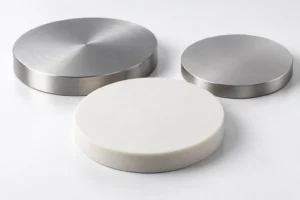
- Geometry: round, rectangular, or another required shape.
- Dimensions: diameter or length and width, target thickness, and tolerances.
- Edge and surface requirements: only where they are defined by the cathode, fixture, or handling process.
- Backing plate: material, dimensions, hole pattern, interface drawing, and whether customer-supplied hardware will be used.
- Bonding: requested bond system or service, plus thermal and process constraints known to the buyer.
- Cathode information: manufacturer/model where available, clamp area, cooling arrangement, and usable erosion zone.
- Operating context: RF or DC mode under evaluation, planned power range, gas chemistry, and whether reactive operation is involved.
For backed assemblies, review the target bonding service and submit the interface drawing. Bonding and cooling choices must be evaluated as an assembly and process question; a generic backing-plate statement cannot establish compatibility with a particular cathode.
Purity, impurities, density, and documentation
Ask for evidence that matches the risk of the application. A headline purity grade is incomplete unless the calculation basis, analyzed elements, detection limits, and test method are clear. If particular impurities can affect the program, name them and state individual limits instead of relying only on total purity.
| Document or result | What to check |
|---|---|
| Lot-specific CoA | Material identity, composition basis, reported impurities, method, units, and lot traceability |
| Density result, when required | Measured value, units, method, and whether a theoretical-density percentage uses a stated reference |
| Dimensional report | Drawing revision, measured dimensions, tolerances, and inspection date |
| Bonding record, when applicable | Assembly identity, backing-plate identity, bond method, and inspection criteria agreed for the order |
| SDS | Current document for hazard communication; an SDS is not a composition certificate or proof of film performance |
Density can be a relevant target attribute, but it should be treated as a measured property with a disclosed method—not as an unsupported “high-density” promise. The acceptable value depends on the agreed material and manufacturing specification.
A controlled GST target qualification workflow
- Define the film objective. Record the intended Ge-Sb-Te composition and the electrical, optical, or structural measurement that will determine success.
- Freeze the target RFQ. Specify composition basis, tolerances, geometry, backing or bonding, documentation, and cathode information.
- Check incoming evidence. Match the target identity and lot documents to the purchase requirement before installation.
- Establish a conservative process window. Follow the tool and cathode limits; record power, pressure, gas, substrate condition, geometry, and pre-sputter history.
- Measure the film. Verify composition and the application-relevant properties rather than assuming they match the target.
- Change one variable at a time. When possible, separate material changes from power, pressure, temperature, and annealing changes.
- Lock the qualified baseline. Preserve target lot, process settings, film metrology, and device-test context for the next comparison.
This workflow matters because research on GST and related phase-change materials shows that switching outcomes are system-specific: composition, interfaces, thermal history, cell architecture, and programming conditions all contribute. Supplier documentation can support material traceability, but the buyer’s process and device data establish suitability.
Application context without performance guarantees

GST thin films are investigated and used in phase-change memory and optical or photonic structures because a reversible change of material state can produce electrical and optical contrast. They are also researched for neuromorphic and reconfigurable-photonic concepts. These are application contexts, not claims that a particular target will deliver a specified switching speed, endurance, optical contrast, or device yield.

GST sputtering target RFQ checklist
- Exact GST composition or nominal formula, with atomic/weight basis stated
- Composition tolerance and any named impurity limits
- Required analytical method and lot-specific CoA format
- Target geometry, full dimensions, tolerances, and drawing revision
- Backing-plate and bonding requirements, if applicable
- Cathode/tool model, clamp interface, cooling arrangement, and usable area
- RF/DC and reactive/non-reactive process context under evaluation
- Required dimensional, density, bonding, SDS, and packaging documentation
- Quantity, destination, and requested delivery window
Send the checklist and drawing through the TFM contact and RFQ page. TFM can then confirm which requested composition, geometry, documentation, and assembly requirements are feasible; do not treat this guide as confirmation of availability before technical review.
Frequently asked questions
Is GST always Ge2Sb2Te5?
No. GST names the germanium-antimony-tellurium material family. Ge2Sb2Te5, or GST-225, is a widely discussed composition, but the requested ratio must be stated explicitly.
Does the target composition guarantee the film composition?
No. The target is one input. Film composition and properties must be measured after deposition because the tool, process conditions, substrate state, geometry, and thermal history can influence the result.
What should be included in a GST target quotation request?
Include the exact composition and basis, purity and named impurity requirements, dimensions and tolerances, backing or bonding information, cathode model or interface drawing, process context, quantity, and required documents.
Technical references
- Materials Advances review: recent advances in doped Ge2Sb2Te5 thin-film phase-change memories
- Applied Physics Letters: crystallization of sputter-deposited and ion-implanted amorphous Ge2Sb2Te5 films
- Nature Communications: device architecture, programming conditions, and endurance in carbon-doped GeSbTe phase-change memory
- International Journal of Applied Glass Science: chalcogenide phase-change materials review
Evidence boundary: the references above establish research context and illustrate why material, film, and device variables must be separated. They do not certify a TFM target, lot, process result, or device outcome.