
Introduction
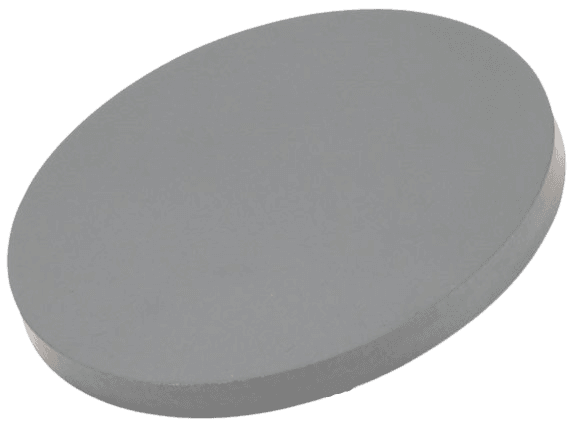
Lanthanum Strontium Chromate (La₁₋ₓSrₓCrO₃, commonly referred to as LSCr) is a perovskite oxide material widely used in high-temperature electrochemical systems and functional oxide electronics. Known for its excellent electrical conductivity, chemical stability, and resistance to harsh environments, LSCr is a key material for solid oxide fuel cells (SOFCs), interconnect coatings, and advanced thin film devices. High-quality sputtering targets are essential to achieve uniform, defect-free films with controlled stoichiometry.
Detailed Description
Lanthanum Strontium Chromate adopts a perovskite crystal structure, where partial substitution of lanthanum (La) by strontium (Sr) enables precise tuning of electrical conductivity and thermal expansion behavior. The compositional parameter “x” (typically ranging from 0.1 to 0.5) directly influences charge carrier concentration and transport properties, making LSCr highly adaptable for different functional applications.
LSCr sputtering targets are produced through advanced ceramic processing techniques, including high-purity powder synthesis, calcination, and high-temperature sintering. Achieving phase-pure perovskite structure and high density is critical, as porosity or compositional inhomogeneity can negatively impact sputtering stability and thin film quality.
Compared to manganate-based perovskites, LSCr offers superior chemical and thermal stability under both oxidizing and reducing atmospheres, which is particularly important for high-temperature applications such as SOFC interconnects. Dense targets (≥95% theoretical density) ensure consistent sputtering rates, reduced particle generation, and improved film uniformity.
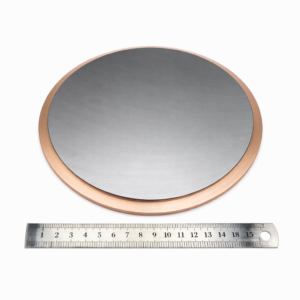
For enhanced thermal management during deposition, targets can be supplied with copper backing plates using indium or elastomer bonding. Custom compositions and geometries are available to match specific process requirements.
Applications
Lanthanum Strontium Chromate Sputtering Targets are widely used in:
- Solid Oxide Fuel Cells (SOFCs): Interconnect coatings and conductive layers
- High-Temperature Electronics: Stable conductive oxide films
- Protective Coatings: Oxidation-resistant layers in harsh environments
- Oxide Electronics: Functional thin films in perovskite-based devices
- Research & Development: Studies on mixed ionic-electronic conductors
Technical Parameters
| Parameter | Typical Value / Range | Importance |
|---|---|---|
| Chemical Formula | La₁₋ₓSrₓCrO₃ | Defines perovskite structure |
| Composition (x) | 0.1 – 0.5 (customizable) | Controls conductivity and stability |
| Purity | ≥ 99.9% (3N) | Ensures phase purity and performance |
| Density | ≥ 95% theoretical density | Improves sputtering efficiency |
| Diameter | 25 – 200 mm (custom) | Fits sputtering systems |
| Thickness | 3 – 6 mm | Affects deposition rate and lifetime |
| Bonding | Unbonded / Cu-backed (Indium/Elastomer) | Enhances heat dissipation |
Comparison with Related Materials
| Material | Key Advantage | Typical Application |
|---|---|---|
| La₁₋ₓSrₓCrO₃ (LSCr) | High thermal stability, oxidation resistance | SOFC interconnects |
| La₁₋ₓSrₓMnO₃ (LSMO) | Strong magnetic and conductive properties | Spintronics, electrodes |
| LaCrO₃ | Stable but lower conductivity | Basic oxide coatings |
| SrTiO₃ | Excellent dielectric properties | Substrates, capacitors |
FAQ
| Question | Answer |
|---|---|
| Can the Sr doping level (x) be customized? | Yes, the composition can be tailored to optimize electrical and thermal properties for specific applications. |
| Is LSCr suitable for high-temperature deposition? | Yes, it is highly stable under elevated temperatures and harsh environments. |
| What sputtering method is recommended? | RF sputtering is typically used due to the ceramic nature of the material. |
| Can bonded targets be supplied? | Yes, copper-backed targets with indium or elastomer bonding are available. |
| Which industries use LSCr targets? | Energy (SOFC), advanced coatings, electronics, and research institutions. |
Packaging
Our Lanthanum Strontium Chromate Sputtering Target, La₁₋ₓSrₓCrO₃, is meticulously tagged and labeled externally to ensure efficient identification and maintain high standards of quality control. We take great care to prevent any potential damage during storage and transportation, ensuring the target arrives in perfect condition.
Conclusion
Lanthanum Strontium Chromate Sputtering Targets provide a robust solution for depositing high-performance oxide thin films in demanding environments. With excellent thermal stability, tunable conductivity, and customizable specifications, LSCr is an ideal material for energy systems and advanced functional coatings.
For detailed specifications and a quotation, please contact us at sales@thinfilmmaterials.com.
Reviews
There are no reviews yet.