
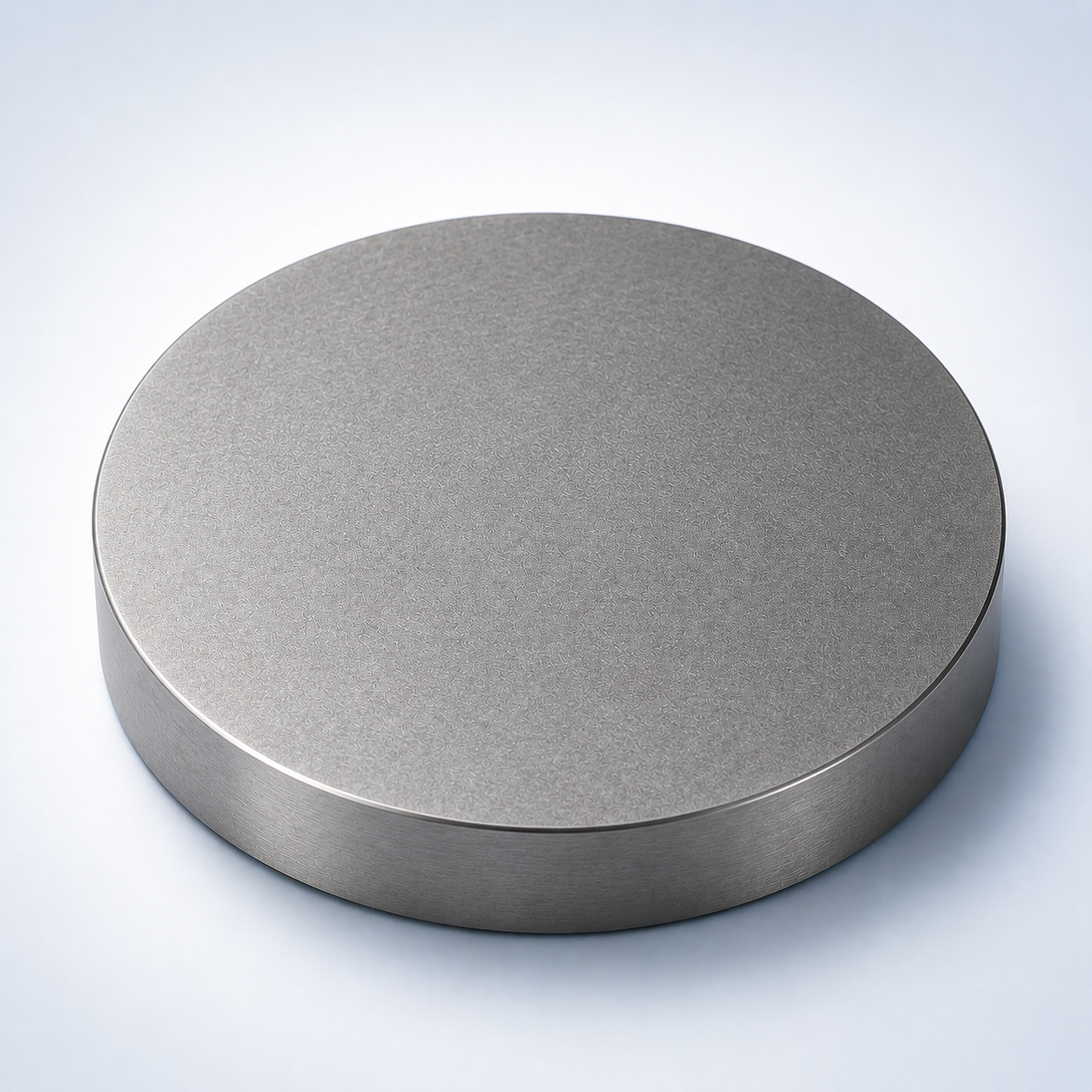
Product Overview
Germanium Antimony Sputtering Target (Ge-Sb) is a composition-specific sputtering target for thin-film deposition and PVD process development. The practical specification normally includes chemistry, purity, dimensions, density, target configuration, and any bonding or backing requirement needed by the sputtering cathode.
Material and Deposition Characteristics
Power mode and process conditions should be selected according to the target conductivity, thermal behavior, and the requirements of the cathode system. For less common materials, conservative initial power density and film-composition verification are good practice.
Technical Data
| Parameter | Typical Value / Range | Importance |
|---|---|---|
| Chemical Composition | Ge–Sb alloy (custom ratios) | Controls phase-change properties |
| Purity | 99.9% – 99.99% | Reduces defect density in films |
| Diameter | 25 – 200 mm (custom available) | Compatible with sputtering systems |
| Thickness | 3 – 6 mm | Influences target lifetime |
| Density | ≥ 99% theoretical | Improves plasma stability |
| Sputtering Mode | DC / RF sputtering | Suitable for conductive alloys |
| Bonding | Unbonded / Cu backing (optional) | Enhances thermal management |
| Material | Key Advantage | Typical Application |
|---|---|---|
| Ge–Sb | Tunable phase-transition behavior | PCM & data storage |
| Ge–Sb–Te (GST) | Mature phase-change system | Rewritable memory |
| Pure Sb | Rapid crystallization | Switching layers |
| Ge–Se | Optical transparency | IR thin films |
| Question | Answer |
|---|---|
| Can the Ge–Sb composition be customized? | Yes, alloy ratios can be tailored to meet specific electrical or optical requirements. |
| Is DC sputtering suitable? | Yes, Ge–Sb alloys are typically compatible with DC sputtering systems. |
| Are bonded targets available? | Yes, copper backing plates are available upon request. |
| How is the target packaged? | Vacuum-sealed with protective foam and export-grade cartons or crates. |
Typical Thin-Film Applications
- Thin-film research and materials-development projects requiring a composition-specific sputtering source
- Semiconductor, optical, energy, electronic, or laboratory coatings depending on the material system
- Custom R&D work where target composition, purity, and geometry need to be specified together
Target Configuration and Ordering Considerations
For quotation and manufacturability review, provide target size, thickness, purity or alloy composition, quantity, and the sputtering gun or cathode model if known. If a bonded assembly is required, include backing-plate material, bonding preference, and any dimensional tolerances, surface-finish needs, or inspection-document requirements. TFM can also review customer drawings or old-target samples for replacement builds.
Frequently Asked Questions
What is the main reason to use a Germanium Antimony sputtering target?
It provides a composition-specific source for thin-film deposition when the target material itself is important to the desired film chemistry or process.
How should the sputtering mode for Germanium Antimony be selected?
The power mode should be chosen according to target conductivity, thermal behavior, and equipment capability. Less-conductive materials are commonly evaluated with RF power.
Why are density and microstructure important for Germanium Antimony targets?
These factors can influence erosion stability, thermal behavior, particle generation, and the risk of cracking or local hot spots.
Can Germanium Antimony be supplied with a backing plate?
Yes. If the material is brittle or the cathode requires it, a bonded configuration can be reviewed according to target size, thickness, cooling, and power.
Does target composition always equal film composition?
No. Film chemistry may differ because of sputtering yields, process conditions, substrate temperature, re-sputtering, and chamber history. Film verification is recommended when composition matters.
What should I provide to request a quotation for Germanium Antimony?
Please provide the composition, purity, dimensions, quantity, target configuration, cathode details, and any drawing or inspection requirements.

Reviews
There are no reviews yet.