Note: No customer-specific project data were provided for this article. The case below is written as a technically realistic, anonymized representative case study based on common Al/Cu evaporation requirements and published thin-film research, rather than as a claim about a specific completed customer order.
Project Background
A thin-film research team was developing aluminum–copper metallization layers for experimental electronic devices. The objective was not simply to deposit a conductive aluminum coating, but to investigate how a controlled addition of copper affected the electrical behavior, microstructure, thermal stability, and reliability of the resulting metallic film.
Aluminum has long been used as a metallization material because of its high electrical conductivity, low density, relatively easy vacuum deposition, and compatibility with semiconductor processing. Adding a small amount of copper is particularly relevant to metallization research because Cu additions have historically been used to improve the electromigration resistance of aluminum-based conductors. Published work on Al-Cu metallization has specifically discussed incorporating approximately 0.5% Cu into aluminum films for this purpose.
For the research program, however, purchasing a generic aluminum evaporation source was insufficient. The deposition team needed custom Al/Cu evaporation material with controlled alloy composition, high chemical purity, a practical charge geometry, and consistent material from batch to batch.
The central engineering issue soon became clear: specifying an Al/Cu source composition is not the same as guaranteeing that the deposited film will reproduce that composition.
That difference became the key consideration in the material design.
The Challenge: Source Composition Is Not Necessarily Film Composition
Single-source evaporation of an alloy can look straightforward. An alloy containing aluminum and copper is placed in a crucible, heated under vacuum, and the resulting vapor condenses on the substrate.
In practice, the process is considerably more complicated.
Aluminum and copper do not evaporate at exactly the same rate. Their vapor pressures and thermodynamic behavior differ, so the composition of the vapor leaving an Al-Cu melt may not equal the nominal composition of the bulk source.
Published research on vacuum evaporation of Cu-Al alloys showed that film composition depends on both source composition and the vapor-pressure behavior of the two elements. The researchers found that calculated and measured film compositions could diverge significantly across portions of the Cu-Al compositional range.
More recent work has demonstrated the same fundamental challenge from another perspective. Al-Cu films deposited from a single source showed measurable surface and depth-dependent composition gradients, whereas co-deposition from separate Al and Cu sources allowed a much broader and more controllable compositional library to be produced.
For the research team, this meant the procurement question could not simply be:
“What Al/Cu alloy percentage should we order?”
The more useful question was:
“What source composition and material form will give us a stable starting point for developing the film composition we actually need?”
That distinction shaped the entire custom material specification.
Representative Material Requirement
For this case study, the project was defined around an aluminum-rich Al/Cu evaporation source intended for controlled metallization experiments.
| Parameter | Representative Requirement | Engineering Reason |
|---|---|---|
| Material | Aluminum–Copper alloy | Source material for metallic Al-Cu films |
| Composition | Custom Al-rich Al/Cu ratio | Allows film-composition studies |
| Purity | 99.99% class or project-specific | Limits uncontrolled metallic impurities |
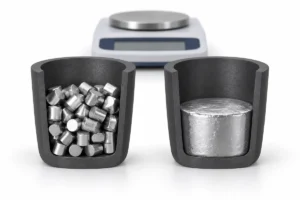
| Form | Granules / pieces / pellets | Practical crucible loading and replenishment |
| Size | Controlled, relatively uniform pieces | Supports repeatable charge loading |
| Surface | Clean, low visible contamination | Important for vacuum processing |
| Packaging | Sealed protective packaging | Reduces contamination during handling |
| Documentation | Composition and material identification | Supports experimental traceability |
TFM can supply Aluminum Copper Evaporation Materials in powder, granule, and customized forms, with listed purity options ranging from 99.9% to 99.999%.
Why the Al/Cu Ratio Required Special Attention
One of the most important decisions was to avoid treating the nominal alloy composition as a direct prediction of deposited-film composition.
Consider an aluminum-rich source such as Al-2 wt% Cu. Published process discussions of alloy evaporation show that preferential evaporation can make the resulting vapor and film substantially more aluminum-rich than the original alloy. One reported example estimated that a 98 wt% Al / 2 wt% Cu source could initially produce a film containing only about 0.7 wt% Cu, with practical values under certain conditions reported even lower.
This does not mean that every Al-2Cu source will produce the same result. Evaporation temperature, source geometry, melt condition, chamber configuration, deposition angle, source depletion, deposition rate, and equipment design all matter.
Instead, the practical lesson is:
The source composition should be treated as one controlled process variable, not as a guarantee of film stoichiometry.
That principle was incorporated into the material recommendation.
Rather than promise that a particular Al/Cu source would automatically generate an identical Al/Cu film, the material was specified accurately at the source level, while final film composition would be established experimentally through deposition and characterization.
This is particularly important for research institutions, where misleading precision at the material-supply stage can create more problems than it solves.
Selecting the Material Form
Composition was only one part of the specification. The physical form of the evaporation charge also mattered.
Very fine powder can provide a high surface area, but it is not always the most convenient form for loading a conventional evaporation crucible. Handling losses, surface oxide, dust generation, and charge packing can become practical concerns.
Large irregular chunks, on the other hand, may load unevenly and can make repeatable charge mass or melt geometry more difficult.
For this project type, controlled granules, pellets, or small alloy pieces provide a practical compromise. They can be weighed easily, loaded consistently, and supplied in dimensions compatible with the intended evaporation source.
The purpose of dimensional control is not cosmetic. A more repeatable charge geometry can help researchers reduce one source of run-to-run variability when they are already studying a deposition system in which alloy composition may evolve during evaporation.
Material Preparation Strategy
For an Al/Cu evaporation material, the goal is to produce a chemically controlled alloy source rather than mechanically mixing unrelated pieces immediately before shipment.
The target composition is therefore defined first, followed by selection of appropriate starting materials and an alloy-processing route suitable for the requested quantity and form.
After alloy preparation, the material can be converted into evaporation-compatible pieces or granules and cleaned to reduce loose contamination from cutting or handling.
Particular attention is required because aluminum naturally forms a stable surface oxide when exposed to air. Eliminating every trace of native oxide under normal handling conditions is unrealistic, so material preparation should instead focus on maintaining a clean, controlled surface and preventing unnecessary contamination before vacuum use.
Packaging is therefore part of the material specification rather than an afterthought.
Why Purity Matters in Metallization Research
High purity is especially important when researchers are trying to correlate film properties with a deliberately controlled Cu addition.
If Fe, Si, Mg, Ni, or other metallic impurities are introduced at uncontrolled levels, it becomes more difficult to distinguish the effect of the intentional Al/Cu composition from the effect of contamination.
This does not mean that the highest available purity is automatically necessary for every experiment. A preliminary process-development program and a device-oriented research project may have very different purity requirements.
The appropriate question is whether the impurity level is sufficiently low relative to the property being investigated.
For fundamental thin-film studies, tighter chemistry control generally improves experimental interpretation and batch-to-batch comparability.
The Deposition Problem the Researchers Still Had to Solve
Supplying a composition-controlled alloy solves the source-material problem, but it does not eliminate the deposition-process problem.
As evaporation proceeds, the more volatile component can be depleted preferentially from the melt. Consequently, the composition of the remaining source can evolve during a run.
Teaching material on alloy evaporation illustrates this directly: preferential vaporization can cause an initially correct vapor composition to change progressively, producing a film whose chemistry varies through thickness unless the process is carefully controlled.
Experimental studies of Al-Cu evaporation have likewise found compositional gradients associated with single-source deposition.
For the research team, several process variables therefore became important during qualification: evaporation rate, charge mass, source temperature, fraction of the charge consumed during each run, substrate position, deposition angle, and whether fresh material was added between cycles.
The critical recommendation was to characterize actual deposited films rather than infer their chemistry exclusively from the certificate of the evaporation source.
Techniques such as EDS/EDX, XPS, XRF, RBS, or another validated compositional method can be selected according to film thickness, substrate, required accuracy, and available instrumentation.
Single-Source Evaporation or Co-Evaporation?
The project also raised a broader equipment question.
When a single Al/Cu alloy source is used, the material is straightforward to load and can simplify hardware requirements. It is therefore attractive when the required film composition can be achieved reproducibly after process development.
However, independent evaporation sources provide another level of control.
Published research on Al-Cu vapor-phase co-deposition used separate Al and Cu sources to intentionally create a wide range of alloy compositions. The resulting films showed pronounced composition-dependent changes in microstructure and electrical resistivity.
For a laboratory that needs to rapidly screen many Al/Cu ratios, co-evaporation can therefore be attractive.
For a laboratory trying to reproduce one qualified composition with simpler source handling, a custom pre-alloyed Al/Cu evaporation material may be preferable.
Neither approach is universally superior. The correct choice depends on the objective of the experiment.
Film Metallization Considerations
The deposited Al/Cu layer is ultimately judged by film performance rather than by the appearance of the evaporation charge.
Depending on the project, researchers may examine sheet resistance, bulk resistivity, adhesion, surface roughness, grain morphology, film stress, thermal stability, oxidation behavior, interdiffusion, and electromigration performance.
Copper concentration can strongly influence microstructure and electrical characteristics in Al-Cu systems. Research using compositionally varied evaporated Al-Cu films observed substantial changes in surface microstructure and nearly an order-of-magnitude variation in electrical resistivity across a broad Cu-rich composition range.
Al and Cu can also interact strongly after deposition. Studies of Al/Cu thin-film interfaces have observed interdiffusion and formation of Al-Cu intermetallic phases under appropriate thermal conditions, including Al₂Cu.
Consequently, post-deposition annealing is not simply an independent processing step. Temperature and time can alter the distribution and phase state of the two metals and therefore need to be considered when interpreting film results.
Outcome of the Custom Material Approach
The main outcome of this representative project was not a claim that one custom Al/Cu composition solved every metallization problem.
The value was better control of the starting material.
Instead of using separately sourced aluminum and copper pieces of uncertain combined composition, the research team could begin each experiment with an alloy source having a defined nominal chemistry, controlled purity, suitable piece dimensions, and documented material identity.
This reduced variability on the materials side and allowed the research team to focus on the variables inherent to the evaporation process.
Equally important, the team did not assume that the source certificate described the finished film. Source composition and film composition were treated as separate quantities requiring separate verification.
That distinction is particularly valuable in alloy evaporation research.
What This Case Shows About Custom Al/Cu Evaporation Materials
Aluminum Copper Evaporation Materials are not simply “aluminum with some copper added.”
For thin-film metallization work, four specifications interact:
source composition, material purity, physical form, and evaporation behavior.
A well-defined source improves experimental repeatability, but alloy evaporation still requires process development because aluminum and copper can contribute differently to the vapor flux.
The most effective procurement strategy is therefore to specify the evaporation material and the intended deposition process together.
A useful RFQ should identify the required Al/Cu composition, acceptable tolerance, purity, preferred form and piece size, quantity, deposition method, crucible or source configuration, and—where known—the desired film composition.
This gives the material supplier much more useful information than simply requesting “high-purity Al/Cu evaporation material.”
Frequently Asked Questions
Does an Al-2 wt% Cu evaporation source produce an Al-2 wt% Cu film?
Not necessarily. Aluminum and copper have different evaporation characteristics, so source composition and deposited-film composition can differ. Published Al-Cu evaporation studies have demonstrated both surface and depth-dependent composition variations.
Can the Al/Cu composition be customized?
Yes. Al/Cu evaporation material can be prepared to project-specific nominal compositions, subject to manufacturing feasibility and composition tolerance. The required alloy ratio should be included in the RFQ rather than specified only as “Al/Cu.”
Which form is suitable for evaporation?
Granules, pellets, pieces, rods, wire, or other forms may be considered depending on the evaporation equipment. TFM lists powder, granule, and customized configurations for its Aluminum Copper Evaporation Materials.
Why add copper to aluminum metallization?
Cu has historically been introduced into aluminum metallization to improve reliability, particularly electromigration resistance. The required concentration depends on the device design and deposition process.
Is a pre-alloyed Al/Cu source better than separate Al and Cu sources?
It depends on the research objective. Pre-alloyed material simplifies source handling, while independent co-evaporation can offer greater flexibility in adjusting film composition. Published Al-Cu co-deposition research demonstrates the compositional range possible with independently controlled sources.
Conclusion
Custom Aluminum Copper Evaporation Materials provide a controlled starting point for researchers developing Al-Cu metallization layers, conductive coatings, and experimental electronic thin films.
The most important engineering lesson is that nominal source composition should not be confused with deposited-film composition. Differential evaporation, source depletion, geometry, deposition rate, and thermal processing can all influence the final Al/Cu ratio.
By controlling alloy chemistry, purity, material form, charge dimensions, packaging, and documentation at the source-material stage—and then verifying actual film composition during process development—researchers can build a much more reproducible metallization workflow.
TFM supplies Al/Cu evaporation materials in customized compositions, purities, dimensions, and physical forms for thin-film research and vacuum deposition applications.
For custom Al/Cu composition, particle size, purity, or packaging requirements, please contact sales@thinfilmmaterials.com.