Introduction
Germanium Antimony Telluride (GST) is one of the most important phase-change materials used in modern data storage, non-volatile memory, and photonic switching devices. Typically represented by the stoichiometric compound Ge₂Sb₂Te₅, GST exhibits a unique ability to reversibly switch between amorphous and crystalline states. This transformation results in dramatic changes in electrical resistance and optical reflectivity, making GST indispensable in applications such as phase-change memory (PCM), optical storage media, and programmable photonic components.
To produce high-quality GST thin films, magnetron sputtering is one of the most widely adopted deposition techniques. Germanium Antimony Telluride sputtering targets provide the material source for these thin films, enabling controlled deposition in semiconductor fabrication lines, research laboratories, and advanced optical device manufacturing. High-density GST targets ensure stable sputtering performance, precise film stoichiometry, and consistent material properties essential for reliable device operation.
The Unique Properties of GST Phase-Change Materials
GST belongs to a class of chalcogenide alloys known for their rapid and reversible structural phase transitions. These transitions occur between two primary states:
Amorphous phase
- Disordered atomic structure
- High electrical resistance
- Low optical reflectivity
Crystalline phase
- Ordered lattice structure
- Low electrical resistance
- High optical reflectivity
The transition between these phases can occur within nanoseconds when triggered by thermal or electrical pulses. This capability allows GST materials to function as data storage media where information is encoded through the difference between the two states.
Key properties of GST include:
- Fast switching speed (nanoseconds)
- High cycling endurance
- Large contrast in electrical resistivity
- Significant optical refractive index change
- Good scalability for nanoscale devices
These characteristics make GST particularly suitable for next-generation memory technologies and reconfigurable photonic systems.
GST Sputtering Targets in Thin Film Deposition
In semiconductor and materials research environments, thin films of Ge-Sb-Te are typically fabricated through RF or DC magnetron sputtering. A GST sputtering target is bombarded by energetic ions in a plasma environment, ejecting atoms from the target surface that subsequently condense onto a substrate to form a thin film.
High-quality GST sputtering targets must meet several critical requirements:
- Precise Stoichiometry
The performance of phase-change materials strongly depends on the composition ratio between germanium, antimony, and tellurium. Even small deviations can influence switching speed, crystallization temperature, and device endurance. Carefully controlled target composition ensures uniform film stoichiometry during sputtering.
- High Density and Uniform Microstructure
Dense targets minimize particle generation and provide stable sputtering rates. A homogeneous microstructure helps maintain consistent deposition behavior throughout the lifetime of the target.
- Thermal Stability
During sputtering, targets experience thermal loads from plasma bombardment. Properly fabricated GST targets resist cracking and maintain mechanical integrity under operational conditions.
- Reliable Backing Plate Bonding
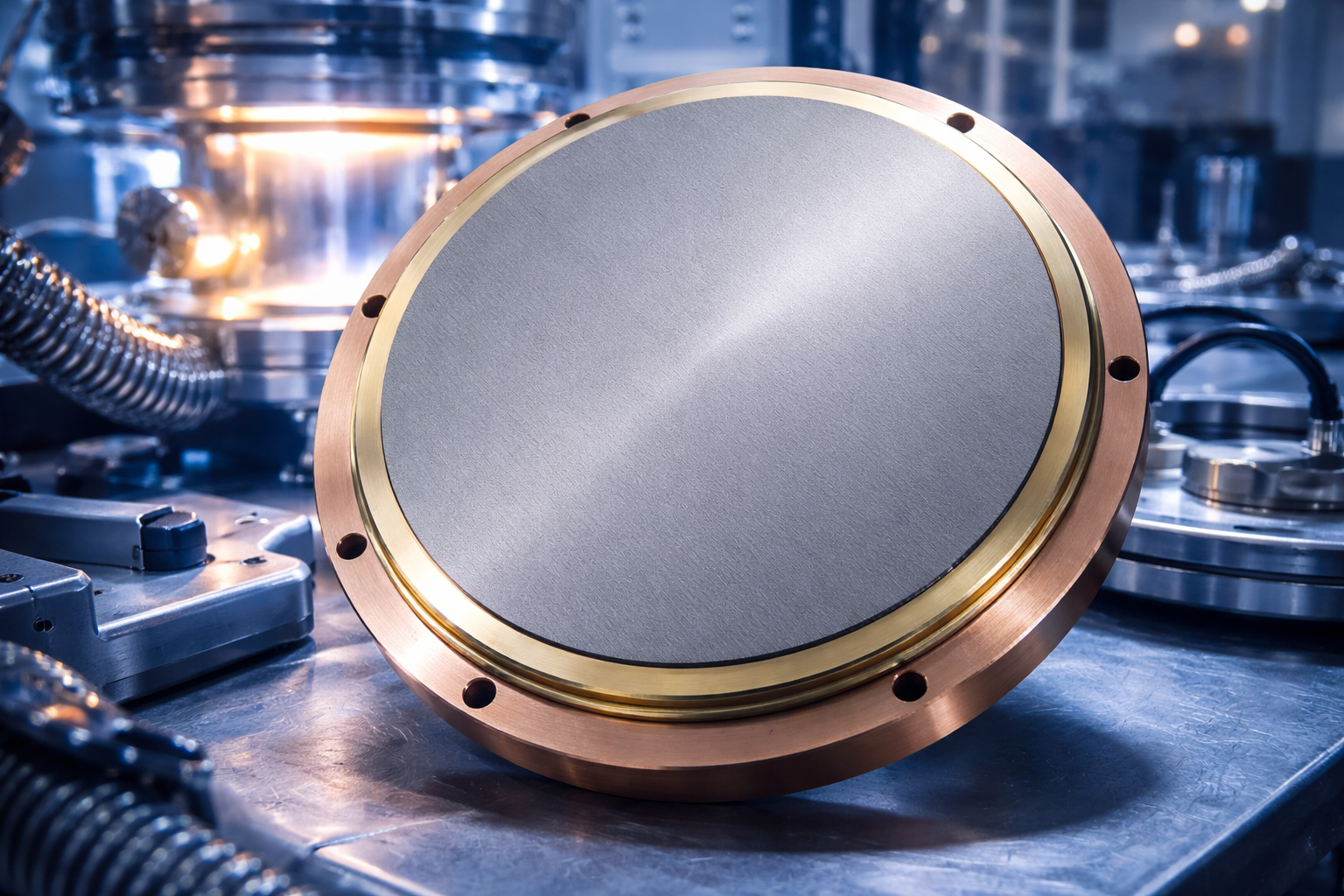
For larger targets used in production systems, GST materials are often bonded to copper backing plates. This configuration improves heat dissipation and ensures stable target performance.
Applications of GST Thin Films
Germanium Antimony Telluride sputtering targets enable the fabrication of thin films used across several advanced technology sectors.
Phase-Change Memory (PCM)

PCM is a promising non-volatile memory technology that stores information using the reversible phase transition of GST materials. Compared with traditional flash memory, PCM offers:
- Faster switching speed
- Higher endurance cycles
- Improved scalability
GST thin films deposited by sputtering serve as the active layer in PCM cells.
Optical Data Storage
GST alloys were widely adopted in optical storage media such as rewritable CDs, DVDs, and Blu-ray discs. The phase transition causes a change in optical reflectivity that can be detected by laser systems during reading operations.
Neuromorphic Computing

GST materials are increasingly studied for neuromorphic hardware systems that mimic biological neural networks. The gradual resistance changes achievable in phase-change materials enable analog computing functions useful for artificial intelligence hardware.
Programmable Photonics
GST thin films can dramatically alter optical properties such as refractive index and absorption coefficient. This capability enables programmable photonic devices, including:
- Optical switches
- Tunable metasurfaces
- Reconfigurable waveguides
- Integrated photonic circuits
Optical Modulators and Smart Devices
Because GST films can change optical properties with electrical or thermal input, they are used in dynamic optical elements for telecommunications and sensing systems.
Technical Parameters
Typical specifications for Germanium Antimony Telluride sputtering targets are summarized below.
| Parameter | Typical Value / Range | Importance |
|---|---|---|
| Composition | Ge₂Sb₂Te₅ (or custom ratios) | Determines phase-change characteristics |
| Purity | 99.9% – 99.99% | Higher purity improves film stability |
| Density | ≥95% theoretical density | Ensures stable sputtering behavior |
| Diameter | 25 – 300 mm (custom) | Compatible with different sputtering systems |
| Thickness | 3 – 6 mm | Influences target lifetime |
| Bonding | Copper backing plate optional | Improves heat dissipation |
Custom shapes such as rectangular, circular, and rotatable targets are also available depending on deposition equipment.
Comparison with Other Phase-Change Materials
| Material | Key Advantage | Typical Application |
|---|---|---|
| Germanium Antimony Telluride (GST) | Balanced switching speed and stability | Phase-change memory, optical storage |
| GeTe | Very fast switching | Research devices and PCM |
| Sb₂Te₃ | Lower power consumption | Optical switching |
| GeSbTe Alloys (various ratios) | Tunable crystallization properties | Advanced photonics |
GST remains the most widely used phase-change alloy due to its excellent combination of switching speed, durability, and optical contrast.
FAQ
| Question | Answer |
|---|---|
| Can GST sputtering targets be customized? | Yes. Composition ratios, diameter, thickness, and backing plate bonding can all be customized based on deposition equipment requirements. |
| What deposition methods are compatible with GST targets? | GST targets are commonly used in RF magnetron sputtering and DC magnetron sputtering systems. |
| What purity level is typically used for GST targets? | Most semiconductor and research applications use 3N–4N purity (99.9–99.99%). |
| Are bonded GST targets available? | Yes. GST materials can be bonded to copper backing plates to improve thermal management during sputtering. |
| What industries use GST sputtering targets most frequently? | Semiconductor memory, optical storage technology, photonics research, and advanced materials development. |
Packaging
Our Germanium Antimony Telluride Sputtering Targets are meticulously tagged and labeled externally to ensure efficient identification and maintain high standards of quality control. We take great care to prevent any potential damage during storage and transportation, ensuring the targets arrive in perfect condition.
Conclusion
Germanium Antimony Telluride sputtering targets play a vital role in the production of phase-change thin films used in modern memory devices, optical storage systems, and emerging photonic technologies. With their ability to support precise thin-film deposition and maintain stable material composition, GST targets enable researchers and manufacturers to develop advanced electronic and optical components.
High-density GST sputtering targets with controlled stoichiometry provide the reliability required for semiconductor processing and thin-film engineering applications. Custom sizes, compositions, and bonding configurations can be tailored to meet specific sputtering system requirements.
For detailed specifications and a quotation, please contact us at sales@thinfilmmaterials.com.