

 MSDS File
Introduction
Aluminium Antimony (AlSb) is a III–V compound semiconductor material widely used in thin-film deposition for infrared optoelectronics and advanced electronic devices. As an evaporation material, AlSb pellets offer stable evaporation behavior, good compositional uniformity, and compatibility with high-vacuum thermal and electron-beam evaporation systems. Their pelletized form ensures controlled feeding, reduced spitting, and improved film reproducibility in research and industrial coating processes.
Detailed Description
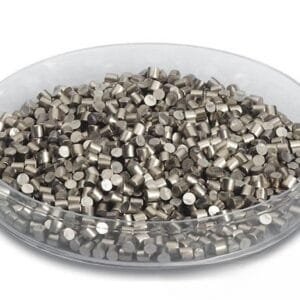
Aluminium Antimony Pellet Evaporation Material (AlSb) is synthesized from high-purity aluminum and antimony under controlled conditions to ensure precise stoichiometry and phase consistency. The pellets are engineered with optimized density and surface quality to support smooth evaporation and minimize material loss during deposition.
Compared with irregular chunks or powders, pelletized AlSb provides:
More uniform evaporation rates, supporting consistent film thickness.
Improved compositional control, critical for semiconductor and infrared applications.
Cleaner handling and loading, reducing contamination risks in vacuum chambers.
AlSb exhibits a narrow bandgap and favorable electron mobility, making it particularly suitable for infrared detectors, heterostructures, and compound semiconductor research. The material can be supplied with tailored pellet sizes to match different crucible or hearth designs.
Applications
Aluminium Antimony evaporation pellets are commonly used in:
Infrared detector and imaging device fabrication
Compound semiconductor thin films
Epitaxial buffer layers and heterostructures
Research and development of III–V semiconductor materials
Optoelectronic and microelectronic experimental coatings
Technical Parameters
| Parameter | Typical Value / Range | Importance |
|---|---|---|
| Chemical Composition | AlSb (stoichiometric) | Ensures stable electrical and optical properties |
| Purity | 99.9% – 99.99% | Reduces defects and contamination in thin films |
| Pellet Size | 1 – 6 mm (customizable) | Matches evaporation sources and crucibles |
| Form | Solid pellets | Enables controlled evaporation and easy handling |
| Evaporation Method | Thermal / E-beam | Compatible with common PVD systems |
Comparison with Related Materials
| Material | Key Advantage | Typical Application |
|---|---|---|
| Aluminium Antimony (AlSb) | Narrow bandgap, good lattice matching | Infrared detectors, III–V research |
| Gallium Antimonide (GaSb) | Higher hole mobility | High-performance IR devices |
| Indium Antimonide (InSb) | Extremely narrow bandgap | Long-wavelength IR sensing |
FAQ
| Question | Answer |
|---|---|
| Can AlSb pellets be customized in size? | Yes, pellet diameter and weight can be tailored to specific evaporation sources. |
| Which evaporation methods are suitable? | AlSb pellets are compatible with both thermal and electron-beam evaporation. |
| How is compositional uniformity ensured? | Controlled synthesis and strict quality inspection ensure consistent stoichiometry. |
| Is the material suitable for R&D use? | Yes, it is widely used in laboratory research and pilot-scale production. |
Packaging
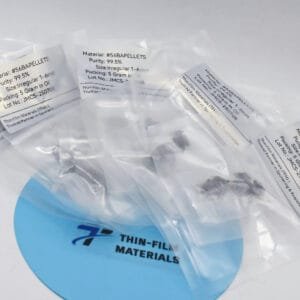
Our Aluminium Antimony Pellet Evaporation Materials are carefully tagged and labeled for clear identification and traceability. Each batch is vacuum-sealed and packed with protective materials to prevent oxidation, contamination, or mechanical damage during storage and transportation, ensuring the pellets arrive in optimal condition.
Conclusion
Aluminium Antimony Pellet Evaporation Material (AlSb) provides a reliable solution for precise thin-film deposition in infrared and compound semiconductor applications. With controlled purity, customizable pellet sizes, and consistent evaporation performance, it supports both advanced research and specialized industrial processes.
For detailed specifications and a quotation, please contact us at sales@thinfilmmaterials.com.
Reviews
There are no reviews yet.