
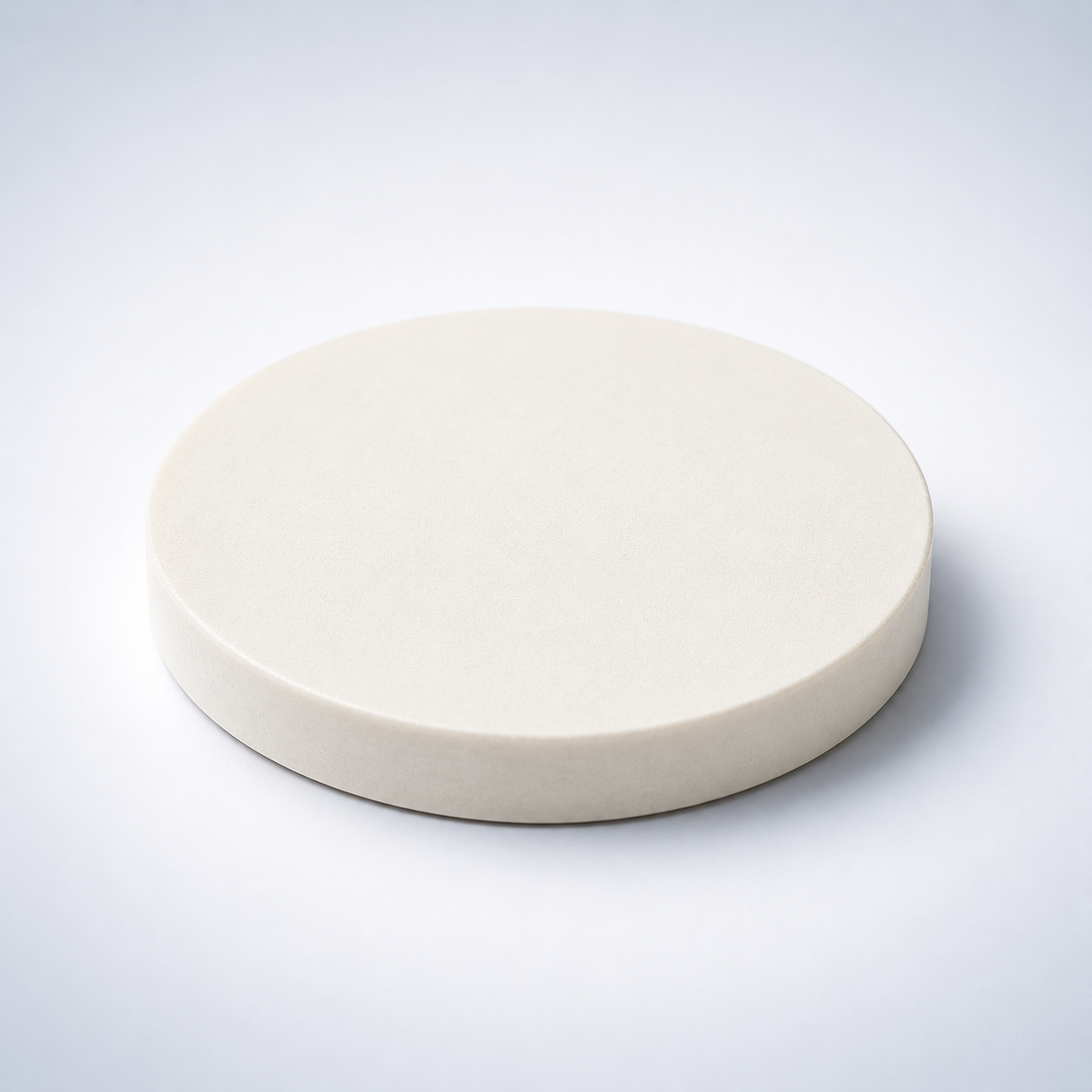
Product Overview
Boron Nitride Sputtering Target (BN) is a compound sputtering target used to deposit thin films where a specific pre-compounded chemistry is required. These materials can behave differently from conductive metallic targets in terms of electrical response, thermal shock resistance, density sensitivity, and cracking risk, so target dimensions, density, backing design, and sputtering mode should be considered together.

Material and Deposition Characteristics
The appropriate sputtering mode depends on target conductivity, thermal behavior, and the power-supply configuration. Many compound ceramic targets are evaluated first with RF magnetron sputtering, especially when electrical resistivity is high. For brittle or low-thermal-conductivity materials, density, backing support, and stable cooling are important for reliable operation.
Technical Data
| Parameter | Typical Value / Range | Importance |
|---|---|---|
| Purity | 99% – 99.99% | Ensures film quality and reduces contamination |
| Density | ≥ 95% theoretical | Improves sputtering stability |
| Diameter | 50 – 200 mm (custom available) | Compatible with sputtering systems |
| Thickness | 3 – 6 mm | Influences target lifetime |
| Bonding | Indium / Elastomer / Cu backing | Enhances heat dissipation |
| Crystal Type | h-BN / c-BN | Determines film properties |
| Material | Key Advantage | Typical Application |
|---|---|---|
| Boron Nitride (BN) | Excellent insulation, thermal stability | Dielectric and protective films |
| Aluminum Nitride (AlN) | High thermal conductivity, good dielectric | Electronics, heat dissipation layers |
| Silicon Nitride (Si₃N₄) | Strong mechanical properties | Protective coatings, MEMS |
| Question | Answer |
|---|---|
| Can BN sputtering targets be customized? | Yes, size, purity, crystal structure, and bonding options can be tailored. |
| What sputtering method is suitable for BN? | RF magnetron sputtering is typically used due to its insulating nature. |
| What is the difference between h-BN and c-BN? | h-BN offers lubricating and insulating properties, while c-BN provides extreme hardness and wear resistance. |
| Are bonded targets necessary? | Yes, bonding improves thermal stability and reduces the risk of cracking. |
| Which industries use BN sputtering targets? | Semiconductor, electronics, optics, and advanced coatings industries. |
Typical Thin-Film Applications
- Compound thin films for semiconductor, optical, protective, hard-coating, and functional-material research
- Applications where a pre-compounded target is preferred over co-sputtering separate elemental targets
- Projects requiring controlled chemistry and tailored target geometry for PVD development
Target Configuration and Ordering Considerations
When requesting a quotation, provide target diameter or rectangular dimensions, thickness, purity or composition, required quantity, and whether a backing plate or bonded assembly is needed. For brittle ceramic or compound targets, it is useful to specify the cathode model, backing-plate material, preferred bonding method, operating power if known, and any density, tolerance, or inspection-document requirements. TFM can review drawings, old-target photos, and application details when custom dimensions are required.
Frequently Asked Questions
What is the main reason to use a Boron Nitride sputtering target?
It provides a composition-specific source for depositing thin films when the required chemistry is better introduced from a pre-compounded target than from co-sputtering separate elements.
How should the sputtering mode for Boron Nitride be selected?
The power mode should be selected from target conductivity, thermal behavior, and equipment capability. Many compound ceramic targets are first evaluated with RF magnetron sputtering.
Why are density and microstructure important for Boron Nitride targets?
Uniform density and microstructure help support stable erosion and thermal behavior, while pores or local defects can increase the risk of cracking, particles, or unstable plasma.
Can a Boron Nitride target be supplied with a backing plate?
Yes. Where the material is brittle or the cathode requires a backing assembly, bonded configurations can be reviewed according to target size, thickness, cooling, and operating power.
Does target composition always equal film composition?
No. Film chemistry can shift because of different sputtering yields, reactive conditions, substrate temperature, re-sputtering, or chamber history. Verify the film when the chemistry is critical.
What should I provide to request a quotation for Boron Nitride?
Please provide material composition, purity, dimensions, quantity, target or backing configuration, cathode model or system details, and any drawing, tolerance, or inspection requirements.
Reviews
There are no reviews yet.