
Cerium Strontium Ferrite (Ce₀.₂Sr₀.₈Fe₀.₈₂) Sputtering Target
Introduction
The Cerium Strontium Ferrite (Ce₀.₂Sr₀.₈Fe₀.₈₂) Sputtering Target is a precisely engineered perovskite oxide designed for advanced thin-film deposition. With a finely tuned Ce/Sr/Fe ratio, this compound delivers a balance of ionic and electronic conductivity, making it an ideal material for energy conversion devices, magnetic thin films, and oxide electronic applications.
Detailed Description
Ce₀.₂Sr₀.₈Fe₀.₈₂ is a mixed-valence oxide with a distorted perovskite structure. The substitution of cerium and strontium ions in the ferrite lattice tailors its electronic configuration, improving its redox stability and catalytic efficiency.
Produced through solid-state sintering or chemical co-precipitation, this sputtering target features:
High density and homogeneity for stable sputtering rates.
Controlled oxygen stoichiometry, minimizing secondary phases.
Excellent adhesion and surface smoothness, ensuring uniform thin-film quality.
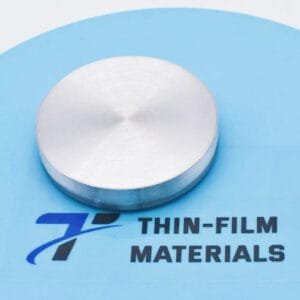
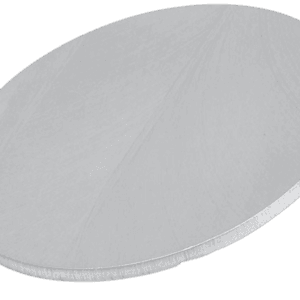
Each target undergoes precision machining and polishing to ensure dimensional accuracy and compatibility with commercial magnetron sputtering systems. Bonding to copper or indium backing plates is available upon request for enhanced thermal performance.
Applications
Ce₀.₂Sr₀.₈Fe₀.₈₂ thin films are used in various research and industrial coating processes, including:
Solid Oxide Fuel Cells (SOFCs) as cathode or interlayer materials.
Oxygen-permeable membranes and catalytic electrodes.
Spintronic and magnetic oxide devices.
Gas sensors and resistive switching memory films.
Electrocatalytic coatings for renewable energy and environmental technologies.
Technical Parameters
| Parameter | Typical Value / Range | Importance |
|---|---|---|
| Chemical Formula | Ce₀.₂Sr₀.₈Fe₀.₈₂ | Optimized for mixed conductivity and stability |
| Purity | 99.9% – 99.99% | Ensures reproducible thin film chemistry |
| Density | ≥ 6.0 g/cm³ | Higher density improves film uniformity |
| Diameter | 25 – 200 mm (custom sizes) | Fits most sputtering systems |
| Thickness | 3 – 6 mm | Balances film yield and target life |
| Bonding | Indium, elastomer, or copper backing | Enhances thermal dissipation |
| Form | Disc, rectangular, or custom geometry | Suitable for R&D and industrial tools |
Comparison with Related Materials
| Material | Key Advantage | Typical Application |
|---|---|---|
| Ce₀.₂Sr₀.₈Fe₀.₈₂ | Balanced ionic & electronic conductivity | SOFC and catalytic electrodes |
| La₀.₈Sr₀.₂FeO₃ | Higher conductivity | Fuel cell cathodes |
| Ce₀.₅Sr₀.₅FeO₃ | Enhanced redox stability | Oxygen membranes |
| SrFeO₃₋δ | Strong oxygen vacancy mobility | Catalytic and gas-sensing films |
FAQ
| Question | Answer |
|---|---|
| Can the Ce/Sr/Fe ratio be adjusted? | Yes. The composition can be tailored for specific conductivity or catalytic needs. |
| Is bonding required for high-power sputtering? | Indium or copper bonding is recommended for heat management above 200 W. |
| How are the targets packaged? | Each target is vacuum-sealed, wrapped in foam, and shipped in export-safe cartons or wooden crates. |
| What deposition methods are compatible? | DC/RF magnetron sputtering, pulsed laser deposition (PLD), and reactive sputtering. |
| Are custom shapes available? | Yes, round, rectangular, and ring shapes can be supplied on request. |
Packaging
Our Ce₀.₂Sr₀.₈Fe₀.₈₂ Sputtering Targets are meticulously labeled and vacuum-packed to ensure purity and easy identification. Anti-static materials and shock-proof packaging prevent contamination and mechanical damage during transport.
Conclusion
The Cerium Strontium Ferrite (Ce₀.₂Sr₀.₈Fe₀.₈₂) Sputtering Target offers precise compositional control and reliable sputtering performance for advanced oxide film research. Its versatility and stability make it an essential material for laboratories and production environments developing next-generation electronic and energy devices.
For detailed specifications or a quotation, please contact us at [sales@thinfilmmaterials.com].

Reviews
There are no reviews yet.