

 MSDS File
Introduction
Chromium Nitride (CrN) evaporation materials are widely used in thin film deposition processes to produce hard, corrosion-resistant, and wear-resistant coatings. Known for its excellent mechanical strength, chemical stability, and attractive metallic appearance, CrN has become a key material in both industrial coating technologies and advanced thin-film research.
In Physical Vapor Deposition (PVD) processes such as thermal evaporation and electron beam evaporation, Chromium Nitride evaporation materials enable the formation of dense and uniform coatings with strong adhesion to various substrates. These coatings are frequently applied in cutting tools, decorative finishes, microelectronics, and protective layers where durability and stability are essential.
Detailed Description
Chromium Nitride (CrN) is a ceramic compound consisting of chromium and nitrogen atoms arranged in a stable crystalline structure. This compound is well known for its high hardness, good oxidation resistance, and excellent resistance to corrosion and wear. When used as an evaporation material in vacuum deposition systems, CrN allows the formation of thin films with superior mechanical and chemical properties.
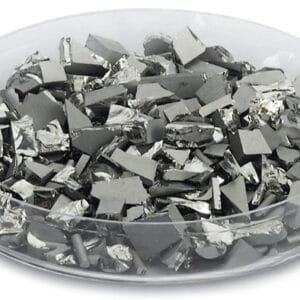
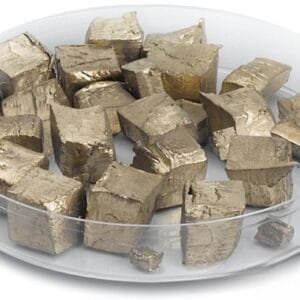
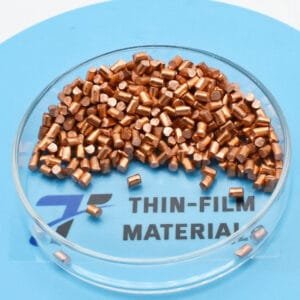
CrN evaporation materials are typically supplied in the form of granules, pellets, or pieces suitable for loading into evaporation boats or crucibles. The morphology and particle size are optimized to ensure stable evaporation behavior and consistent vapor generation during the deposition process.
One of the most significant advantages of CrN coatings is their ability to provide both mechanical protection and chemical resistance. Chromium contributes excellent corrosion resistance, while the nitride structure significantly increases hardness and wear resistance. As a result, CrN coatings are widely used in environments where surfaces experience friction, mechanical stress, or exposure to aggressive chemicals.
Another important characteristic of CrN thin films is their relatively low coefficient of friction compared to other hard coatings. This property makes them suitable for tribological applications such as cutting tools, molds, and sliding components. Additionally, CrN coatings can maintain good stability at elevated temperatures, making them useful for applications involving thermal cycling or high-temperature operation.
In thin film deposition systems, high purity and uniform composition of the evaporation material are critical. High-purity CrN ensures that the resulting thin films exhibit consistent hardness, color, and corrosion resistance. These materials are compatible with both thermal evaporation and electron beam evaporation systems used in research laboratories and industrial coating facilities.
Applications
Chromium Nitride evaporation materials are used in a variety of advanced coating technologies and industrial applications, including:
Hard protective coatings for cutting tools, molds, and mechanical components
Wear-resistant coatings used in automotive and aerospace parts
Decorative coatings with metallic silver-gray appearance
Corrosion-resistant layers for chemical processing equipment
Microelectronics and semiconductor coatings requiring durable barrier layers
Tribological coatings for low-friction surfaces in mechanical systems
Due to its balanced mechanical and chemical properties, CrN is widely considered one of the most versatile nitride coating materials.
Technical Parameters
| Parameter | Typical Value / Range | Importance |
|---|---|---|
| Purity | 99.5% – 99.99% | Higher purity improves film consistency |
| Form | Pellets / Granules / Pieces | Suitable for various evaporation sources |
| Particle Size | 1 – 6 mm typical | Influences evaporation stability |
| Density | ~6.1 g/cm³ | Important for evaporation rate control |
| Melting Point | ~1770 °C (approx.) | Determines compatibility with high-temperature evaporation |
| Deposition Method | Thermal / E-Beam Evaporation | Compatible with common PVD systems |
Comparison with Related Materials
| Material | Key Advantage | Typical Application |
|---|---|---|
| Chromium Nitride (CrN) | High hardness and corrosion resistance | Protective and tribological coatings |
| Titanium Nitride (TiN) | Golden color and high hardness | Decorative and tool coatings |
| Chromium (Cr) | Excellent adhesion and corrosion resistance | Adhesion layers and protective films |
| Titanium Aluminum Nitride (TiAlN) | Superior high-temperature stability | High-speed cutting tools |
FAQ
| Question | Answer |
|---|---|
| Can Chromium Nitride evaporation materials be customized? | Yes, the purity, particle size, and packaging can be customized according to specific deposition systems. |
| What deposition techniques are compatible with CrN evaporation materials? | CrN can be used in thermal evaporation and electron beam evaporation systems. |
| What advantages do CrN coatings offer compared to pure chromium films? | CrN coatings provide higher hardness, better wear resistance, and improved chemical stability. |
| Which industries commonly use CrN coatings? | Automotive, aerospace, tooling, semiconductor, and decorative coating industries. |
| Are CrN coatings suitable for high-temperature applications? | Yes, CrN coatings maintain stability and protective performance at moderately high temperatures. |
Packaging
Our Chromium Nitride Evaporation Materials are meticulously tagged and labeled externally to ensure efficient identification and maintain high standards of quality control. We take great care to prevent any potential damage during storage and transportation, ensuring the targets arrive in perfect condition.
Conclusion
Chromium Nitride (CrN) evaporation materials provide an effective solution for producing durable, corrosion-resistant, and wear-resistant thin films through vacuum deposition processes. Their combination of high hardness, chemical stability, and attractive metallic appearance makes them widely used in industrial coatings, microelectronics, and decorative applications.
With customizable purity levels, particle sizes, and packaging formats, CrN evaporation materials can be tailored to meet the requirements of modern thin film deposition systems.
For detailed specifications and a quotation, please contact us at sales@thinfilmmaterials.com.
Reviews
There are no reviews yet.