

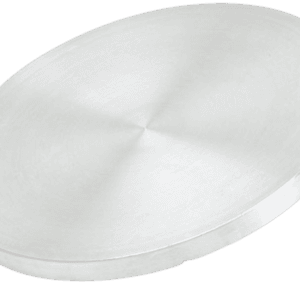
Cobalt Manganese Silicon Sputtering Target
Introduction
The Cobalt Manganese Silicon Sputtering Target (Co₂MnSi) is a Heusler alloy widely studied for its half-metallic ferromagnetic properties, making it an important material in spintronics and magnetic thin film research. With its ordered crystal structure and high spin polarization, Co₂MnSi is ideal for applications where electron spin control and magnetic stability are essential.
Detailed Description
Co₂MnSi belongs to the family of full Heusler alloys, known for their unique combination of metallic conductivity and ferromagnetism. When used as a sputtering target, this material enables the fabrication of thin films with desirable properties such as:
High spin polarization for spintronic devices.
Stable L2₁ crystal structure, improving film uniformity.
High Curie temperature, ensuring reliable performance under thermal stress.
Tailorable composition to adjust magnetic and electronic behavior.
To ensure efficient thin film deposition, Co₂MnSi sputtering targets are produced with high density, fine grain structure, and optional backing plates for heat dissipation.
Applications
The Co₂MnSi sputtering target is primarily applied in:
Spintronics and magnetoresistive random-access memory (MRAM).
Magnetic tunnel junctions (MTJs) for read/write heads.
Quantum devices exploring half-metallic ferromagnets.
Functional coatings in electronics and sensors.
Academic and industrial research into Heusler alloys.
Technical Parameters
| Parameter | Typical Value / Range | Importance |
|---|---|---|
| Purity | 99.9% – 99.99% | Ensures minimal contamination in functional films |
| Diameter | 25 – 150 mm (customizable) | Matches magnetron sputtering system holders |
| Thickness | 3 – 6 mm | Influences target life and deposition rate |
| Bonding | Indium / Copper backing | Enhances heat transfer and stability |
Comparison with Related Materials
| Material | Key Advantage | Typical Application |
|---|---|---|
| Cobalt Manganese Silicon | High spin polarization, Heusler alloy | Spintronic devices |
| Cobalt Iron Aluminum | Tunable ferromagnetism | MRAM, sensors |
| Nickel Manganese Gallium | Shape memory properties | Actuators, smart materials |
FAQ
| Question | Answer |
|---|---|
| Can the stoichiometry be adjusted? | Yes, composition can be modified for research requirements. |
| Is bonding necessary? | Not always, but copper or titanium backing improves target stability in long sputtering runs. |
| How are the targets packaged? | Each target is vacuum-sealed and cushioned with protective foam in export-ready crates. |
| What sputtering techniques are suitable? | DC, RF, and magnetron sputtering systems. |
| Can custom dimensions be supplied? | Yes, we provide tailored diameters, thicknesses, and bonding options. |
Packaging
Every Cobalt Manganese Silicon Sputtering Target is vacuum-packed, externally labeled for traceability, and shipped in foam-padded, export-compliant packaging to ensure safe delivery.
Conclusion
The Co₂MnSi sputtering target is a cutting-edge material for advanced magnetic and electronic applications. With its half-metallic ferromagnetic properties and customizable specifications, it is an excellent choice for both R&D and industrial thin film deposition.
For detailed specifications and a quotation, please contact us at [sales@thinfilmmaterials.com].


Reviews
There are no reviews yet.