

Introduction
KF (QF) HV Blank Flanges (Brass) are practical vacuum components designed to seal unused ports in high-vacuum (HV) systems. By combining the standardized KF/QF geometry with the favorable machining and sealing characteristics of brass, these blank flanges provide a reliable and economical option for laboratories and industrial vacuum setups where ease of installation and dependable sealing are required.
Detailed Description
Manufactured to KF (also known as QF or NW) vacuum standards, brass KF blank flanges are used together with a centering ring, elastomer O-ring, and clamp to form a secure seal. The standardized dimensions ensure full interchangeability with KF hardware from different suppliers.
Brass offers good corrosion resistance, excellent machinability, and stable sealing surfaces. Compared with stainless steel, brass blanks are easier to machine and often chosen for cost-sensitive applications or systems that do not require aggressive bakeout or extreme chemical resistance.
Key features include:
Precision-machined sealing face for uniform O-ring compression
Smooth surface finish to reduce particle generation
Good dimensional stability for repeated assembly
Full compatibility with standard KF clamps and centering rings
Applications
Sealing unused KF/QF ports in HV vacuum lines
Laboratory vacuum systems and R&D equipment
Thin film deposition tools and coating systems
Analytical instruments and leak-test setups
Temporary isolation during maintenance or system modification
Technical Parameters
| Parameter | Typical Value / Range | Importance |
|---|---|---|
| Material | Brass (vacuum-grade) | Good machinability, stable sealing |
| Standard Sizes | KF10, KF16, KF25, KF40, KF50 | Matches common KF ports |
| Connection Type | KF (QF / NW) | Ensures standard compatibility |
| Sealing Method | O-ring with centering ring & clamp | Reliable HV sealing |
| Surface Finish | Machined / polished | Influences cleanliness |
| Vacuum Range | Up to ~10⁻⁷ mbar (typical) | Suitable for HV systems |
Comparison with Other KF Blank Flanges
| Material | Key Advantage | Typical Application |
|---|---|---|
| Brass KF Blank | Cost-effective, easy machining | General HV & lab systems |
| Aluminum KF Blank | Lightweight, corrosion resistant | Mobile or modular setups |
| Stainless Steel KF Blank | Higher strength, bakeout capable | Demanding HV/UHV use |
FAQ
| Question | Answer |
|---|---|
| Are KF, QF, and NW interchangeable? | Yes, they refer to the same standardized flange system. |
| Is this suitable for UHV systems? | Primarily for HV; CF blanks are recommended for UHV. |
| Are O-rings and clamps included? | Usually supplied separately unless ordered as a set. |
| Can different brass grades be supplied? | Standard vacuum-grade brass is used; alternatives may be discussed. |
| How are the blanks packaged? | Cleaned and packed to protect sealing surfaces. |
Packaging
Our KF (QF) HV Blank Flanges (Brass) are cleaned, individually packed, and protected with foam inserts. Each unit is clearly labeled and shipped in export-grade cartons to ensure safe delivery and preserved surface quality.
Conclusion
KF (QF) HV Blank Flanges (Brass) offer a reliable and economical solution for sealing KF vacuum ports in high-vacuum systems. Their standardized design, good sealing behavior, and ease of handling make them well suited for laboratory, research, and general industrial vacuum applications.
For detailed specifications and a quotation, please contact us at sales@thinfilmmaterials.com.
Ordering Table
| Flange Size/OD | Type | Flange Material | Drawing | Part Number |
| KF10 (1.18" OD) | Blank, Flange | 360 Brass |
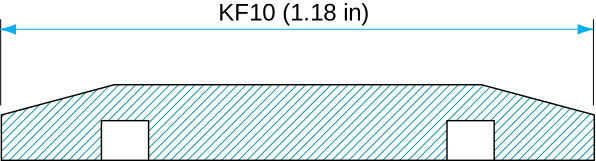
| QF10-050-BB |
| KF16 (1.18" OD) | Blank, Flange | 360 Brass |
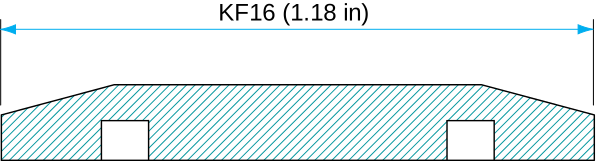
| QF16-075-BB |
| KF25 (1.57" OD) | Blank, Flange | 360 Brass |
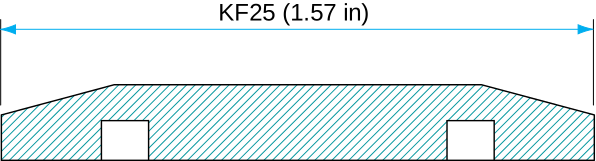
| QF25-100-BB |
| KF40 (2.16" OD) | Blank, Flange | 360 Brass |
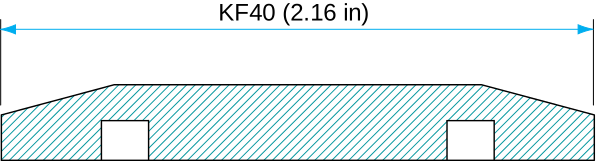
| QF40-150-BB |
| KF50 (2.95" OD) | Blank, Flange | 360 Brass |
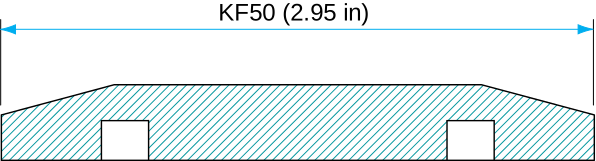
| QF50-200-BB |
Accessories Table
| Description | For | Per Package | Part Number |
| Cast Clamps (Aluminum) | KF10, KF16 Flanges | 1 | QF16-075-C |
| Cast Clamps (Aluminum) | KF25 Flanges | 1 | QF25-100-C |
| Cast Clamps (Aluminum) | KF40 Flanges | 1 | QF40-150-C |
| Cast Clamps (Aluminum) | KF50 Flanges | 1 | QF50-200-C |
| Lever Clamps (Aluminum) | KF10, KF16 Flanges | 1 | QF16-075-CHA |
| Lever Clamps (Aluminum) | KF25 Flanges | 1 | QF25-100-CHA |
| Lever Clamps (Aluminum) | KF40 Flanges | 1 | QF40-150-CHA |
| Description | For | Per Package | Part Number |

Reviews
There are no reviews yet.