

Introduction
Manganese Gallium (Mn-Ga) sputtering targets are advanced intermetallic materials primarily used for depositing magnetic and spintronic thin films. Known for their unique magnetic anisotropy and tunable magnetic properties, Mn-Ga alloys are of particular interest in next-generation data storage, spintronic devices, and magnetic sensor technologies.
Detailed Description
Mn-Ga sputtering targets are typically fabricated through vacuum melting followed by precision machining or powder metallurgy techniques to ensure compositional uniformity and high density. The Mn:Ga ratio can be carefully adjusted (commonly Mn₃Ga, Mn₂Ga, or other stoichiometries) to tailor magnetic properties such as coercivity, saturation magnetization, and perpendicular magnetic anisotropy (PMA).
One of the most notable characteristics of Mn-Ga alloys is their ability to form tetragonal crystal structures (e.g., L1₀ or D0₂₂ phases), which exhibit strong perpendicular magnetic anisotropy. This makes them highly suitable for high-density magnetic storage and spintronic applications where stable magnetization at nanoscale dimensions is required.
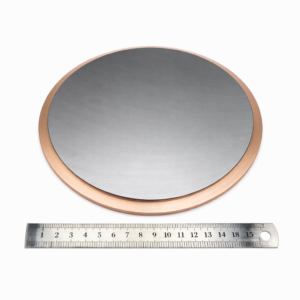
The targets are engineered to provide stable sputtering performance with minimal arcing and particle generation. Due to their conductive nature, Mn-Ga targets are compatible with DC magnetron sputtering, though RF sputtering can also be used depending on system configuration. For high-power applications, bonding to copper backing plates enhances thermal conductivity and prolongs target life.
Key features include:
Tunable Mn:Ga composition for optimized magnetic properties
Strong perpendicular magnetic anisotropy (PMA)
High density and uniform microstructure for stable sputtering
Compatible with DC and RF sputtering systems
Suitable for advanced magnetic and spintronic applications
Applications
Mn-Ga sputtering targets are widely used in:
Spintronic devices and magnetic tunnel junctions (MTJs)
High-density magnetic storage media
Magnetic sensors and memory devices
Perpendicular magnetic anisotropy (PMA) thin films
Research in magnetic materials and nanotechnology
Advanced semiconductor and data storage technologies
Technical Parameters
| Parameter | Typical Value / Range | Importance |
|---|---|---|
| Composition | Mn-Ga (e.g., Mn₃Ga, Mn₂Ga) | Controls magnetic behavior |
| Purity | 99.9% – 99.99% | Ensures film consistency |
| Density | ≥ 95% theoretical | Stable sputtering performance |
| Diameter | 50 – 200 mm (custom available) | System compatibility |
| Thickness | 3 – 6 mm | Affects target lifetime |
| Electrical Type | Conductive | Suitable for DC sputtering |
| Bonding | Cu backing / In / elastomer | Improves heat dissipation |
Comparison with Related Materials
| Material | Key Advantage | Typical Application |
|---|---|---|
| Mn-Ga | Strong PMA, tunable magnetism | Spintronics, memory |
| CoFeB | High spin polarization | MTJs, MRAM |
| FePt | Ultra-high magnetic anisotropy | High-density storage |
| NiFe (Permalloy) | Soft magnetic properties | Sensors, inductors |
FAQ
| Question | Answer |
|---|---|
| What compositions are commonly used? | Typical stoichiometries include Mn₃Ga and Mn₂Ga, depending on application needs. |
| Is Mn-Ga suitable for DC sputtering? | Yes, due to its conductive nature. |
| Can magnetic properties be tuned? | Yes, by adjusting composition and deposition conditions. |
| Is bonding recommended? | For high-power sputtering, copper backing plates are recommended. |
| Which industries use Mn-Ga targets most? | Spintronics, data storage, and advanced electronics industries. |
Packaging
Our Manganese Gallium Sputtering Targets are meticulously tagged and labeled externally to ensure efficient identification and maintain high standards of quality control. We take great care to prevent any potential damage during storage and transportation, ensuring the targets arrive in perfect condition.
Conclusion
Manganese Gallium sputtering targets offer a powerful platform for developing advanced magnetic thin films with tailored properties. With strong perpendicular magnetic anisotropy and flexible composition control, Mn-Ga is an ideal material for cutting-edge spintronic and data storage applications.
For detailed specifications and a quotation, please contact us at sales@thinfilmmaterials.com.
Reviews
There are no reviews yet.