

Introduction
Manganese Iron Oxide Sputtering Target (MnFe₂O₄), commonly known as manganese ferrite, is a ceramic compound target widely used in thin film deposition processes such as magnetron sputtering and other physical vapor deposition (PVD) techniques. As a member of the spinel ferrite family, MnFe₂O₄ exhibits excellent magnetic, electrical, and chemical stability properties, making it an important material for functional magnetic thin films.
MnFe₂O₄ sputtering targets are frequently used in the fabrication of magnetic sensors, microwave devices, spintronic materials, and advanced electronic components. Their ability to produce ferrite-based thin films with controlled magnetic properties makes them particularly valuable for research laboratories and emerging technologies in magnetics and electronics.
Detailed Description
Manganese Iron Oxide (MnFe₂O₄) is a spinel-structured ferrite compound composed of manganese (Mn²⁺) and iron (Fe³⁺) ions within an oxygen lattice. This crystal structure provides a unique combination of ferrimagnetic behavior, electrical resistivity, and chemical stability. Thin films deposited from MnFe₂O₄ sputtering targets are known for their tunable magnetic characteristics, which can be adjusted through deposition parameters such as temperature, oxygen partial pressure, and substrate type.
Manufacturing MnFe₂O₄ sputtering targets typically involves advanced ceramic processing methods. High-purity manganese oxide and iron oxide powders are carefully mixed in the correct stoichiometric ratio and then consolidated using techniques such as cold isostatic pressing (CIP), hot pressing, or sintering at elevated temperatures. These processes produce dense ceramic targets with uniform grain structures that support stable sputtering performance.
Achieving high density and uniform microstructure is critical for ceramic sputtering targets. Dense MnFe₂O₄ targets ensure consistent sputtering rates, minimize particle generation, and enable uniform thin film deposition across substrates.
In sputtering systems, MnFe₂O₄ targets are commonly used in RF magnetron sputtering due to their ceramic nature and electrical resistivity. The deposited films often maintain the spinel ferrite structure, enabling functional magnetic behavior in thin film form.
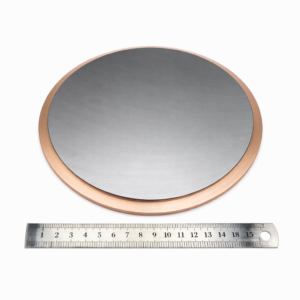
For larger industrial sputtering systems, MnFe₂O₄ targets may be bonded to backing plates such as copper or stainless steel to improve thermal stability and mechanical support during deposition.
Applications
Manganese Iron Oxide Sputtering Targets are used in various advanced magnetic and electronic technologies, including:
Magnetic thin films for sensors, magnetic storage media, and spintronic devices
Microwave and RF devices including ferrite components and isolators
Magnetic recording technologies requiring ferrimagnetic thin film materials
Spintronic materials research exploring magnetoelectric and spin transport phenomena
Electronic and magnetic sensors used in industrial and automotive systems
Advanced materials research involving ferrite thin films and oxide electronics
These applications benefit from MnFe₂O₄’s combination of magnetic functionality and chemical stability.
Technical Parameters
| Parameter | Typical Value / Range | Importance |
|---|---|---|
| Purity | 99.9% – 99.99% | Higher purity improves thin film performance |
| Composition | Stoichiometric MnFe₂O₄ | Ensures correct magnetic properties |
| Density | ≥ 95% theoretical density | Provides stable sputtering performance |
| Diameter | 25 – 300 mm (custom) | Compatible with various sputtering systems |
| Thickness | 3 – 6 mm | Influences target life and deposition rate |
| Bonding | Copper / Stainless Steel backing available | Improves thermal stability |
Comparison with Related Materials
| Material | Key Advantage | Typical Application |
|---|---|---|
| Manganese Iron Oxide (MnFe₂O₄) | Ferrimagnetic spinel with tunable magnetic properties | Magnetic thin films and sensors |
| Cobalt Ferrite (CoFe₂O₄) | Strong magnetic anisotropy and hardness | Magnetic recording and spintronics |
| Nickel Ferrite (NiFe₂O₄) | Good magnetic and electrical properties | Microwave devices and magnetic films |
| Iron Oxide (Fe₃O₄) | High magnetization | Magnetic storage and biomedical research |
FAQ
| Question | Answer |
|---|---|
| Can the MnFe₂O₄ sputtering target be customized? | Yes, diameter, thickness, density, and bonding options can be customized to match different sputtering systems. |
| Which sputtering method is typically used for MnFe₂O₄ targets? | RF magnetron sputtering is commonly used because MnFe₂O₄ is a ceramic material with relatively high electrical resistivity. |
| What substrates are compatible with MnFe₂O₄ thin films? | Common substrates include silicon, sapphire, MgO, and other oxide substrates depending on the application. |
| Are MnFe₂O₄ films magnetic? | Yes, MnFe₂O₄ is a ferrimagnetic material and its thin films can exhibit tunable magnetic properties depending on deposition conditions. |
| Which industries commonly use this material? | Semiconductor research laboratories, magnetic device manufacturers, microwave technology companies, and materials science institutes. |
Packaging
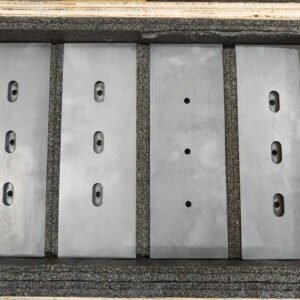
Our Manganese Iron Oxide Sputtering Target are meticulously tagged and labeled externally to ensure efficient identification and maintain high standards of quality control. We take great care to prevent any potential damage during storage and transportation, ensuring the targets arrive in perfect condition.
Conclusion
Manganese Iron Oxide Sputtering Targets are an important material source for depositing ferrite-based thin films with unique magnetic and electronic properties. Their spinel ferrite structure enables functional magnetic coatings suitable for sensors, microwave devices, and spintronic technologies.
With customizable dimensions, high purity options, and reliable manufacturing processes, MnFe₂O₄ sputtering targets provide a dependable solution for advanced magnetic thin film deposition.
For detailed specifications and a quotation, please contact us at sales@thinfilmmaterials.com.

Reviews
There are no reviews yet.