

Introduction
The Niobium Oxide Sputtering Target (Nb₂O₅) is a high-purity ceramic target widely used for depositing functional oxide thin films with excellent dielectric, optical, and electrochemical properties. Niobium pentoxide is known for its high refractive index, wide bandgap, and chemical stability, making it an important material in optical coatings, electronic devices, and energy-related thin-film technologies.
Detailed Description
Niobium oxide (Nb₂O₅) is a transition-metal oxide that exhibits strong insulating behavior and favorable optical characteristics. As a sputtering target, Nb₂O₅ enables precise deposition of stoichiometric thin films with controlled thickness and uniform microstructure.
Our Nb₂O₅ sputtering targets are manufactured from high-purity niobium oxide powders through controlled calcination, granulation, and high-temperature sintering. This production route ensures:
High phase purity, minimizing secondary phases
Dense and homogeneous microstructure, supporting stable sputtering rates
Excellent stoichiometric transfer, critical for optical and dielectric film performance
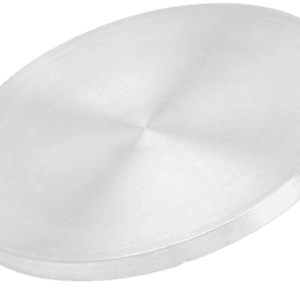
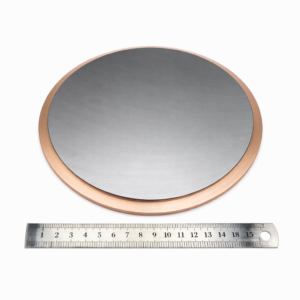
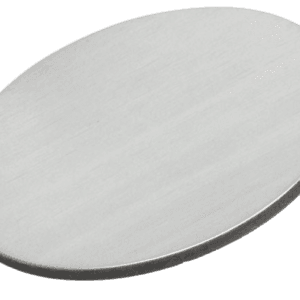
Targets can be supplied as unbonded ceramic discs or bonded to copper or titanium backing plates to enhance heat dissipation and mechanical stability during RF sputtering.
Applications
Niobium Oxide sputtering targets are commonly used in:
Optical coatings with high refractive index
Dielectric layers for capacitors and electronic components
Electrochromic and photoelectrochemical devices
Thin-film batteries and energy storage research
Semiconductor and advanced functional oxide R&D
Technical Parameters
| Parameter | Typical Value / Range | Importance |
|---|---|---|
| Chemical Formula | Nb₂O₅ | Defines dielectric and optical behavior |
| Crystal Structure | Orthorhombic / Amorphous (film-dependent) | Influences optical properties |
| Purity | 99.9% – 99.99% | Reduces defects and leakage current |
| Diameter | 25 – 300 mm (custom) | Compatible with standard sputtering systems |
| Thickness | 3 – 6 mm | Ensures sputtering stability |
| Density | ≥ 95% theoretical | Improves film uniformity |
| Bonding | Optional Cu / Ti backing plate | Enhances thermal management |
Comparison with Related Oxide Targets
| Material | Key Advantage | Typical Application |
|---|---|---|
| Nb₂O₅ | High refractive index, good insulation | Optical & dielectric films |
| Ta₂O₅ | Excellent dielectric strength | Capacitors, optical coatings |
| TiO₂ | Photocatalytic activity | Optical & energy applications |
| HfO₂ | High-k dielectric | Advanced semiconductor devices |
FAQ
| Question | Answer |
|---|---|
| Is RF or DC sputtering recommended? | RF sputtering is typically recommended for Nb₂O₅ ceramic targets. |
| Can the target be bonded to a backing plate? | Yes, Cu or Ti backing plates are available. |
| Can film properties be tuned? | Yes, deposition parameters and post-annealing affect film structure and properties. |
| Is customization available? | Yes, target size, thickness, and bonding can be tailored. |
Packaging
Our Niobium Oxide Sputtering Targets (Nb₂O₅) are individually labeled and vacuum-sealed to ensure traceability and prevent contamination. Protective packaging is used to avoid mechanical damage during storage and international transportation.
Conclusion
The Niobium Oxide Sputtering Target (Nb₂O₅) provides a reliable solution for depositing high-quality dielectric and optical thin films. With high purity, dense structure, and flexible customization options, it supports demanding research and industrial sputtering applications.
For detailed specifications and a quotation, please contact us at sales@thinfilmmaterials.com.*
Reviews
There are no reviews yet.