

Introduction
The Rotatable-Through Blank (Blind) is a precision vacuum component designed to seal unused ports in ultra-high vacuum (UHV) and high vacuum (HV) systems while allowing flexible alignment during installation. Featuring a rotatable outer flange ring, this design enables the bolt holes to rotate independently, making it easier to align and mount the flange in complex vacuum assemblies.
Rotatable-through blanks are commonly used in vacuum chambers, semiconductor manufacturing systems, thin film deposition equipment, and research laboratory vacuum systems. By providing a reliable metal seal while simplifying installation, these components are an important part of modular vacuum system design.
Detailed Description
A Rotatable-Through Blank (Blind) consists of a solid blank sealing plate combined with a rotatable flange ring, allowing the flange holes to rotate freely around the central sealing surface. This feature significantly reduces installation difficulty, especially in vacuum systems where several flanges must be aligned simultaneously.
The component is typically manufactured from high-quality stainless steel such as 304 or 316L, which offers excellent corrosion resistance, high mechanical strength, and low outgassing properties—critical factors for maintaining vacuum integrity.
In UHV systems, these blanks are most commonly produced with ConFlat® (CF) flange standards, which use a knife-edge sealing surface that compresses a soft copper gasket to form a reliable metal-to-metal seal. This sealing method ensures extremely low leak rates suitable for pressures below 10⁻⁹ mbar.
The blank center plate completely closes the port, preventing gas flow and isolating unused connections within the vacuum system. This makes rotatable-through blanks particularly useful in systems where ports may be reserved for future instrumentation, gauges, feedthroughs, or process expansion.
Precision machining and surface finishing ensure that the sealing surfaces maintain high vacuum compatibility and long service life.
Applications
Rotatable-through blank flanges are widely used in vacuum and research environments:
Ultra-high vacuum chambers used in physics and materials research
Thin film deposition systems, including sputtering and evaporation equipment
Semiconductor fabrication equipment
Particle accelerators and synchrotron facilities
Mass spectrometry and analytical vacuum systems
Temporary or permanent sealing of unused vacuum ports
Technical Parameters
| Parameter | Typical Value / Range | Importance |
|---|---|---|
| Component Type | Rotatable-Through Blank (Blind) | Seals unused vacuum ports |
| Material | Stainless Steel 304 / 316L | Ensures corrosion resistance and low outgassing |
| Flange Standard | CF (ConFlat®) | Compatible with UHV systems |
| Seal Type | Copper gasket knife-edge seal | Provides leak-tight metal sealing |
| Vacuum Range | Atmospheric to <10⁻⁹ mbar | Suitable for ultra-high vacuum |
| Typical Sizes | CF16 – CF250 (custom available) | Fits a wide range of vacuum chambers |
Comparison with Related Vacuum Components
| Component | Key Advantage | Typical Application |
|---|---|---|
| Rotatable-Through Blank (Blind) | Easy bolt alignment with full vacuum sealing | UHV chamber port closure |
| Standard Blank Flange | Simple design for sealing unused ports | General vacuum systems |
| Rotatable CF Flange | Flexible bolt alignment for pipeline connections | Vacuum piping assemblies |
FAQ
| Question | Answer |
|---|---|
| What is the advantage of a rotatable flange design? | The rotatable ring allows bolt holes to align easily with mating flanges, simplifying installation in complex vacuum systems. |
| Are these blanks suitable for ultra-high vacuum systems? | Yes. When used with CF flanges and copper gaskets, they provide leak-tight sealing suitable for UHV environments. |
| What materials are typically used? | Most rotatable-through blanks are manufactured from stainless steel such as 304 or 316L. |
| What sizes are available? | Standard CF flange sizes from CF16 to CF250 are commonly available, with custom sizes possible. |
| Can these components be used for temporary sealing? | Yes. They are frequently used to temporarily close unused ports in vacuum chambers or pipelines. |
Packaging
Our Rotatable-Through Blank (Blind) components are meticulously tagged and labeled externally to ensure efficient identification and maintain strict quality control standards. Each flange is cleaned for vacuum compatibility and packaged with protective covers, sealed bags, and export-grade cartons or wooden crates to prevent contamination and mechanical damage during storage and transportation.
Conclusion
The Rotatable-Through Blank (Blind) is a reliable vacuum hardware component designed to seal unused ports while simplifying installation through its rotatable flange design. Its stainless steel construction, compatibility with CF vacuum standards, and leak-tight metal sealing make it an essential part of modern vacuum systems.
With precision engineering, high-quality materials, and customizable sizes, rotatable-through blanks provide dependable performance in semiconductor equipment, thin film deposition systems, and advanced scientific research facilities.
For detailed specifications and a quotation, please contact us at sales@thinfilmmaterials.com.
Ordering Table
| Flange Size/OD | Type | Flange Material | Nominal Tube OD (in) | Drawing | Thickness (in) | Minimal Number of Clamps | Optimal Number of Clamps | Part Number |
| ISO63-K (3.74") | Blank, Clamp Style | 304L SS | 2-1/2 |
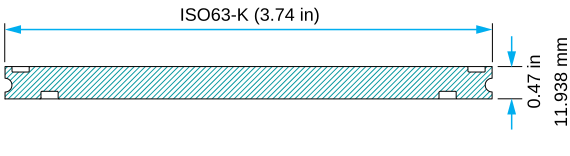
| 0.47 | 3 | 4 | QF63-BK |
| ISO63-K (3.74") | Blank, Clamp Style | 6061-T6 Aluminum | 2-1/2 |

| 0.47 | 3 | 4 | QF63-ABK |
| ISO80-K (4.33") | Blank, Clamp Style | 304L SS | 3 |

| 0.47 | 4 | 8 | QF80-BK |
| ISO80-K (4.33") | Blank, Clamp Style | 6061-T6 Aluminum | 3 |

| 0.47 | 4 | 8 | QF80-ABK |
| ISO100-K (5.12") | Blank, Clamp Style | 304L SS | 4 |

| 0.47 | 4 | 8 | QF100-BK |
| ISO100-K (5.12") | Blank, Clamp Style | 6061-T6 Aluminum | 4 |

| 0.47 | 4 | 8 | QF100-ABK |
| ISO160-K (7.09") | Blank, Clamp Style | 304L SS | 6 |

| 0.47 | 4 | 8 | QF160-BK |
| ISO160-K (7.09") | Blank, Clamp Style | 6061-T6 Aluminum | 6 |

| 0.47 | 4 | 8 | QF160-ABK |
| ISO200-K (9.45") | Blank, Clamp Style | 304L SS | 8 |

| 0.47 | 6 | 12 | QF200-BK |
| ISO200-K (9.45") | Blank, Clamp Style | 6061-T6 Aluminum | 8 |

| 0.47 | 6 | 12 | QF200-ABK |
| ISO250-K (11.42") | Blank, Clamp Style | 304L SS | 10 |

| 0.47 | 6 | 12 | QF250-BK |
| ISO250-K (11.42") | Blank, Clamp Style | 6061-T6 Aluminum | 10 |

| 0.47 | 6 | 12 | QF250-ABK |
| ISO320-K (14.57") | Blank, Clamp Style | 304L SS | 12-3/4 |

| 0.67 | 8 | 12 | QF320-BK |
| ISO320-K (14.57") | Blank, Clamp Style | 6061-T6 Aluminum | 12-3/4 |

| 0.67 | 8 | 12 | QF320-ABK |
| ISO400-K (17.72") | Blank, Clamp Style | 304L SS | 16 |

| 0.67 | 8 | 16 | QF400-BK |
| ISO400-K (17.72") | Blank, Clamp Style | 6061-T6 Aluminum | 16 |

| 0.67 | 8 | 16 | QF400-ABK |
| ISO500-K (21.65") | Blank, Clamp Style | 304L SS | 20 |

| 0.67 | 12 | 16 | QF500-BK |
| ISO500-K (21.65") | Blank, Clamp Style | 6061-T6 Aluminum | 20 |

| 0.67 | 12 | 16 | QF500-ABK |
| ISO630-K (27.17") | Blank, Clamp Style | 304L SS | 24 |

| 0.86 | 14 | 18 | QF630-BK |
| ISO630-K (27.17") | Blank, Clamp Style | 6061-T6 Aluminum | 24 |

| 0.87 | 14 | 18 | QF630-ABK |


Reviews
There are no reviews yet.