

Tungsten Hafnium Carbide Sputtering Target (WHfC)
Introduction
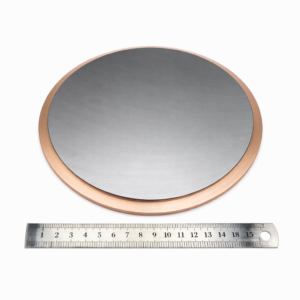
The Tungsten Hafnium Carbide (WHfC) Sputtering Target is a high-performance ceramic material designed for thin film deposition under extreme conditions. Combining the exceptional hardness and thermal stability of tungsten carbide with the oxidation resistance and toughness of hafnium carbide, WHfC offers superior film quality and reliability. This makes it a preferred choice for industries requiring protective, wear-resistant, and functional coatings.
Detailed Description
WHfC belongs to the family of ultra-high temperature ceramics (UHTCs). With melting points exceeding 3800 °C and strong resistance to thermal shock, it is particularly suited for sputtering environments involving high power and long deposition cycles.
Manufactured via hot pressing or vacuum sintering, the WHfC sputtering target achieves:
High density (>95% theoretical) for consistent sputtering performance.
Fine-grain microstructure minimizing particle ejection and defects.
Customizable dimensions and backing to suit a wide range of sputtering systems.
Its combined tungsten–hafnium carbide composition ensures hardness, oxidation resistance, and superior thermal conductivity compared to single-carbide targets.
Applications
WHfC sputtering targets are widely used in:
Semiconductors – diffusion barriers and advanced device coatings.
Optical coatings – durable protective films for sensors and lenses.
Cutting tools and wear parts – hard, oxidation-resistant thin films.
Aerospace – coatings for turbine and re-entry components.
Energy systems – protective coatings in nuclear and high-temperature energy devices.
R&D – development of next-generation UHTC thin films.
Technical Parameters
| Parameter | Typical Value / Range | Importance |
|---|---|---|
| Purity | 99.5% – 99.9% | Ensures low contamination in thin films |
| Density | ≥ 95% theoretical | Improves film uniformity and durability |
| Diameter | 25 – 300 mm (custom) | Fits various sputtering systems |
| Thickness | 3 – 10 mm | Balances target life and sputtering rate |
| Backing Plate | Copper / Molybdenum | Enhances thermal conductivity and stability |
Comparison with Related Materials
| Material | Key Advantage | Typical Application |
|---|---|---|
| WHfC (Tungsten Hafnium Carbide) | Balance of hardness, toughness, and oxidation resistance | Aerospace & wear-resistant coatings |
| WC (Tungsten Carbide) | Extreme hardness, cost-effective | Cutting tools |
| HfC (Hafnium Carbide) | Ultra-high melting point | Thermal protection & aerospace |
| Ta₄HfC₅ (Tantalum Hafnium Carbide) | One of the highest melting points known | Ultra-high temperature coatings |
FAQ
| Question | Answer |
|---|---|
| Can WHfC targets be customized? | Yes, size, thickness, purity, and backing can be tailored. |
| What bonding options are available? | Copper or molybdenum plates are commonly used. |
| How is it packaged? | Vacuum-sealed, foam-protected, and shipped in export-safe crates. |
| Is it suitable for high-temperature use? | Yes, WHfC is designed for ultra-high temperature coatings. |
| Which industries use WHfC most? | Semiconductor, aerospace, optics, energy, and R&D. |
Packaging
Each Tungsten Hafnium Carbide Sputtering Target is carefully vacuum-packed, labeled for traceability, and cushioned with protective foam. Strong cartons or wooden crates are used for secure shipping worldwide.
Conclusion
The WHfC sputtering target combines the superior hardness of tungsten carbide with the stability of hafnium carbide, making it a top-tier material for demanding thin film applications. Its adaptability and high performance ensure consistent results in research and industry.
For detailed specifications or a quotation, please contact us at [sales@thinfilmmaterials.com].

Reviews
There are no reviews yet.