In the rapidly evolving fields of microelectronics, telecommunications, and clean energy, the demand for advanced thin-film deposition materials has never been higher. Among these specialized materials, the Scandium sputtering target has emerged as a critical component. Known for its exceptional ability to enhance piezoelectric properties and stabilize crystal structures, Scandium (Sc) is driving innovation in everything from 5G RF filters to next-generation Solid Oxide Fuel Cells (SOFCs).
As a leading provider of Thin Film Materials (TFM), we have engineered our Scandium targets to meet the rigorous demands of modern Physical Vapor Deposition (PVD) systems. This guide explores the technical properties, core applications, and material advantages of Scandium, helping engineers and procurement managers optimize their thin-film processes.
What is a Scandium Sputtering Target?
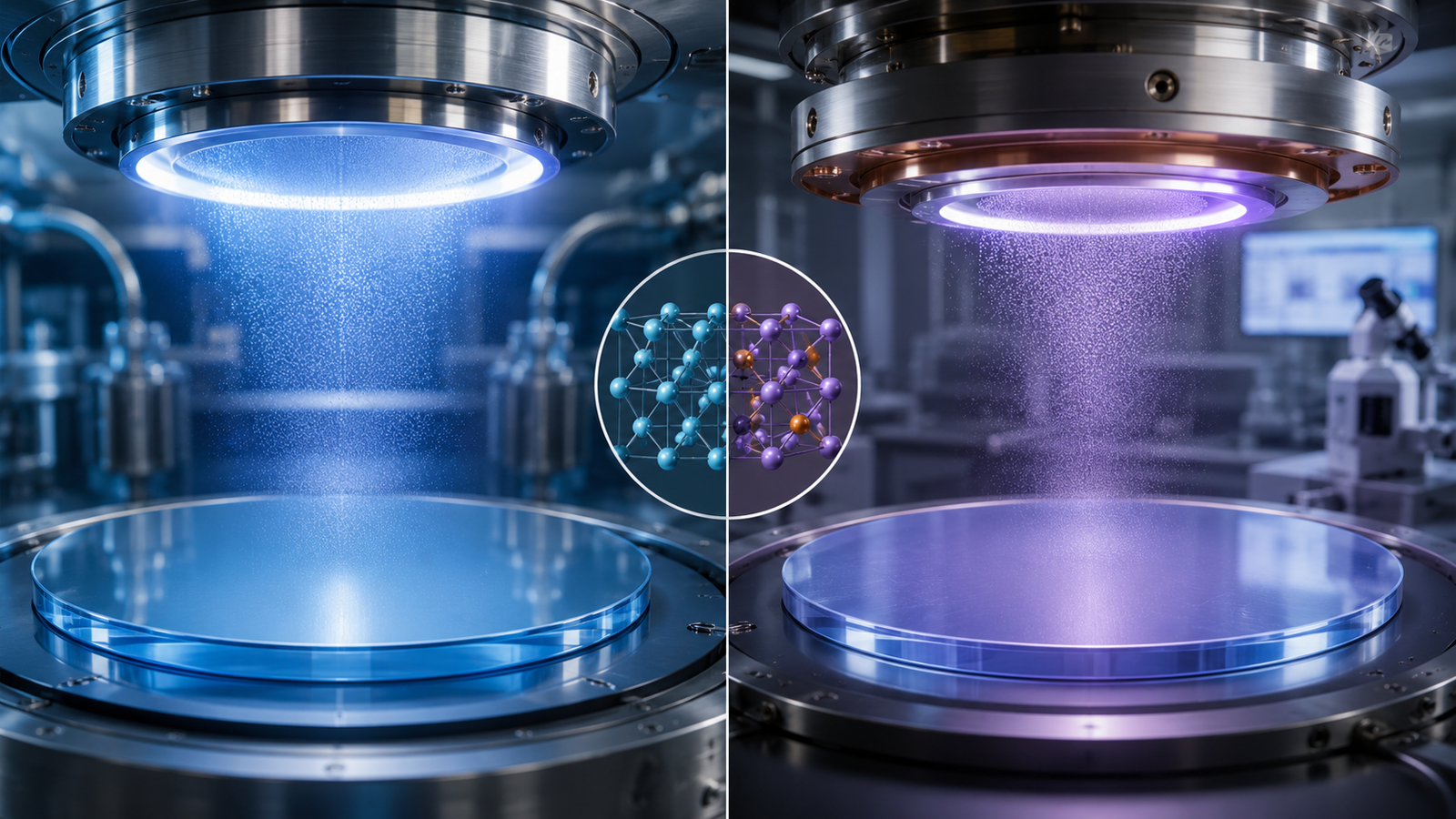
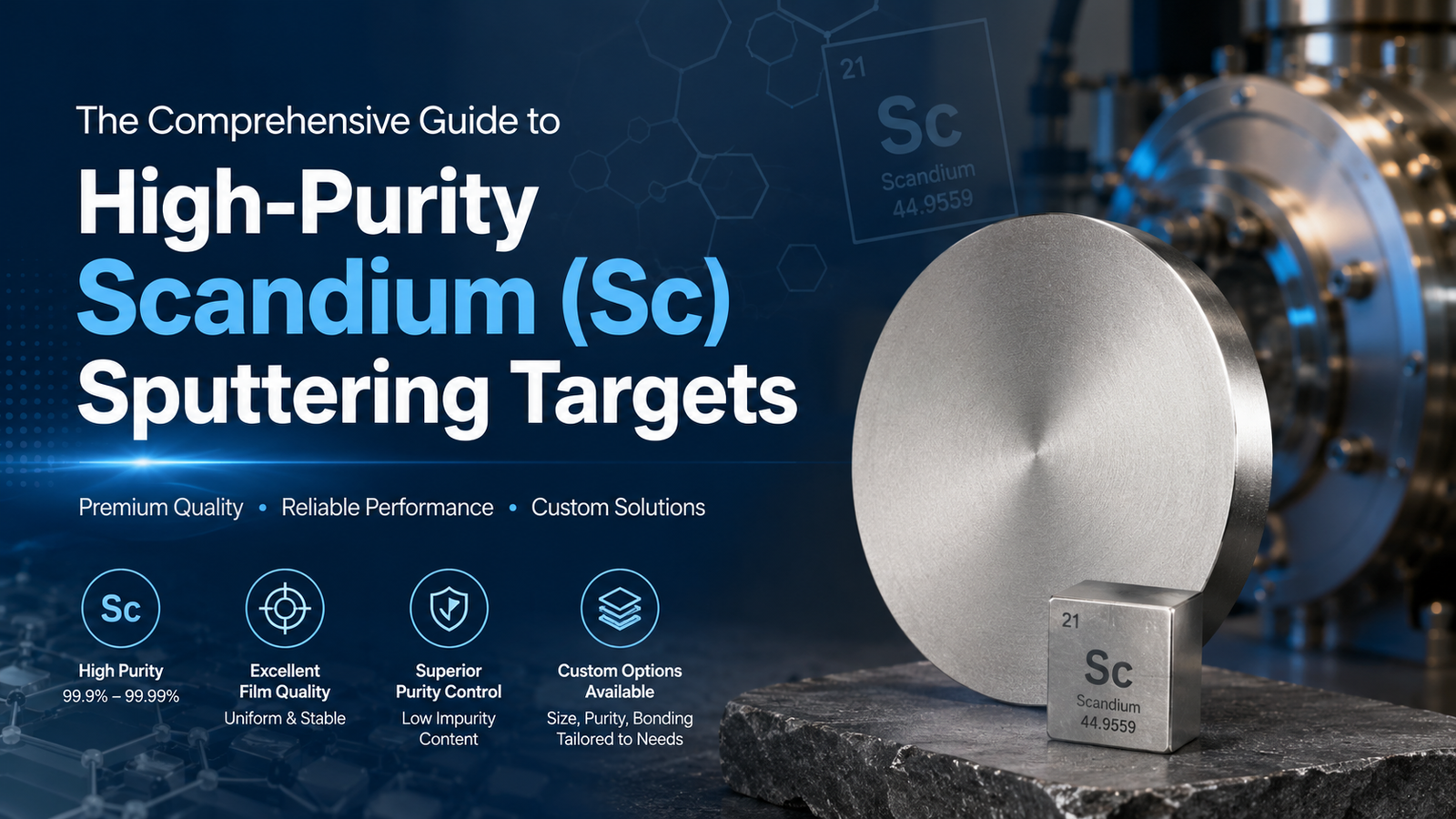
A Scandium (Sc) sputtering target is a solid block of high-purity scandium metal used as a source material in PVD processes, particularly magnetron sputtering. During deposition, high-energy ions bombard the target in a vacuum chamber, ejecting scandium atoms that condense onto a substrate to form an ultra-thin, uniform film.
Due to Scandium’s high reactivity with oxygen, manufacturing these targets requires stringent vacuum handling and proprietary consolidation techniques to achieve high density and low gas impurities.
Table 1: Core Physical Properties of Scandium for PVD
| Property | Value | Relevance to PVD Process |
| Atomic Number | 21 | Determines sputtering yield parameters. |
| Melting Point | 1541°C | High thermal stability during high-power sputtering. |
| Density | 2.985 g/cm³ | Requires specialized compaction for high-density targets. |
| Crystal Structure | Hexagonal Close-Packed (HCP) | Influences film growth epitaxy. |
Key Applications of Scandium Thin Films
Scandium thin films and Sc-doped compounds are revolutionizing several high-tech industries. By integrating high-quality evaporation materials and sputtering targets, engineers can achieve breakthrough device performance.
1. 5G RF Filters and Micro-Electromechanical Systems (MEMS)
One of the most critical applications for Scandium is the production of Scandium-doped Aluminum Nitride (ScAlN) thin films. By co-sputtering Aluminum and Scandium, or using custom Sc-Al alloy targets, manufacturers significantly increase the piezoelectric response of the film. This is essential for manufacturing Bulk Acoustic Wave (BAW) and Surface Acoustic Wave (SAW) filters used in 5G communication devices.
2. Solid Oxide Fuel Cells (SOFCs)
In the renewable energy sector, Scandium is used to stabilize Zirconia (ScSZ). Scandium-stabilized zirconia exhibits the highest ionic conductivity among solid electrolytes, allowing SOFCs to operate at much lower, more efficient temperatures (around 700°C – 800°C).
3. Advanced Optical Coatings
Scandium oxide (Sc2O3), deposited via reactive sputtering using pure Sc targets, offers a high refractive index and excellent laser damage threshold, making it highly valuable for UV and high-power laser optical coatings.
Horizontal Product Comparison: Scandium vs. Alternative Dopants
When engineers evaluate materials for doping Aluminum Nitride or stabilizing Zirconia, Scandium is often compared against Yttrium and pure Aluminum. The table below outlines the comparative advantages.
Table 2: Dopant Material Comparison for PVD Applications
| Feature / Material | Scandium (Sc) | Yttrium (Y) | Aluminum (Al) – Pure |
| Piezoelectric Enhancement (in AlN) | Extremely High (Up to 400% increase) | Negligible | Baseline |
| Ionic Conductivity (in Zirconia) | Best-in-class (Highest conductivity) | Moderate | N/A |
| Sputtering Deposition Rate | Moderate to High | Moderate | Very High |
| Cost Profile | Premium / High | Medium | Low |
| Primary Use Case | 5G RF Filters, SOFC Electrolytes | General ceramics, Superconductors | Base metallization, CMOS |
Result: While Scandium carries a premium cost due to its rarity, its unparalleled performance enhancements in microelectronics and energy sectors provide a massive return on investment, reducing the required footprint of microchips and improving cell lifespan in SOFCs.
The TFM Advantage: Manufacturing and Quality Control
Achieving a stable, defect-free thin film requires a sputtering target with zero compromises on purity or density. Sub-par targets lead to arcing, nodule formation, and uneven film thickness. TFM leverages advanced metallurgy to ensure our PVD coating materials deliver reliable, repeatable results.
- Ultra-High Purity: We offer Scandium targets with purities ranging from 99.9% (3N) to 99.99% (4N), strictly controlling oxygen (O), nitrogen (N), and carbon (C) impurities.
- Optimized Microstructure: Our proprietary manufacturing process ensures a fine, uniform grain size and >99% theoretical density, minimizing particle generation during the sputtering process.
- Custom Bonding Services: We provide in-house bonding to copper (Cu) or molybdenum (Mo) backing plates using advanced Indium or Elastomer bonding technologies, ensuring optimal thermal management.
Table 3: TFM Scandium Target Specifications & Tolerances
| Specification Parameter | Standard Availability | Customization Options |
| Purity Options | 99.9% (3N), 99.99% (4N) | Custom Sc-Al Alloys (e.g., Sc 20% / Al 80%) |
| Target Geometry | Circular, Rectangular | Tubular/Rotary, Custom Step Designs |
| Maximum Dimensions | Diameter up to 14 inches | Custom multi-tile configurations for larger cathodes |
| Density | > 99% | N/A (Consistently maximal) |
| Surface Finish | < 32 Microinches (RMS) | Tailored roughness upon request |
Conclusion: Elevate Your Thin Film Deposition with TFM
The choice of target material dictates the ceiling of your technological innovation. Whether you are scaling up production for next-generation 5G filters or researching high-efficiency fuel cells, a premium Scandium sputtering target is an indispensable asset.
At Thin Film Materials (TFM), we combine deep material science expertise with world-class manufacturing capabilities to deliver sputtering targets that meet the exact specifications of the world’s most demanding R&D labs and semiconductor fabs.
Ready to optimize your PVD process?
Request a Quote for Custom Scandium Targets Today and partner with TFM for reliable, high-yield material solutions.
Frequently Asked Questions (FAQ)
1. What is the typical purity of a TFM Scandium sputtering target?
TFM offers Scandium targets in standard purities of 99.9% (3N) and 99.99% (4N). We rigorously test and control trace metals and gaseous impurities to ensure optimal deposition quality.
2. Why is Scandium added to Aluminum Nitride (AlN) thin films?
Scandium doping distorts the crystal lattice of AlN, significantly increasing its piezoelectric coefficient. This allows for the creation of highly sensitive RF filters (BAW/SAW) required for high-frequency 5G and 6G communications.
3. Are TFM Scandium targets compatible with DC and RF magnetron sputtering?
Yes. Pure Scandium metal targets are highly conductive and excel in DC magnetron sputtering. For reactive sputtering to create Sc2O3 or ScN, pulsed DC or RF sputtering is also highly effective.
4. Can you manufacture custom Scandium-Aluminum (Sc-Al) alloy targets?
Absolutely. We specialize in producing custom Sc-Al alloy targets tailored to your specific atomic percentage requirements, streamlining the deposition process compared to co-sputtering.
5. How do you prevent the oxidation of Scandium targets during shipping and storage?
Scandium is highly reactive to oxygen and moisture. All TFM Scandium targets are vacuum-sealed in cleanroom environments with desiccant packaging to ensure they arrive in pristine condition.
6. Do you provide backing plates and bonding services for Scandium targets?
Yes, we offer comprehensive in-house bonding services. Given Scandium’s thermal properties, we typically recommend bonding to a Copper (Cu) backing plate using Indium for superior heat dissipation during high-power sputtering.
7. Can TFM produce rotary (tubular) Scandium targets?
While Scandium is primarily supplied as planar targets due to material costs and processing constraints, we can discuss custom multi-tile configurations for larger area coating applications. Please contact our engineering team for feasibility.
8. What happens if the density of a Scandium target is too low?
Low-density targets contain microscopic voids. During sputtering, these voids can trap gases, leading to arcing, particle ejection (spitting), and ultimately, defects in the thin film. TFM guarantees >99% density to prevent this.
9. How does Scandium enhance Solid Oxide Fuel Cells (SOFCs)?
When used to dope Zirconia (creating ScSZ), Scandium provides the highest ionic conductivity of any stabilized zirconia. This allows the fuel cell to operate efficiently at lower temperatures, reducing thermal degradation and extending cell life.
10. Do you provide a Certificate of Analysis (COA) with your materials?
Yes. Every sputtering target and evaporation material shipped by TFM includes a detailed COA. This document provides a full elemental analysis, confirming the exact purity and verifying that all trace elements fall within acceptable B2B industry limits.