Ultra-high vacuum (UHV) technology plays a critical role in modern scientific research and advanced manufacturing. From semiconductor fabrication and thin film deposition to particle accelerators and surface science experiments, many high-precision systems depend on vacuum environments where pressures can reach 10⁻⁹ Torr or lower. Achieving and maintaining such extreme vacuum levels requires carefully engineered hardware, particularly the sealing components that connect vacuum chambers, pumps, viewports, and instrumentation.
Among these components, ConFlat® (CF) flanges have become the industry standard for ultra-high vacuum sealing. Their metal-to-metal knife-edge sealing mechanism provides exceptional leak tightness and long-term stability. Within the CF flange family, rotatable CF flanges offer additional mechanical flexibility that significantly simplifies installation and system assembly.
Rotatable CF flanges may appear to be a small design modification, but in complex vacuum systems they can dramatically improve assembly efficiency, reduce installation errors, and enhance overall system reliability. This article explores why rotatable CF flanges are essential in UHV systems, including their design principles, advantages, installation benefits, and typical applications in research and industrial environments.
Understanding Ultra High Vacuum Requirements
Before examining rotatable flanges specifically, it is important to understand the stringent requirements of ultra-high vacuum systems.
UHV environments demand extremely low gas densities. Achieving these conditions requires:
- Leak-tight sealing
- Minimal outgassing
- High structural stability
- Reliable metal sealing surfaces
Even microscopic leaks or poorly aligned components can prevent a system from reaching its target vacuum pressure.
Typical UHV pressure ranges include:
| Vacuum Level | Pressure Range |
|---|---|
| High Vacuum | 10⁻³ – 10⁻⁷ Torr |
| Ultra High Vacuum | 10⁻⁷ – 10⁻¹² Torr |
| Extreme High Vacuum | <10⁻¹² Torr |
At these pressures, traditional elastomer seals such as Viton or rubber gaskets are no longer suitable due to permeation and outgassing. Instead, UHV systems rely on all-metal sealing technologies, and the CF flange is the most widely used design.
What Is a ConFlat (CF) Flange?
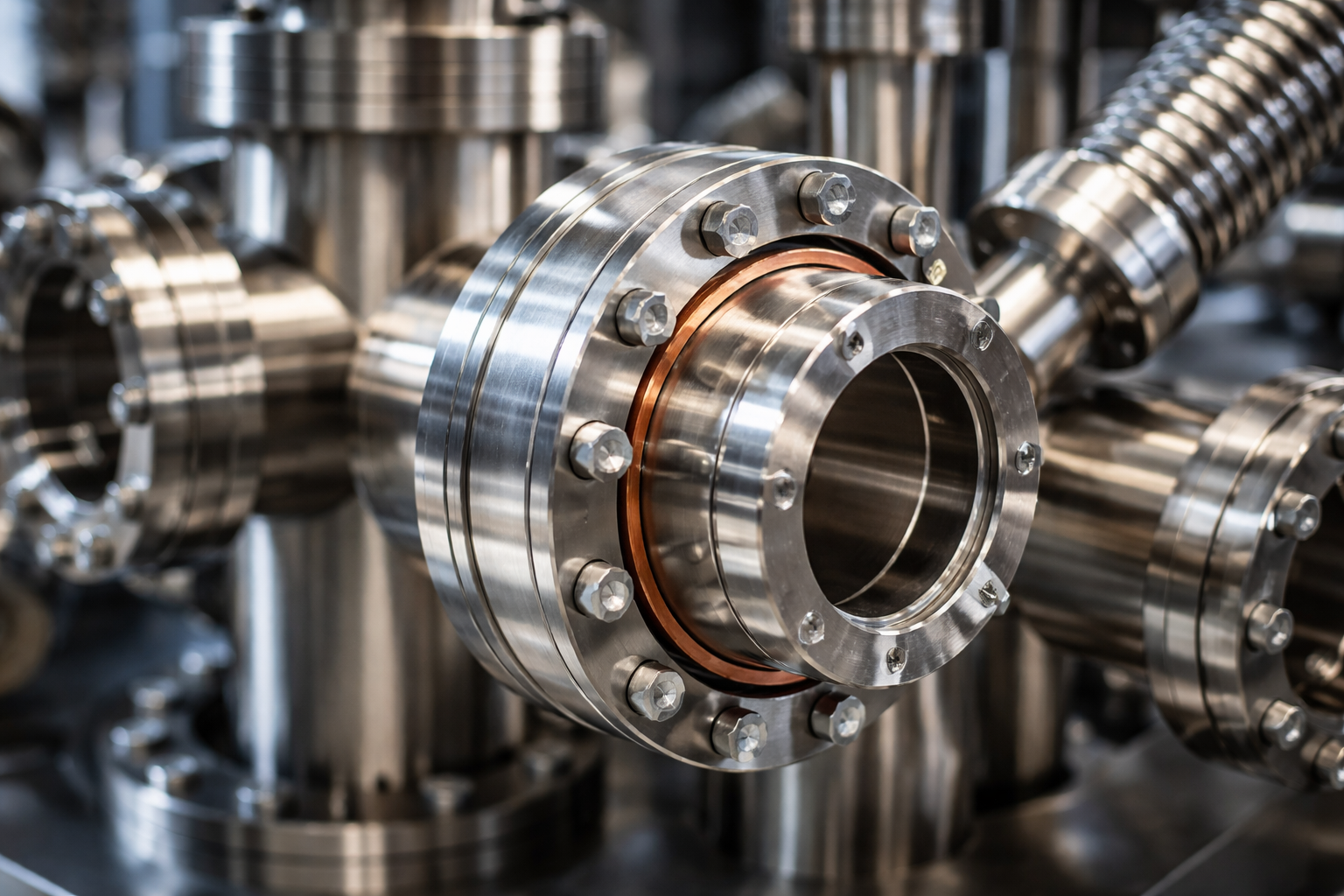
A ConFlat flange is a vacuum flange design developed to provide reliable metal sealing for ultra-high vacuum systems. It uses a knife-edge sealing surface that compresses a soft copper gasket between two stainless steel flanges.
When bolts are tightened, the knife edges cut slightly into the copper gasket, forming a cold-welded metal seal. This process produces an extremely tight joint that prevents gas leakage even under extreme vacuum conditions.
Key features of CF flanges
- Metal-to-metal sealing
- Copper gasket deformation
- High temperature compatibility
- Long-term vacuum stability
- Compatibility with UHV bake-out procedures
Typical CF flanges are manufactured from stainless steel, often grades such as 304L, 316L, or the high-strength 316LN stainless steel used in many advanced vacuum components.
Rotatable vs Fixed CF Flanges
Standard CF flanges can be produced in two basic mechanical configurations:
| Feature | Rotatable CF Flange | Fixed CF Flange |
|---|---|---|
| Bolt hole alignment | Adjustable | Fixed |
| Installation flexibility | High | Limited |
| Assembly speed | Faster | Slower |
| Risk of misalignment | Low | Higher |
| Typical use | Complex UHV systems | Simple connections |
In a fixed CF flange, the bolt holes are machined directly into the flange body. During installation, these holes must align perfectly with the mating flange.
In contrast, a rotatable CF flange includes a separate rotating collar that allows the bolt holes to rotate freely around the flange body. This means that the installer can rotate the bolt ring to align with the mating flange after the gasket and sealing surfaces are positioned.
This seemingly simple design difference provides several important advantages.
The Engineering Design of Rotatable CF Flanges
A rotatable CF flange consists of three primary components:
- Flange body with knife edge
- Rotatable bolt ring
- Retaining structure
The sealing surface and vacuum interface remain identical to a standard CF flange. However, the outer bolt ring is able to rotate independently of the sealing face.
Key structural elements
| Component | Function |
|---|---|
| Knife edge | Forms seal with copper gasket |
| Rotating bolt ring | Allows bolt hole alignment |
| Retaining lip | Holds bolt ring in position |
| Stainless steel body | Provides mechanical strength |
Because the sealing face does not rotate relative to the gasket during tightening, the integrity of the vacuum seal is maintained while still allowing flexible bolt positioning.
Why Rotatable CF Flanges Are Essential in UHV Systems
1. Simplified Bolt Alignment
One of the biggest challenges when assembling vacuum systems is aligning bolt holes between multiple flanges.
In large vacuum chambers or complex piping networks, components may be difficult to reposition once installed. Fixed flanges require precise orientation, which can slow down assembly.
Rotatable CF flanges eliminate this issue. Installers can simply rotate the bolt ring until the holes match the mating flange.
Benefits include:
- Faster installation
- Reduced assembly stress
- Less risk of damaging components
2. Reduced Mechanical Stress on Vacuum Hardware
Vacuum chambers and beamline equipment are often expensive precision components. Misalignment during installation can introduce mechanical stress that may damage equipment or compromise sealing surfaces.
Rotatable flanges help avoid forcing components into alignment. Instead of rotating the entire chamber or pipe, technicians only rotate the bolt ring.
This protects:
- knife-edge sealing surfaces
- copper gaskets
- vacuum chamber structures
3. Improved Installation Efficiency
In research laboratories and semiconductor fabrication facilities, downtime is extremely costly. Equipment may require frequent maintenance or reconfiguration.
Rotatable flanges significantly speed up installation processes by:
- reducing alignment time
- minimizing adjustments
- simplifying assembly in confined spaces
For large UHV systems containing dozens or even hundreds of CF connections, the cumulative time savings can be substantial.
4. Ideal for Complex Vacuum Systems
Modern UHV systems often include many interconnected components such as:
- deposition chambers
- load locks
- ion pumps
- viewports
- manipulators
- diagnostic instruments
These systems may have irregular geometries that make fixed flange alignment difficult.
Rotatable flanges allow engineers to design vacuum systems without worrying about bolt hole orientation during fabrication.
5. Enhanced Reliability in Large Installations
Large scientific facilities such as synchrotron beamlines or particle accelerators contain thousands of vacuum connections.
In these environments, even small improvements in assembly reliability can reduce maintenance costs and system downtime.
Rotatable CF flanges improve reliability by reducing the chance of:
- misaligned bolts
- uneven gasket compression
- sealing failures
Materials Used in Rotatable CF Flanges
Rotatable CF flanges are typically manufactured from high-quality stainless steel alloys that provide strength, corrosion resistance, and low outgassing properties.
Common materials
| Material | Key Properties |
|---|---|
| 304L Stainless Steel | Good vacuum compatibility |
| 316L Stainless Steel | Improved corrosion resistance |
| 316LN Stainless Steel | High strength and nitrogen reinforcement |
316LN stainless steel is often preferred for advanced vacuum systems because it offers:
- higher yield strength
- excellent weldability
- improved resistance to deformation
- low magnetic permeability
These properties make it particularly suitable for high-precision UHV hardware.
Copper Gaskets and Sealing Mechanism
The CF sealing system relies on annealed copper gaskets. Copper is soft enough to deform under bolt pressure while still maintaining a strong metal seal.
Sealing process
- Copper gasket placed between flanges
- Bolts tightened gradually
- Knife edges penetrate gasket
- Copper plastically deforms
- Gas-tight metal seal forms
This metal seal can achieve leak rates as low as:
10⁻¹³ Torr·L/s
Such extremely low leakage rates are essential for ultra-high vacuum environments.
Applications of Rotatable CF Flanges
Rotatable CF flanges are widely used in many high-technology industries and research fields.
Semiconductor Manufacturing
Semiconductor fabrication tools rely heavily on UHV systems for processes such as:
- sputtering deposition
- molecular beam epitaxy (MBE)
- atomic layer deposition (ALD)
- ion implantation
Rotatable flanges simplify maintenance and reconfiguration of these complex vacuum tools.
Thin Film Deposition Systems
In thin film research and industrial coating systems, CF flanges connect many components including:
- sputtering targets
- evaporation sources
- vacuum gauges
- gas inlets
- optical ports
The ability to quickly align bolt holes speeds up chamber maintenance.
Particle Accelerators and Synchrotron Facilities
Large scientific instruments require long vacuum beamlines that may extend hundreds of meters.
Rotatable flanges make it easier to assemble these systems without stressing sensitive components.
Surface Science and Physics Research
UHV chambers used for surface analysis techniques such as:
- XPS (X-ray photoelectron spectroscopy)
- STM (scanning tunneling microscopy)
- LEED (low-energy electron diffraction)
often require modular configurations. Rotatable flanges allow rapid system modifications.
Advantages Summary
The main advantages of rotatable CF flanges include:
| Advantage | Impact |
|---|---|
| Flexible bolt alignment | Easier installation |
| Reduced component stress | Longer equipment life |
| Faster assembly | Lower labor costs |
| Improved sealing reliability | Better vacuum performance |
| Ideal for complex systems | Greater design flexibility |
Because of these benefits, rotatable CF flanges have become a preferred choice in many modern UHV systems.
Best Practices for Installation
To ensure optimal performance, several installation practices should be followed.
Key recommendations
- Always use new copper gaskets
- Clean sealing surfaces carefully
- Tighten bolts in a cross pattern
- Apply torque gradually
- Avoid over-tightening bolts
Proper installation ensures that the knife edges deform the gasket evenly and create a reliable vacuum seal.
Future Trends in UHV Flange Technology
As vacuum technology continues to evolve, improvements in materials and manufacturing processes are further enhancing flange performance.
Emerging trends include:
- precision machining for smoother sealing surfaces
- improved stainless steel alloys
- optimized gasket materials
- advanced surface treatments to reduce outgassing
These developments will further improve the reliability and performance of UHV systems.
Conclusion
Rotatable CF flanges represent an elegant engineering solution to a common challenge in ultra-high vacuum system assembly. By allowing bolt holes to rotate independently of the sealing surface, these flanges simplify installation, reduce mechanical stress on vacuum components, and improve overall system reliability.
In environments where pressures must reach extremely low levels and equipment downtime is costly, even small improvements in hardware design can have significant benefits. Rotatable CF flanges provide the flexibility and precision required for modern UHV systems used in semiconductor manufacturing, scientific research, and advanced materials processing.
As vacuum technology continues to support cutting-edge innovation, components such as rotatable CF flanges will remain essential elements in achieving stable, leak-free ultra-high vacuum environments.