Introduction
As global energy consumption continues to rise, improving building energy efficiency has become a major technological priority. One promising solution is the development of thermochromic smart window coatings, which can automatically regulate solar heat transmission depending on temperature. Among the materials investigated for this purpose, Vanadium Dioxide (VO₂) has emerged as one of the most important functional oxides.
Vanadium Dioxide Sputtering Targets are widely used to deposit VO₂ thin films through Physical Vapor Deposition (PVD) techniques such as magnetron sputtering. These films exhibit a remarkable metal–insulator phase transition near 68 °C, enabling them to dynamically control infrared radiation transmission. As a result, VO₂ coatings can reduce cooling loads in buildings while maintaining visible light transparency.
Because of this unique thermochromic behavior, VO₂ thin films are increasingly being explored for energy-efficient architectural glass, automotive smart windows, and adaptive optical systems.
Understanding Thermochromic Behavior in VO₂
Metal–Insulator Phase Transition
The key property that makes vanadium dioxide attractive for smart windows is its reversible metal–insulator transition (MIT).
At temperatures below about 68 °C, VO₂ behaves as a semiconductor with relatively high infrared transparency. When the temperature rises above the transition point, its crystal structure changes and the material becomes metallic.
This structural change causes a dramatic shift in optical properties:
| Temperature State | Crystal Structure | Optical Behavior |
|---|---|---|
| Below ~68 °C | Monoclinic phase | Infrared transparent |
| Above ~68 °C | Rutile metallic phase | Infrared reflective |
As the coating heats up under sunlight, the material automatically reflects infrared heat, preventing excessive solar heating inside buildings.
When the temperature drops, the coating returns to its transparent state, allowing solar heat to enter again.
This passive thermal regulation makes VO₂ an ideal material for smart window technologies.
Role of Vanadium Dioxide Sputtering Targets

Thin Film Deposition Using Magnetron Sputtering
High-quality VO₂ films are commonly fabricated using magnetron sputtering, a widely used thin film deposition method in semiconductor and coating industries.
In this process:
- A Vanadium Dioxide sputtering target is mounted in a vacuum chamber.
- Argon plasma is generated using RF or DC power.
- Energetic ions bombard the target surface.
- Vanadium and oxygen atoms are ejected and deposited onto a substrate.
The deposited material then forms a thin VO₂ coating on surfaces such as glass or sapphire.
Magnetron sputtering offers several advantages:
- Precise thickness control
- Excellent film uniformity
- High purity coatings
- Scalable industrial processing
Because of these advantages, sputtering targets are the primary industrial source for producing VO₂ thermochromic coatings.
Deposition Parameters for VO₂ Thin Films
Producing high-performance VO₂ coatings requires careful control of several deposition parameters.
Oxygen Partial Pressure
The vanadium–oxygen system contains multiple oxide phases including:
- V₂O₃
- VO₂
- V₂O₅
Maintaining the correct oxygen concentration during deposition is essential to form the desired VO₂ phase.
Even small deviations can produce unwanted phases that degrade thermochromic performance.
Substrate Temperature
VO₂ films often require substrate temperatures between 400 °C and 550 °C during sputtering to achieve proper crystallization.
Post-deposition annealing may also be used to improve:
- crystal orientation
- phase purity
- optical switching performance
Film Thickness
Typical VO₂ thermochromic coatings range from 30 nm to 150 nm in thickness.
Film thickness affects:
- infrared modulation efficiency
- optical transparency
- switching performance
Optimizing thickness is critical for balancing visible transparency and solar heat control.
Applications of VO₂ Thermochromic Coatings
Smart Windows for Energy-Efficient Buildings
The most important application of VO₂ coatings is thermochromic architectural glass.
Buildings account for a large percentage of global energy consumption, much of which is used for air conditioning. Smart windows can significantly reduce cooling demand by limiting solar heat gain.
Benefits include:
- passive temperature regulation
- reduced HVAC energy consumption
- improved indoor comfort
- reduced carbon emissions
VO₂ coatings automatically adjust solar heat transmission without requiring electrical power.
Automotive Smart Glass
Automotive manufacturers are also exploring VO₂ coatings for:
- panoramic sunroofs
- smart windshields
- adaptive shading glass
These coatings help prevent excessive heating of vehicle interiors while maintaining visibility.
Adaptive Optical Devices
VO₂ thin films are also used in advanced optical technologies, including:
- infrared optical switches
- optical modulators
- adaptive optical filters
- laser protection coatings
Because VO₂ can rapidly change optical properties, it is suitable for dynamic optical control systems.
Infrared Camouflage and Thermal Management
VO₂ coatings can also control infrared radiation, making them useful in:
- thermal camouflage coatings
- military thermal management systems
- infrared signature control
These properties are important for aerospace and defense applications.
Advantages of VO₂ Thin Film Technology
VO₂ thermochromic coatings offer several key advantages over conventional coatings.
Passive Operation
Unlike electrochromic windows, VO₂ coatings require no external power source. The switching behavior occurs naturally based on temperature.
Automatic Energy Regulation
The coating automatically adjusts infrared transmission, reducing cooling loads during hot weather.
Fast Switching Response
VO₂ undergoes its phase transition extremely quickly, allowing rapid response to temperature changes.
Long-Term Stability
Properly deposited VO₂ coatings exhibit strong environmental stability and durability.
Challenges in VO₂ Smart Window Technology
Despite its advantages, several challenges remain in the commercialization of VO₂ coatings.
High Transition Temperature
The natural transition temperature of VO₂ (~68 °C) is higher than ideal for building applications.
Researchers often introduce dopants such as tungsten (W) to lower the switching temperature closer to room temperature.
Visible Light Transparency
VO₂ coatings can sometimes reduce visible light transmission. Optimizing film thickness and multilayer structures helps maintain transparency.
Large-Scale Manufacturing
Producing uniform VO₂ coatings on large glass panels requires precise industrial sputtering systems and high-quality sputtering targets.
Importance of High-Quality VO₂ Sputtering Targets
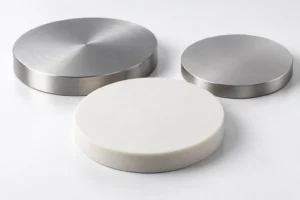
The performance of thermochromic coatings strongly depends on the quality of the sputtering target material.
Key characteristics include:
- high material purity
- controlled stoichiometry
- high density (>95%)
- uniform microstructure
- stable sputtering rate
Poor target quality can lead to:
- unstable plasma conditions
- composition variation
- particle generation
- poor film performance
For industrial coating processes, high-density ceramic VO₂ sputtering targets are essential for achieving consistent results.
Technical Parameters of VO₂ Sputtering Targets
| Parameter | Typical Value / Range | Importance |
|---|---|---|
| Material | Vanadium Dioxide (VO₂) | Thermochromic oxide |
| Purity | 99.9% – 99.99% | Improves film quality |
| Density | ≥95% theoretical | Stable sputtering performance |
| Diameter | 25 – 300 mm | Compatible with sputtering systems |
| Thickness | 3 – 6 mm | Influences sputtering rate |
| Bonding | Copper backing plate optional | Improves thermal conductivity |
Future Outlook for VO₂ Smart Windows
The demand for energy-efficient building materials continues to grow worldwide. VO₂ thermochromic coatings are expected to play a major role in next-generation smart window technologies.
Research efforts are currently focused on:
- lowering transition temperatures
- improving visible transparency
- enhancing durability
- reducing production costs
With continued development, VO₂-based coatings could become a standard technology for sustainable building design.
Conclusion
Vanadium Dioxide Sputtering Targets play a critical role in the fabrication of thermochromic coatings used in smart window technology. Through magnetron sputtering, these targets enable the deposition of high-quality VO₂ thin films that dynamically regulate infrared radiation based on temperature.
The unique metal–insulator transition of VO₂ allows windows to automatically reduce solar heat gain during hot conditions while maintaining visible transparency. This capability offers significant potential for improving building energy efficiency and reducing environmental impact.
As research continues to optimize VO₂ thin film performance, thermochromic smart windows are expected to become an increasingly important component of future energy-efficient architecture and advanced optical technologies.
For detailed specifications or customized Vanadium Dioxide Sputtering Targets, please contact sales@thinfilmmaterials.com.