Introduction
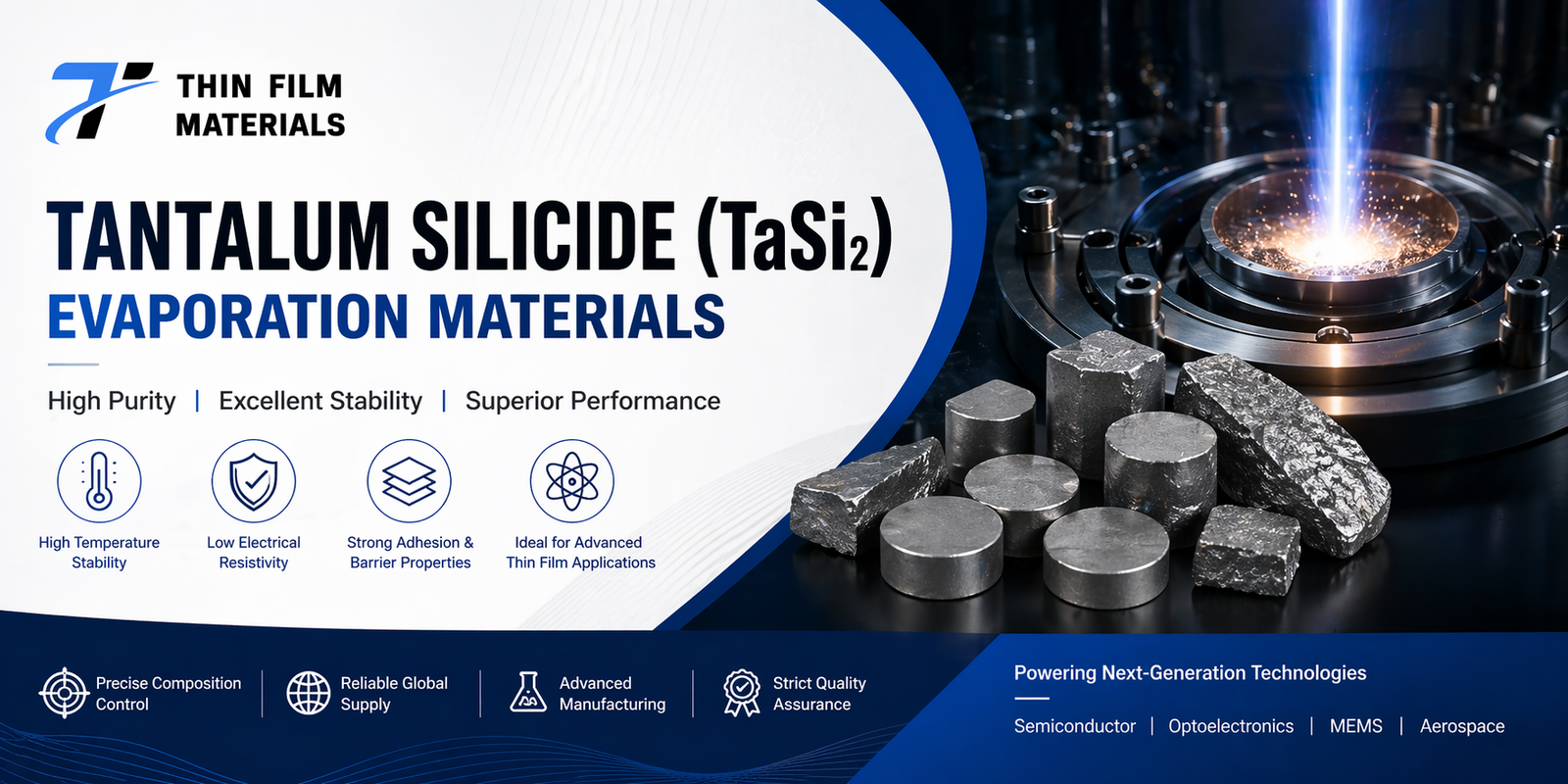
As thin film technologies continue to push the limits of performance in semiconductor devices, high-temperature coatings, and advanced microelectronics, the demand for stable, conductive, and thermally robust materials has grown significantly. Among these, Tantalum Silicide (TaSi₂) evaporation materials have emerged as a critical solution for applications requiring exceptional thermal stability, low resistivity, and strong adhesion to substrates.
TaSi₂ is widely recognized in Physical Vapor Deposition (PVD) processes—particularly thermal and electron beam evaporation—for forming high-performance thin films used in semiconductor interconnects, diffusion barriers, and protective coatings. This article provides a comprehensive, in-depth exploration of TaSi₂ evaporation materials, covering their properties, manufacturing considerations, deposition behavior, and key industrial applications.
What Is Tantalum Silicide (TaSi₂)?
Tantalum silicide is an intermetallic compound composed of tantalum (Ta) and silicon (Si) in a stoichiometric ratio of approximately 1:2. It belongs to a class of refractory silicides known for combining metallic conductivity with ceramic-like thermal and chemical stability.
Key Material Characteristics
- High melting point (~2200°C)
- Low electrical resistivity (~25–50 µΩ·cm)
- Excellent oxidation resistance (up to ~800–1000°C in air)
- Strong adhesion to silicon-based substrates
- Good diffusion barrier properties
These attributes make TaSi₂ particularly valuable in environments where conventional metals such as aluminum or copper would fail due to diffusion, oxidation, or thermal degradation.
Why TaSi₂ for Evaporation?
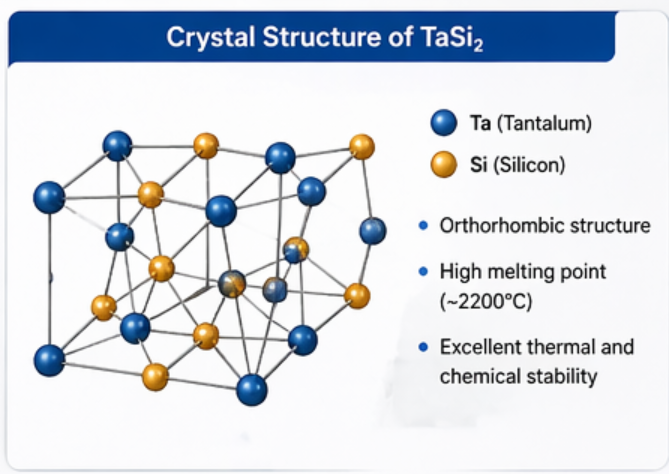
Compared to pure metals or simple alloys, TaSi₂ offers a unique balance of properties that directly impact thin film performance.
1. Thermal Stability in High-Temperature Deposition
In high-vacuum evaporation systems, materials are subjected to extreme temperatures. TaSi₂ maintains structural integrity and composition stability under these conditions, minimizing:
- Phase decomposition
- Elemental segregation
- Vapor pressure imbalance
This ensures consistent film composition during deposition.
2. Controlled Evaporation Behavior
Unlike multi-element mixtures, TaSi₂ is a pre-reacted compound, which means:
- More uniform evaporation rates
- Reduced compositional drift
- Improved repeatability across batches
This is especially important for semiconductor processes where tight control is required.
3. Low Resistivity for Conductive Films
TaSi₂ thin films exhibit significantly lower resistivity than many refractory materials, making them suitable for:
- Gate electrodes
- Interconnect layers
- Contact metallization
4. Superior Interface Compatibility with Silicon
TaSi₂ forms stable interfaces with silicon substrates, reducing issues such as:
- Interdiffusion
- Contact resistance
- Film delamination
Manufacturing of TaSi₂ Evaporation Materials
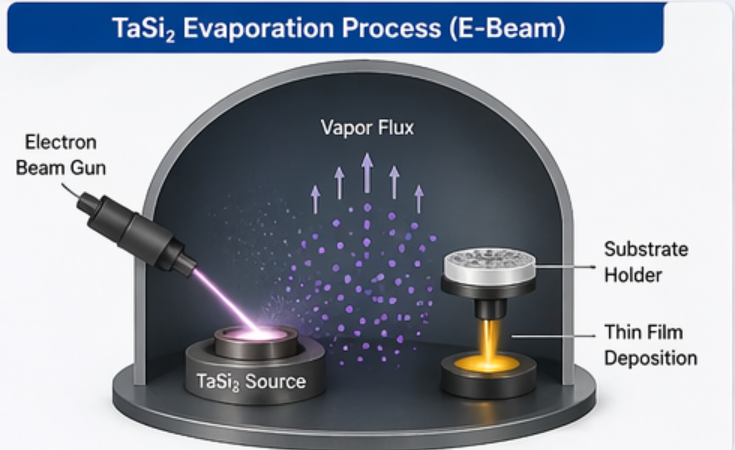
Producing high-quality TaSi₂ evaporation materials is far from trivial. The process must ensure precise stoichiometry, high density, and structural uniformity.
Common Production Methods
1. Vacuum Induction Melting (VIM)
- Ensures homogeneous alloying of Ta and Si
- Minimizes contamination
- Suitable for bulk ingots
2. Powder Metallurgy (PM)
- Fine Ta and Si powders are mixed and sintered
- Allows control over microstructure
- Often used for customized shapes
3. Hot Pressing / Hot Isostatic Pressing (HIP)
- Produces high-density materials (>98%)
- Reduces porosity
- Improves thermal conductivity
Key Challenges
- High melting point of Ta (3017°C) vs. Si (1414°C)
- Risk of phase segregation during solidification
- Achieving uniform grain distribution
- Maintaining low impurity levels (O, C, N)
Forms of TaSi₂ Evaporation Materials
TaSi₂ can be supplied in multiple forms depending on the deposition system:
- Pellets / granules – for standard thermal evaporation
- Chunks / pieces – for e-beam evaporation
- custom-shaped charges – optimized for specific crucibles
Typical Considerations
- Size compatibility with crucible or hearth
- Surface cleanliness (oxide-free)
- Density for stable evaporation rate
Deposition Behavior of TaSi₂ Thin Films
Understanding deposition characteristics is critical for optimizing film quality.
Evaporation Techniques
1. Thermal Evaporation
- Suitable for small-scale or lab use
- Requires high temperatures
- Risk of composition deviation if not controlled
2. Electron Beam (E-Beam) Evaporation
- Preferred for TaSi₂
- Provides localized heating
- Enables controlled evaporation of high-melting materials
Key Deposition Parameters
| Parameter | Impact |
|---|---|
| Vacuum level | Affects film purity |
| Substrate temperature | Influences crystallinity |
| Deposition rate | Controls film density |
| Chamber pressure | Impacts contamination |
Film Properties Achieved
- Dense, uniform coatings
- Low resistivity layers
- Strong adhesion to Si, SiO₂, and metals
Applications of TaSi₂ Evaporation Materials
1. Semiconductor Industry
TaSi₂ is widely used in:
- Gate electrodes in MOSFETs
- Source/drain contacts
- Diffusion barriers
Its ability to maintain low resistivity at elevated temperatures makes it a strong alternative to polysilicon and other silicides.
2. Thin Film Resistors
TaSi₂ films provide:
- Stable resistivity over temperature
- High durability
- Long-term reliability
3. High-Temperature Coatings
Used in:
- Aerospace components
- Thermal protection systems
- Oxidation-resistant coatings
4. Optical and Protective Coatings
- Durable coatings for harsh environments
- Barrier layers in multilayer optical systems
5. Microelectromechanical Systems (MEMS)
TaSi₂ is used for:
- Structural layers
- Conductive pathways
- High-temperature sensors
Comparison with Other Silicide Materials
| Material | Advantage | Limitation | Typical Use |
|---|---|---|---|
| TaSi₂ | High thermal stability, low resistivity | Higher cost | Semiconductors, barriers |
| MoSi₂ | Excellent oxidation resistance | Higher resistivity | High-temp coatings |
| WSi₂ | Good conductivity | Brittle | Microelectronics |
| TiSi₂ | Very low resistivity | Poor high-temp stability | CMOS devices |
Why Choose TaSi₂?
- Better balance between conductivity and stability
- More reliable under thermal cycling
- Stronger interface with silicon
Key Technical Parameters (Typical)
| Parameter | Typical Value / Range | Importance |
|---|---|---|
| Purity | 99.5% – 99.99% | Higher purity ensures film performance |
| Form | Pellets / chunks | Matches evaporation systems |
| Density | >98% theoretical | Ensures stable evaporation |
| Melting Point | ~2200°C | Suitable for high-temp deposition |
| Resistivity | 25–50 µΩ·cm | Critical for conductive films |
Common Challenges and Solutions
1. Composition Drift During Evaporation
Solution: Use pre-alloyed, high-density TaSi₂ materials.
2. Poor Film Adhesion
Solution: Optimize substrate cleaning and temperature.
3. Oxidation Contamination
Solution: Store materials in vacuum or inert environments.
4. Inconsistent Deposition Rate
Solution: Use uniform-sized pellets and stable power input.
Storage and Handling
TaSi₂ is relatively stable compared to reactive metals, but proper handling is still essential:
- Store in dry, inert atmosphere
- Avoid prolonged exposure to air at high humidity
- Clean with acetone or ethanol before use
- Use gloves to prevent contamination
Future Trends and Emerging Applications
As semiconductor nodes continue to shrink and operating temperatures increase, materials like TaSi₂ are becoming increasingly relevant.
Emerging Areas
- Advanced logic devices (sub-5nm nodes)
- Power electronics
- Wide-bandgap semiconductor integration (SiC, GaN)
- Next-generation sensors and MEMS
TaSi₂’s ability to function reliably under extreme conditions positions it as a key material in next-generation electronics.
Conclusion
Tantalum Silicide (TaSi₂) evaporation materials represent a high-performance solution for demanding thin film applications, particularly in semiconductor and high-temperature environments. With its combination of low resistivity, thermal stability, and strong substrate compatibility, TaSi₂ stands out among refractory materials.
From controlled evaporation behavior to long-term film reliability, TaSi₂ enables consistent, high-quality deposition results—making it an essential material for engineers and researchers working at the forefront of advanced materials science.
For detailed specifications, customization options, or technical consultation, please contact:
sales@thinfilmmaterials.com
You May Also Want to Know (FAQ)
1. Can TaSi₂ be customized for specific evaporation systems?
Yes, pellet size, shape, and purity can be tailored to match different crucibles and deposition setups.
2. Is TaSi₂ suitable for both thermal and e-beam evaporation?
While both are possible, e-beam evaporation is generally preferred due to better control over high melting materials.
3. How does TaSi₂ compare to TiSi₂ in semiconductors?
TaSi₂ offers better high-temperature stability, though TiSi₂ may have slightly lower resistivity.
4. What purity level is recommended?
Typically 99.9% or higher for semiconductor-grade applications.
5. Does TaSi₂ oxidize easily?
It has good oxidation resistance, but prolonged exposure at high temperatures in air should still be avoided.